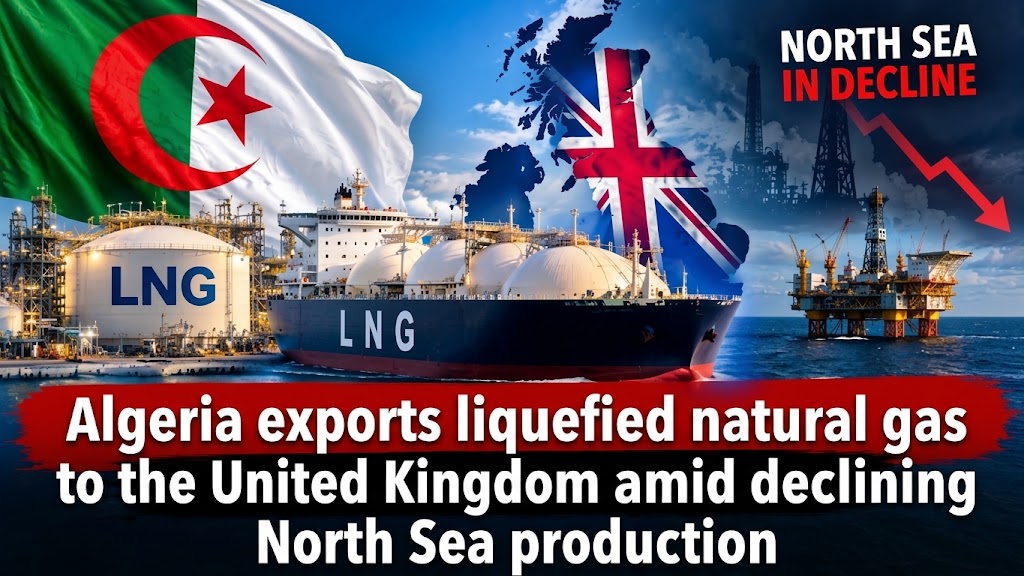
Algeria Gate: Algeria is establishing itself as one of the suppliers of liquefied natural gas (LNG) to the United Kingdom at a time when North Sea gas production is experiencing a clear decline, pushing London to strengthen its dependence on imports to cover its energy needs.
A marked decline in British production
According to data reported by the website of the Algerian daily Echorouk, British North Sea gas production stood at around 28 billion cubic meters in 2025, covering nearly 41% of the country’s needs. However, this production is expected to fall to 14 billion cubic meters over the next four years, before dropping to only 6 billion cubic meters by 2035.
Growing dependence on imports
This structural decline in national production should mechanically increase British dependence on gas imports. According to the same forecasts, the share of imports in covering the United Kingdom’s gas needs should exceed 70% by 2030, before rising to 85% by 2035.
Faced with this announced decline in domestic production, recourse to liquefied natural gas appears to be an unavoidable solution to bridge the growing gap between local supply and the country’s energy demand.
Algeria, an increasingly present supplier on the British market
It is in this context that Algeria has emerged among the United Kingdom’s LNG suppliers. The country, which has significant liquefaction capacities through its historic gas complexes, notably at Arzew and Skikda, as well as the Medgaz pipeline directly linking Algeria to Spain, is seeking to diversify its export outlets in a European energy market that has been undergoing major recomposition for several years.
This development illustrates how the progressive decline of certain historic production basins, such as the North Sea, is opening new opportunities for gas-producing countries capable of responding rapidly to demand, such as Algeria, regularly cited among Europe’s main gas suppliers.