

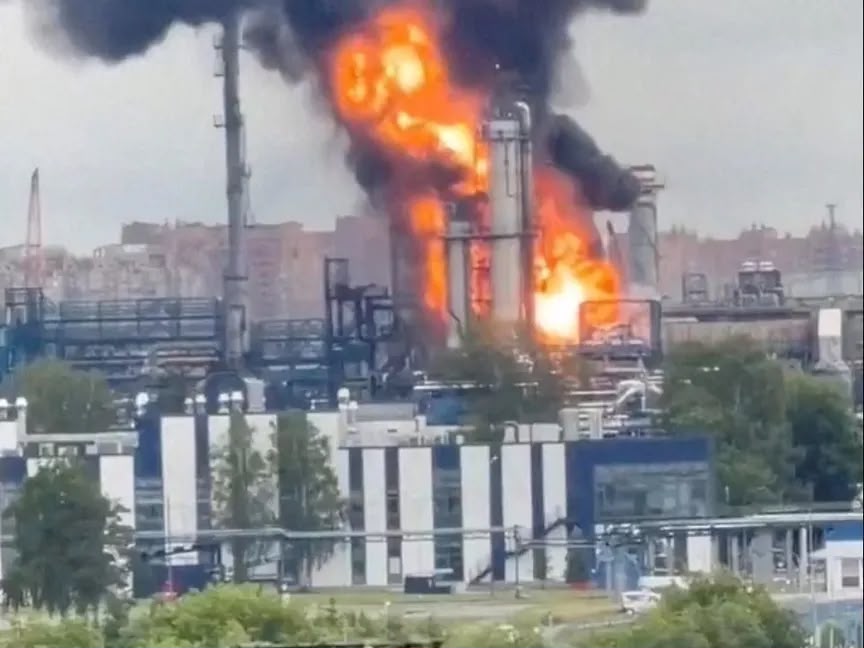
While Russian President Vladimir Putin was hosting Southeast Asian leaders in Kazan as part of an “ASEAN” summit in a setting designed to project a pivot toward Eastern diplomatic influence Moscow, just 700 kilometers away, endured one of the most intense nights of drone attacks since the beginning of the war. The contrast is not incidental; it sits at the heart of the moment: Russia speaks of expanding influence and diplomatic outreach, while its capital comes under sustained attack.
The Numbers Speak
Russia’s Ministry of Defence reported the interception of 555 Ukrainian drones across multiple regions, including around 194 reportedly headed directly toward Moscow, according to Moscow Mayor Sergei Sobyanin. If confirmed, this would mark the largest drone attack on the Russian capital since the start of the war, surpassing previous records set in March.
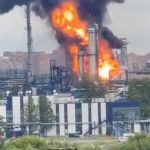
Yet the key issue is not only how many were intercepted, but what managed to get through. Several drones reportedly penetrated air defenses and struck the Kapotnya oil refinery in Moscow’s southeastern district, located less than 15 kilometers from the Kremlin, for the second time in a single week.
Energy: The Unchanging Target
The Kapotnya refinery is no minor facility. It ranks among Russia’s top ten refineries and alone supplies roughly 40% of Moscow’s refined oil products, including nearly 70% of the capital’s gasoline consumption. Striking it twice within a week is not merely a military signal it represents direct pressure on the supply systems sustaining an entire metropolitan region.
The attacks were not limited to Moscow. In Russia’s Rostov region, near the Ukrainian border, an oil depot in the city of Gukovo was reportedly targeted, with injuries confirmed by regional authorities. The pattern appears increasingly consistent: a systematic effort to disrupt Russia’s energy infrastructure rather than isolated strikes.
Repeated Embarrassment, Not Isolated Incidents
This is not the first time major strikes have coincided with high-profile Russian diplomatic events. Weeks earlier, Ukrainian drones reached the St. Petersburg area while Putin was hosting an international economic forum. The repetition turns coincidence into pattern: each summit designed to project stability is met with strikes that challenge that image, particularly for international observers and partners.
President Volodymyr Zelensky himself framed the attacks as a “just response” to Russian strikes on Ukrainian cities, linking them directly to efforts to weaken Russia’s military apparatus. The message is as political as it is military.
An Unanswered Question
Russia is betting on its eastern partnerships to offset Western pressure, while Ukraine seeks to bring the war into Russia’s strategic depth in ways that cannot be ignored or diplomatically softened.
The central question remains open: how long can either side sustain a war that is expanding geographically faster than it can be contained?