Sunday, 18 October 2026 • 19:29 Algiers time
Algeria Gate
News Room
Cameron Hudson: UAE is virtually the sole backer of the RSF..without its support the war in Sudan would not continue Algeria-Niger: Official launch of Trans-Saharan fibre optic link Five minutes of lament over Algeria: Amar Belani exposes CNEWS’s real obsession Algerian courts hand down first death sentences under new drugs law Ségolène Royal’s masterclass on Algeria against an ignorant and demagogic journalist President Tebboune and senior officials receive the remains of Boualem Boualem in Algiers NAPEC 2026 in Oran: Algeria at the Heart of Africa’s and the Mediterranean’s New Energy Landscape Pegasus Files: Amnesty Uncovers Morocco’s Espionage Against Spain President Tebboune Orders Salary Increases in Algeria’s 2027 Budget, Rules Out New Taxes on Citizens Algeria Emerges as a Trusted Power for Regional Peace and Stability
Share this post

European Union: Algeria is a reliable partner in the gas sector and has strong potential to become a key partner in energy projects!

• Author: Lys Iwannughen • 0 comments • 4 views
European Union: Algeria is a reliable partner in the gas sector and has strong potential to become a key partner in energy projects!

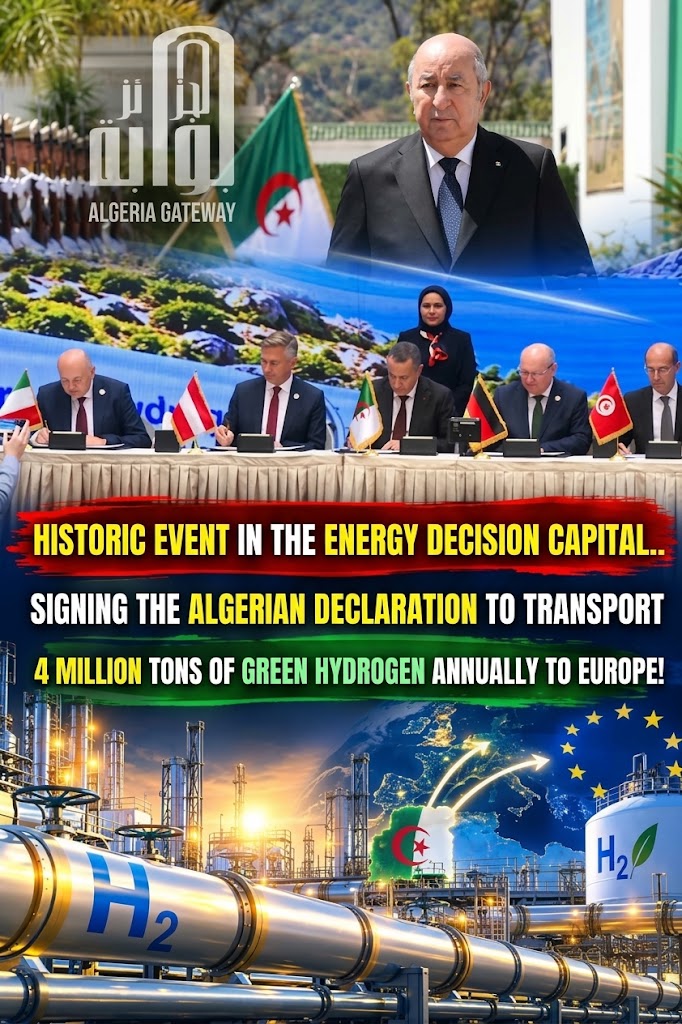
Algeria Gate: The European Union’s Ambassador to Algeria, Diego Melado, stated that “Algeria is a reliable partner in the gas sector,” noting that it possesses strong potential that qualifies it to become a major partner in future energy projects, particularly in renewable energies and green hydrogen.

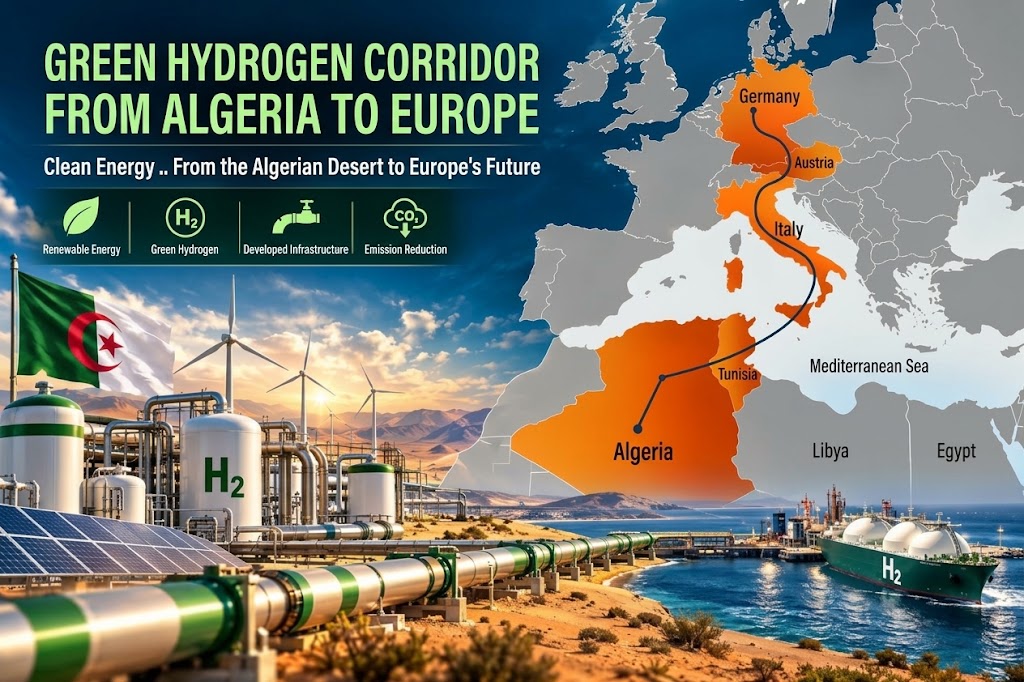
In his opening remarks at the second ministerial meeting of the Southern Hydrogen Corridor project (South2Corridor), held in Algeria, Melado highlighted the importance of the renewable hydrogen project in supporting Europe’s transition toward a low-carbon energy system. He pointed to the significant potential of the Southern Hydrogen Corridor project to become one of the main routes for transporting renewable hydrogen to European markets.
European Union: Algeria is a reliable partner in the gas sector and has strong potential to become a key partner in energy projects!

The European ambassador explained that this corridor would connect the two shores of the Mediterranean, enabling sustainable economic and energy benefits for both sides and opening the way for a new strategic partnership between Europe and North Africa based on clean energies, shared prosperity, and a move toward a more sustainable future.

In this regard, Melado underscored the important potential that Algeria has in renewable energies and the assets it possesses that can be leveraged to make joint energy projects with Europe a success.
European Union: Algeria is a reliable partner in the gas sector and has strong potential to become a key partner in energy projects!

He stressed the importance of continuing efforts to achieve tangible progress and turn the Southern Hydrogen Corridor project into reality, confirming the European Union’s readiness to continue supporting this path and cooperating with various partners to ensure the success of this strategic project.

#Algeria#Europe#Hydrogen
Author
Lys Iwannughen
View my articles

Leave a comment

Your email address will not be published. Required fields are marked *

African coast
Share this post

Raw materials: Algeria benefits from the energy shock, Morocco’s trade deficit soars

Raw materials: Algeria benefits from the energy shock, Morocco’s trade deficit soars

Algeria Gate: The rise in energy and cereal prices does not hit Maghreb economies in the same way. Algeria, an exporter of oil and gas, benefits directly from the increase in hydrocarbons. Morocco, despite its phosphates and fertilisers sector, sees its trade deficit widen sharply. Tunisia, for its part, remains heavily penalised by its energy dependence.

World Bank data illustrate this new tension on raw materials. In its Pink Sheet published in September, the institution indicated notably that its energy index had risen by 8.8% in August, with a 10.1% increase in natural gas. Brent had moved from $83.4 a barrel in July to $90.9 in August. Cereals were also trending upward: maize rose from $213.4 to $224 a tonne and US HRW wheat from $310 to $330.

The World Bank also noted at the end of September that between June and mid-September 2026, world cereal prices had increased by 18%, wheat by 22% and maize by 26%.

Algeria: the rise in hydrocarbons works in favour of revenues

For Algeria, this situation brings an immediate advantage: the rise in oil and gas prices increases the value of energy exports and public revenues.

The IMF estimates that the rise in hydrocarbon prices should stimulate Algerian exports and budget revenues in 2026, while helping to reduce the external deficit. The institution also forecasts growth of 3.8% this year.

This upturn does not mean that the Algerian economy is immune to all risks: the IMF also highlights the high level of the budget deficit and the recent erosion of reserves. But in the short term, the rebound in hydrocarbons offers Algiers an additional source of foreign currency and revenue.

The rise in cereals, on the other hand, constitutes a cost for Algeria, which remains an importer of wheat and other food products. The shock is therefore double, but the importance of hydrocarbon exports gives the country a buffer that its neighbours do not have to the same degree.

Morocco: phosphates are not enough to prevent the trade deficit from widening

Morocco does have a significant phosphates and fertilisers industry. But official figures show that this asset does not prevent a significant deterioration in its trade balance.

Over the first eight months of 2026, Moroccan imports jumped by 15.8% to 617.5 billion dirhams. Exports rose by only 8.7% to 334.9 billion. As a result, the trade deficit increased by 25.4%, reaching around 282.6 billion dirhams, while the coverage rate lost 3.5 points.

Phosphates themselves were not systematically spared. Over the first four months of 2026, Moroccan exports of phosphates and derivatives had fallen by 1.5%. Sales of natural and chemical fertilisers had declined by 3.9%, while exports of raw phosphates fell by 3.2%.

In other words, presenting fertilisers as a sufficient shield against the energy shock would be excessive. They constitute an important source of foreign currency, but the external trade figures show that they do not offset the much faster rise in imports.

The contrast with Algeria is therefore notable: when energy becomes more expensive, Algiers can increase its export revenues, whereas Rabat has to absorb a heavier import bill in an already strongly deficit trade balance.

Tunisia: nearly 9 billion dinars of energy deficit

Tunisia appears even more exposed. During the first eight months of 2026, its overall trade deficit reached 17.85 billion dinars, compared with 14.64 billion a year earlier.

The energy deficit alone amounted to 8.93 billion dinars, compared with 7.15 billion over the same period of 2025. It thus represents roughly half of Tunisia’s trade deficit.

Any further lasting rise in oil or gas prices therefore risks directly increasing pressure on the country’s foreign currency needs and external accounts.

A global shock, three very different situations

The rebound in raw materials ultimately acts as a revealer of Maghreb economic structures.

Algeria benefits from the rise in hydrocarbons thanks to its status as a major energy exporter. Morocco retains the phosphates asset, but it is not enough to prevent its trade deficit from rising by more than 25%. As for Tunisia, its dependence on energy imports continues to weigh heavily on its external accounts.

In a period of high prices, the balance of power is therefore very different: what produces additional revenues for Algeria becomes a heavier bill for its energy-importing neighbours.

#Algeria#Morocco#Tunisia
Author
Lys Iwannughen
View my articles
Algeria
Share this post

Hana Mansour denounces the use of her image by Le Point to illustrate an article by Kamel Daoud

Hana Mansour denounces the use of her image by Le Point to illustrate an article by Kamel Daoud

Algeria Gate: A controversy erupted after the French magazine Le Point published an article by Kamel Daoud entitled “Imaginary Monologue of a Franco-Algerian Woman,” illustrated by a photograph of Algerian actress Hana Mansour. According to the actress, this use was made without her authorisation.

Hana Mansour states that she was neither approached nor consulted and publicly denounces the association of her image with a text to which she says she is completely foreign. She also refuses that her photograph could lead people to believe that she adheres to the content or the editorial line of the article.

https://twitter.com/algatedzEng/status/2106384093520994674?s=20

The actress is now demanding the removal of her photo from the article as well as from related promotional materials. She also indicates that she reserves the possibility of taking the necessary steps to have her rights respected.

The affair thus raises the question of the right to one’s image and the use of a photograph of a real person to illustrate a story presented as imaginary. At this stage, however, it is appropriate to speak of a challenge formulated by Hana Mansour: the available elements do not make it possible to affirm that a court has established an illegal use of her image.

#Hana Mansour#Kamel Daoud
Author
Lys Iwannughen
View my articles
African coast
Share this post

President Tebboune’s warning: why Algeria sent combat aircraft to Niger

President Tebboune’s warning: why Algeria sent combat aircraft to Niger

Algeria Gate: President of the Republic Abdelmadjid Tebboune spoke publicly for the first time about the reasons that led Algeria to send combat aircraft to Niger at the end of August 2026. In extracts from his periodic interview with the national press broadcast on the night of 2–3 October, the head of state directly linked this decision to the attempt at destabilisation that occurred in Niamey.

According to Abdelmadjid Tebboune, the sequence of events was decisive. Nigerien Prime Minister Ali Mahamane Lamine Zeine had just carried out a working visit to Algeria on 26 and 27 August 2026. Shortly after his return to Niamey, an attempted coup took place on the night of 28–29 August, notably around Air Base 101 in the Nigerien capital.

https://twitter.com/algatedzEng/status/2106384974278484023?s=20

The Algerian president considered that the timing of this attempt constituted a “provocation” toward Algeria. He declared that aircraft had been sent because “some people had gone too far,” without, however, publicly identifying the actors to whom he was referring.

Four Algerian Su-30s sent to Niamey

The Algerian Ministry of National Defence had announced on 30 August the dispatch of two patrols composed of four Sukhoi Su-30 fighter aircraft, accompanied by a tanker aircraft. The planes landed the same day in Niamey.

According to the official communiqué of the ministry, this mission had been decided on the instruction of President Tebboune and at the request of the Nigerien authorities, in order to support the Nigerien army after the events aimed at destabilising the country.

The Nigerien prime minister himself welcomed the Algerian deployment on its arrival and expressed his thanks to President Tebboune as well as to the Algerian people for this support.

Algeria directly links Niger’s stability to its own security

This intervention illustrates the strategic importance that Algiers attaches to Niger and to the stability of the Sahel. Algeria shares a long border with Niger and has for several years considered instability in this region, terrorism and political upheavals as issues directly linked to its national security.

The dispatch of fighters to Niamey was also noted because it constitutes a particularly visible use of Algerian military means beyond national borders. Le Monde noted that the deployment included four Su-30s as well as transport and refuelling aircraft, seeing in it a notable evolution in Algeria’s regional posture.

For Abdelmadjid Tebboune, the decision therefore appears as a signal of support for the Nigerien authorities and of firmness in the face of any attempt at destabilisation liable to affect Algeria’s security environment.

The president did not, however, name the parties he suspects of being behind the “provocation.” At this stage, it is therefore appropriate to distinguish his political assessment from the officially established facts concerning the authors and the motivations of the attempted coup.

#Algeria#Niger#President tebboune
Author
Lys Iwannughen
View my articles