
Sunday, 6 September 2026 13:25 Algiers time
Algeria Gate
News Room
$50B Revival: Algeria Spearheads Africa’s Economic Awakening Tiny Emirate Trapped by Hormuz, Continental Algeria’s Oil Crushes UAE’s Fragile India Bet 5.6 Million Cubic Meters per Day by 2030… Algeria Moves Desalination to the Heart of the Economy Algerian “INATEL” Enters the New Kinshasa City Project Covering 43,300 Hectares From VIP Glitter on Screens… to the Dark Shadows of Drug Networks! Tiny Companies, Astronomical Figures: AI Exposes $130 Billion Import Scam in Algeria Algeria Declares War on Cartels: Cutting Supply Lines and Choking Cash Flow After Algeria… Morocco tries to flood Spain with 3 tons of cocaine! Emirati fixer in Spain on a last-ditch bid to rescue Ayoub Aissiou! UAE falls into the trap… Algerian retaliation is coming hard! Algeria-Qatar’s Baladna project pumps $1.2 billion into the treasury every year… and buries the French import lobby!
Share this post

Morocco Facing a Test of Unity: The Rif, Western Sahara, and the Throne Threads of One Crisis?

Author: yasmine ouazib 0 comments 106 views
Morocco Facing a Test of Unity: The Rif, Western Sahara, and the Throne Threads of One Crisis?

Three sensitive issues are converging in Morocco, reviving a long-standing debate over the resilience of the kingdom’s political structure: renewed Rif activism at home and within the diaspora, the unresolved Western Sahara conflict, and growing questions surrounding the royal succession. None of these issues is new on its own, but their convergence has prompted observers to revisit scenarios that have long remained confined to academic discussions.

The Rif: From Al Hoceima to Brussels

The Rif issue remains one of Morocco’s most enduring internal challenges. The protest movement that began in Al Hoceima in late 2016 and continued through the summer of 2017 ended with the arrest of its leading figures most notably Nasser Zefzafi and prison sentences of up to 20 years on charges of undermining state security.

Nine years later, the issue remains unresolved. In Brussels, the Rif National Party organized a commemorative gathering marking the ninth anniversary of the death of Imad Attabi, who was fatally shot by Moroccan security forces during demonstrations in Al Hoceima on July 20, 2017. Participants displayed the flag of the “Republic of the Rif” and called for independence.

It is important, however, to distinguish the nature of the event. It was not a large-scale popular demonstration but a limited commemorative gathering organized by a political movement known for its separatist positions and supported mainly by segments of the Rif diaspora in Belgium and the Netherlands. While symbolically significant, it should not be taken as evidence of broad support within the Rif itself, where public demands have historically focused more on development, social justice, and civil rights than on secession.

https://twitter.com/algatedzEng/status/2079538861831512540?s=20

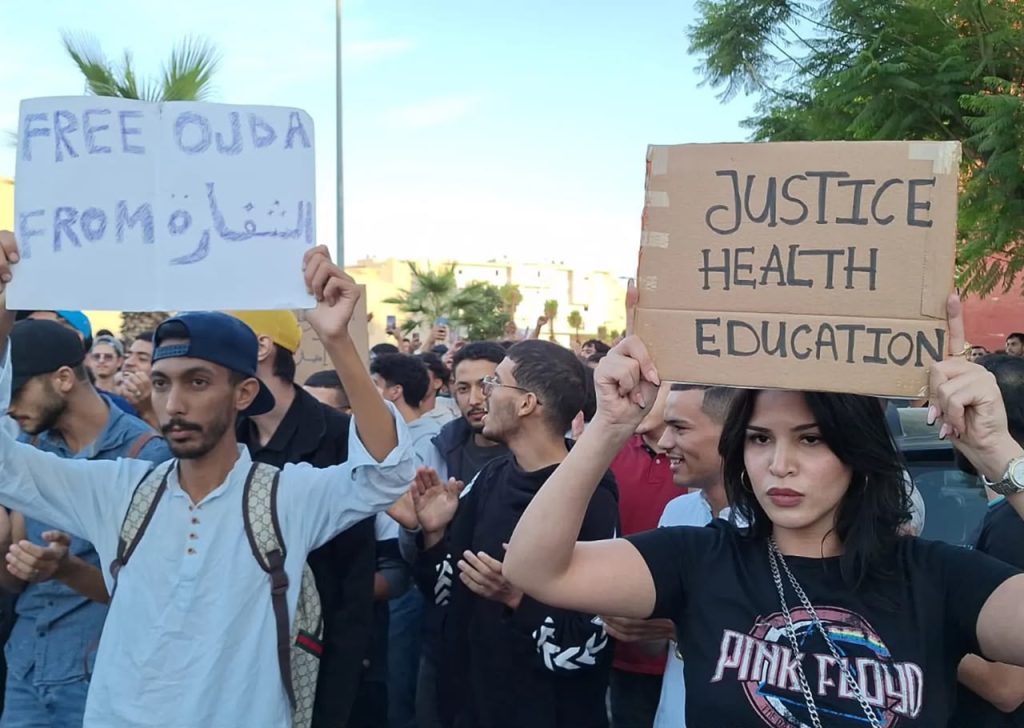
At the same time, several Moroccan cities have witnessed youth-led protests since late 2025 under the banner of the “Generation Z 212” movement. The movement has focused primarily on healthcare, education, anti-corruption reforms, and the release of detained protesters. Although these demands are largely socio-economic rather than separatist, they reflect a broader climate of public discontent that could provide fertile ground for more radical narratives on the political margins, including in the Rif.
Western Sahara: The Unresolved Dispute

Western Sahara remains the most influential factor in any discussion about Morocco’s territorial cohesion. The conflict between Morocco and the Polisario Front has remained unresolved for decades, with UN-led efforts failing to produce a final political settlement. Any discussion of potential fragmentation cannot be separated from this issue, which Morocco regards as its foremost territorial integrity concern, while its opponents view it as an unresolved decolonization question.

The Succession Question: A Quiet Transition or a Silent Crisis?

The third issue is perhaps the most sensitive and least transparent: the royal succession.

Crown Prince Moulay Hassan, born in 2003, is the official heir to the Alaouite throne and has increasingly assumed prominent state responsibilities. In May 2026, King Mohammed VI appointed him Coordinator of the Offices and Services of the General Command of the Royal Armed Forcest the same position Mohammed VI held while serving as Crown Prince before ascending the throne. He has also represented the King with increasing frequency at international events, meetings with world leaders, and major national initiatives.

This gradual institutional transition has coincided with unconfirmed media speculation regarding the King’s health and alleged internal disagreements over the succession process. Some reports have cited claims attributed to the French newspaper Le Monde. These reports should be treated with considerable caution, as no official confirmation or independently verified evidence has substantiated claims of any open conflict within the royal family.

https://twitter.com/algatedzEng/status/2078818065668518356?s=20

Between Theory and Reality

Some academic studies including one published by the Centre for Arab Unity Studies have explored theoretical scenarios involving the possible fragmentation of Morocco into ethnically or regionally based entities, including a hypothetical “Republic of the Rif,” should separatist movements gain significant momentum. However, the study itself presents this as a hypothetical scenario within academic debate rather than a description or prediction of current realities.

What is clear today is that Morocco faces growing social discontent, an unresolved Rif issue, a protracted Western Sahara conflict, and an institutional succession process unfolding amid unverified speculation. Together, these developments warrant close observation. Yet there remains a significant difference between acknowledging existing structural tensions and concluding that Morocco is on the verge of fragmentation. Responsible reporting requires staying firmly within the boundaries of verifiable facts.


Author
yasmine ouazib

Leave a comment

Your email address will not be published. Required fields are marked *

Algeria
Share this post

Pedro Sánchez Arrives in Algeria for Energy and Diplomatic Talks with Tebboune

Pedro Sánchez Arrives in Algeria for Energy and Diplomatic Talks with Tebboune

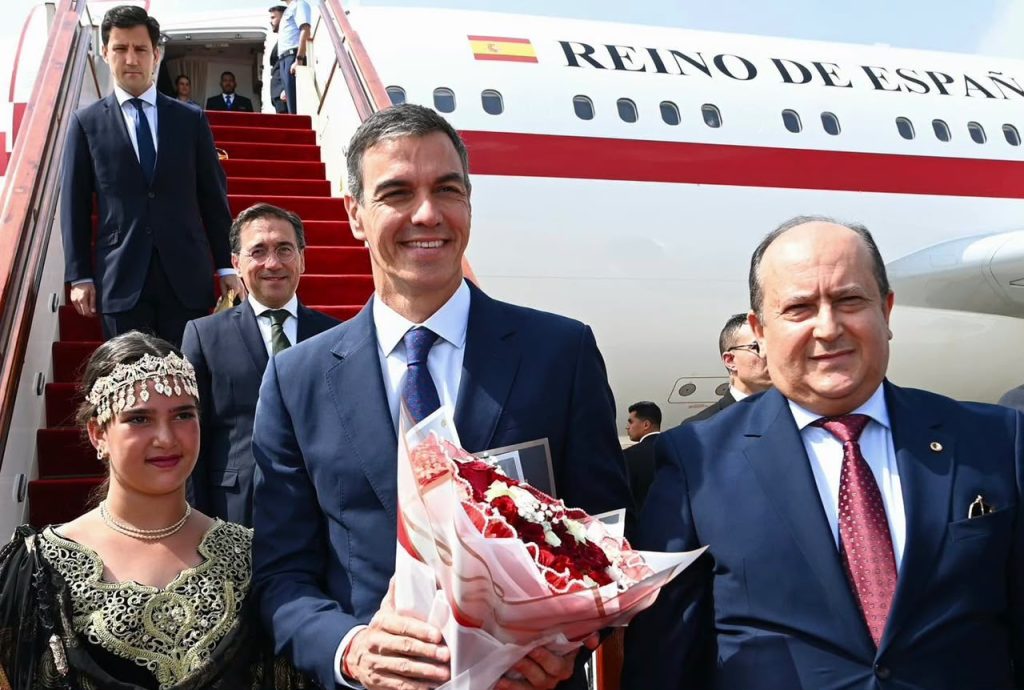
Algeria Gate ; ALGIERS, July 20 Spanish Prime Minister Pedro Sánchez arrived in Algeria on Monday for his first official visit to the country since October 2020, aiming to cement a diplomatic thaw with Algiers after years of tension over Western Sahara.

Sánchez was welcomed at Houari Boumediene Airport by Algerian Prime Minister Sifi Ghrieb, ahead of official talks with President Abdelmadjid Tebboune, who is set to host the Spanish leader for the visit’s central meeting.

https://twitter.com/algatedzEng/status/2079148374129889670?s=20

Energy security tops the agenda. Algeria reclaimed its position as Spain’s top gas supplier in the first half of 2026, providing 33% of Spain’s total gas imports, according to grid operator Enagás. Sánchez’sdelegation includes the heads of Spain’s largest energy firms Naturgy, Repsol, Moeve, and Enagás signaling Madrid’s push to lock in long-term supply guarantees, including a possible expansion of the Medgaz pipeline. Talks are also expected to touch on renewable energy and green hydrogen cooperation.

https://twitter.com/algatedzEng/status/2079137285446975994?s=20

Sánchez is accompanied by Foreign Minister José Manuel Albares and Ecological Transition Minister Sara Aagesen. Beyond energy, Western Sahara and irregular migration remain sensitive items on the bilateral agenda, even as both governments emphasize economic cooperation publicly.

Trade between Algeria and Spain reached approximately €8.5 billion in 2025, with more than 100 Spanish companies now operating in the Algerian market still below pre-crisis levels but recovering steadily since the diplomatic rupture that followed Madrid’s 2022 shift on

Author
yasmine ouazib
International press
Share this post

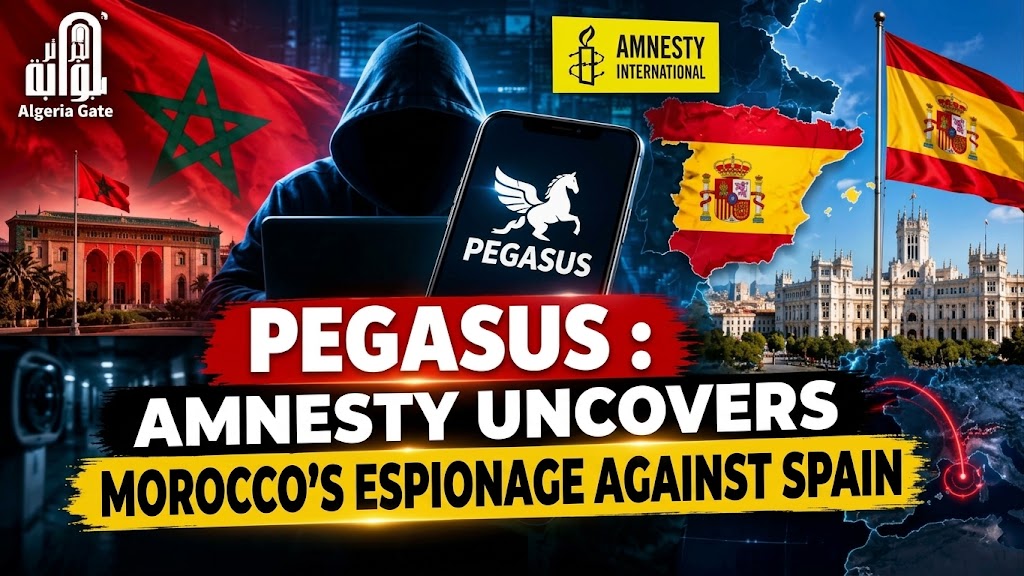
Pegasus Espionage Scandal: Former Algerian Ambassador to Madrid Targeted by Morocco

Pegasus Espionage Scandal: Former Algerian Ambassador to Madrid Targeted by Morocco

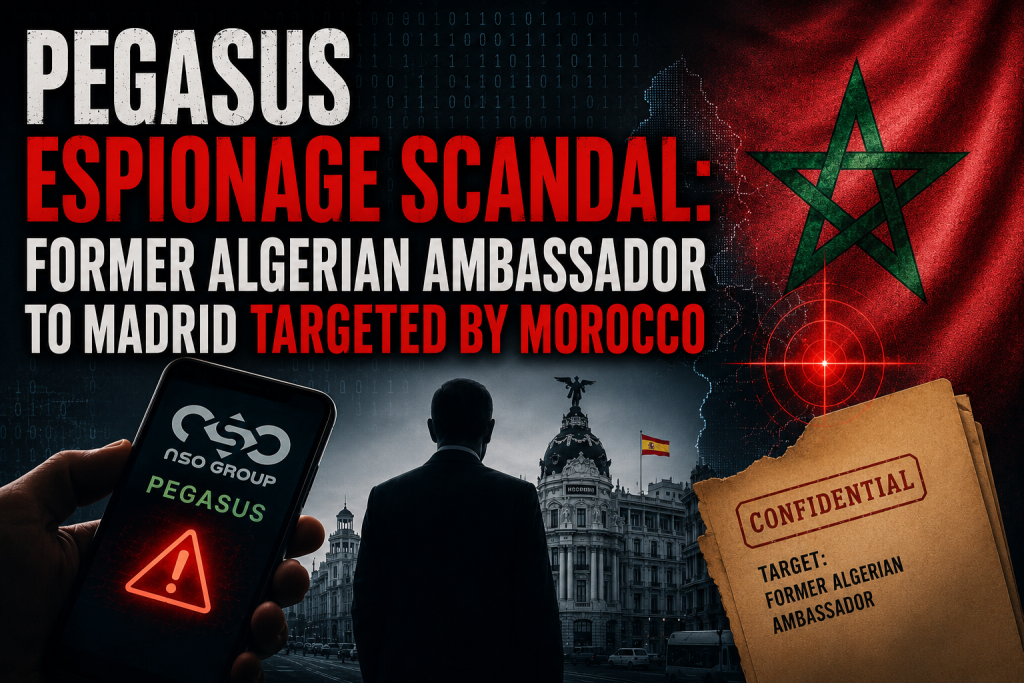
Algeria Gate: A former Algerian ambassador to Madrid was targeted by Morocco using the spyware Pegasus, according to numerous foreign media outlets.

Five years after the Pegasus scandal broke, new revelations from the international press shed light on this espionage operation carried out by Moroccan services using that spyware.

As new evidence continues to incriminate Morocco, clearly demonstrating the involvement of its services (notably the DGST and foreign intelligence), the Spanish newspaper El Confidencial has released figures illustrating the scale of the operation and the names of certain targeted personalities in Spain.

El Confidencial is part of the consortium of 16 international media outlets that first exposed the scandal in July 2021.

According to the Spanish newspaper, 768 cyberattacks targeted 250 mobile phones in Spain between May 2018 and June 2019 alone. A record was even set on March 16, 2019, with 106 attacks in a single day.

Pegasus Revelations: More Light Shed on Targeted Personalities

The kingdom’s services targeted not only Moroccan journalists and opponents, but also foreign journalists, diplomats, and leaders, including French President Emmanuel Macron and Spanish Prime Minister Pedro Sánchez.

In Spain, most of the attacked phones belonged to Moroccans and Sahrawis residing in the country, but devices belonging to Algerians and Spaniards were also affected, including that of a Guardia Civil colonel, the media summarizes.

Algeria featured prominently on the list of targeted countries. El Confidencial reveals which Algerians were spied on Spanish soil. The newspaper reports that “a handful of Algerian diplomats accredited in Spain at the end of the last decade appear in the Moroccan DGST’s directory.”

Among these targeted Algerian diplomats, the most prominent figure is Taous Feroukhi, who served as ambassador to Madrid until the end of 2019.

Thousands of phones were spied on across several countries as part of this operation. Algeria has consistently been cited as one of the most heavily targeted nations. The revelations published by El Confidencial on Thursday, July 16th, concern only the confirmed attacks on Spanish territory.

#Algeria#Morocco#Pegasus#Spain
Author
Lys Iwannughen
Algeria
Share this post

French Ambassador’s Visa Pledge Reignites Right-Wing Fury Over Algeria

French Ambassador’s Visa Pledge Reignites Right-Wing Fury Over Algeria

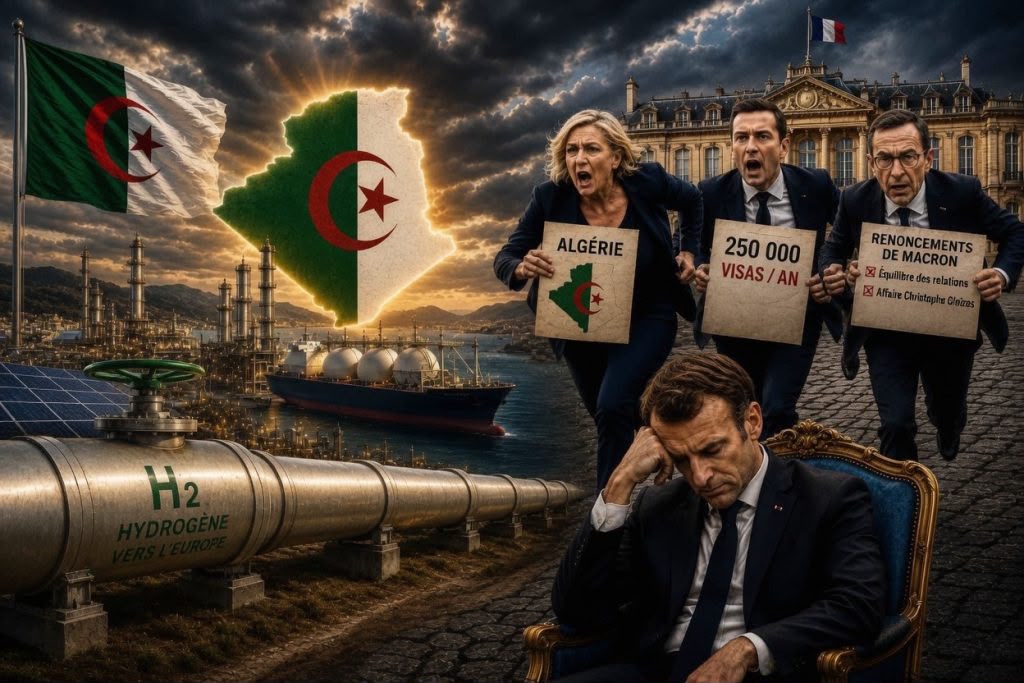
France’s ambassador to Algeria, Stéphane Romatet, has triggered a political storm within the French right after pledging to restore visa issuance for Algerians to pre-crisis levels roughly 250,000 visas a year. The statement came in an interview with Algerian news site TSA, published Wednesday, July 15, in which Romatet insisted that citizens should not be made to pay the price for political disputes between states.

The backlash was immediate. Bruno Retailleau, leader of the Republicans party (LR) and a candidate in France’s presidential race, called it “a tragedy to see our diplomacy forced to bow its head over the president’s concessions to the Algerian regime.” Retailleau leveled three specific accusations at the Élysée: abandoning the push to deport “delinquent Algerians” back to their country, sacrificing the balance of the bilateral relationship, and failing to demand the release of French journalist Christophe Gleizes, imprisoned in Algeria since May 2024 and sentenced to seven years for “glorifying terrorism.”

https://twitter.com/AlgeriaGatePlus/status/2078420431812358586?s=20

Retailleau was not alone. National Rally leader Jordan Bardella joined the attack, branding the move a “capitulation of Macronism to the Algerian regime.” François-Xavier Bellamy also weighed in, listing what he believes the ambassador should have said instead starting with visas.

The French Foreign Ministry pushed back, stating that visa issuance is not part of the ongoing talks with Algeria and that “no numerical target has been set,” an attempt to contain the controversy without abandoning the détente track Macron set in motion when he reinstated Romatet in May, more than a year after recalling him at the height of the diplomatic crisis.

The episode exposes a deeper rift in French politics over Algeria: one camp pushing pragmatic normalization on economic and diplomatic grounds, another an ascendant right casting every gesture of deescalation as surrender. Retailleau, mid-campaign for the presidency, has found in the visa file a fresh opportunity to stake his claim as the voice of the hardline position on Algeria. The Élysée, meanwhile, is betting that gradual thaw remains the only route back to resolving the harder cases still on the table Gleizes’ file chief among them.

Author
yasmine ouazib