
Monday, 7 September 2026 07:58 Algiers time
Algeria Gate
News Room
Two Years into President Tebboune’s Second Term: Algeria Expands Its Influence from New York to Niamey President Tebboune draws the red line: Death for those who burn and those who kidnap children Algeria expands pharmaceutical presence across Africa President Tebboune in Madrid in October: Algiers takes back the initiative Egypt: TV presenter Sarah Khalifa sentenced to death in a drug-trafficking case President Tebboune’s directives and instructions to the Algerian government Aouchiche… Hanoun and the RCD… Will the people hold them to account on November 28? $50B Revival: Algeria Spearheads Africa’s Economic Awakening Tiny Emirate Trapped by Hormuz, Continental Algeria’s Oil Crushes UAE’s Fragile India Bet 5.6 Million Cubic Meters per Day by 2030… Algeria Moves Desalination to the Heart of the Economy
Share this post

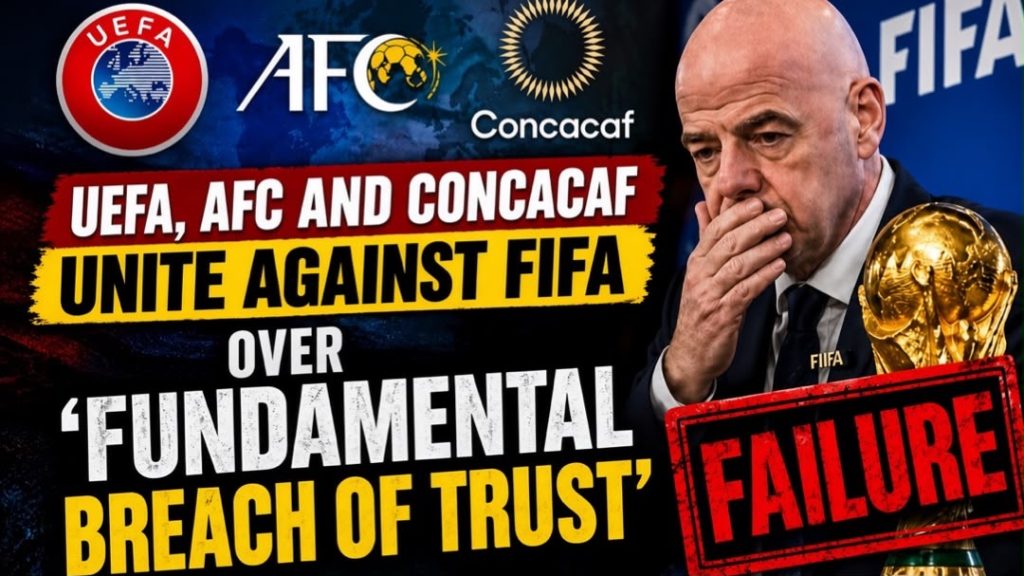
UEFA, AFC and CONCACAF Unite Against FIFA Over ‘Fundamental Breach of Trust’

Author: Lys Iwannughen 0 comments 45 views
UEFA, AFC and CONCACAF Unite Against FIFA Over ‘Fundamental Breach of Trust’

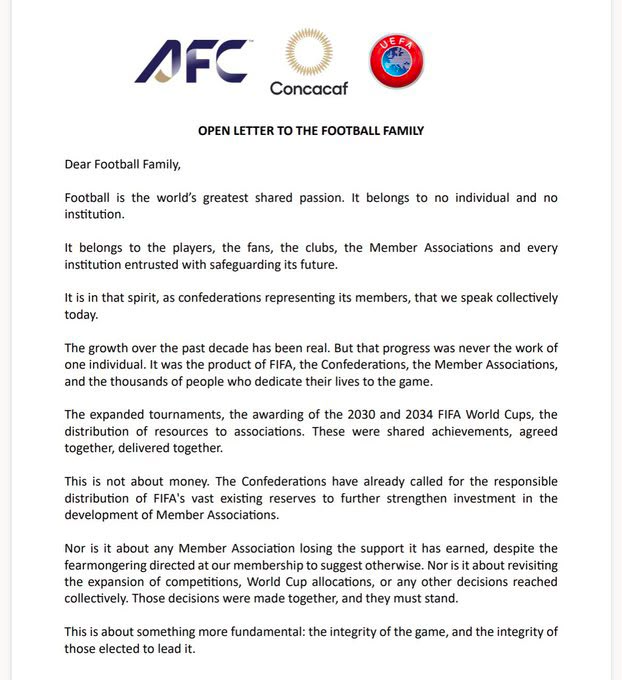
Algeria Gate: World football is facing a major institutional crisis. UEFA, the Asian Football Confederation (AFC) and CONCACAF have issued a strongly worded joint statement criticising FIFA and its president Gianni Infantino after the collapse of a controversial plan to open key FIFA competitions, including the World Cup, to private investors.

The three confederations insist the issue goes far beyond a simple communication or procedural failure. They accuse FIFA’s leadership of a “fundamental breach of trust” and of serious shortcomings in judgment and governance.

The FIFA Forward Enterprise project at the centre of the storm

At the heart of the dispute is the FIFA Forward Enterprise (FFE) project. The initiative aimed to bring private investment into FIFA’s flagship competitions. It triggered immediate and widespread opposition, largely because several confederations and national federations said they had not been consulted before the plan was made public.
Beyond money: a battle over governance

For UEFA, AFC and CONCACAF, the controversy is no longer primarily about finance. The three bodies argue that the governance of world football must be based on transparency, proper consultation with all stakeholders, and collective decision-making.

The united front presents a serious challenge to Gianni Infantino. UEFA had previously raised the possibility of boycotting certain FIFA competitions if the project went ahead, while the AFC publicly aligned itself with the European and North American positions.

An institutional crisis that threatens Infantino’s leadership

The dispute has now escalated into a broader institutional confrontation. Senior figures in football are demanding clear explanations, and some are openly questioning whether Infantino remains fit to lead FIFA.
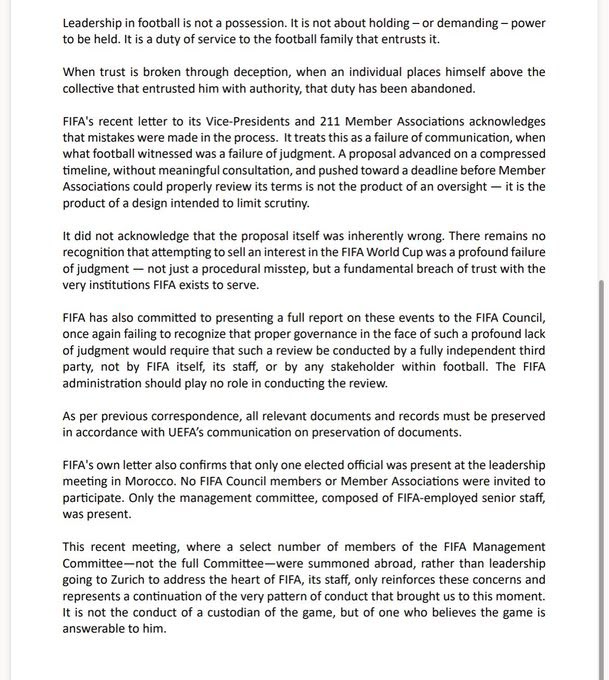
FIFA has admitted mistakes in the way the project was handled. However, the three confederations consider this response inadequate. They say the real problems are now trust, governance and the overall credibility of the organisation.

This confrontation could become one of the most significant power struggles in the recent history of world football. At stake is a fundamental question: who should ultimately decide the future of the World Cup and of international football?

#FIFA
Author
Lys Iwannughen

Leave a comment

Your email address will not be published. Required fields are marked *

Maghrebi files
Share this post

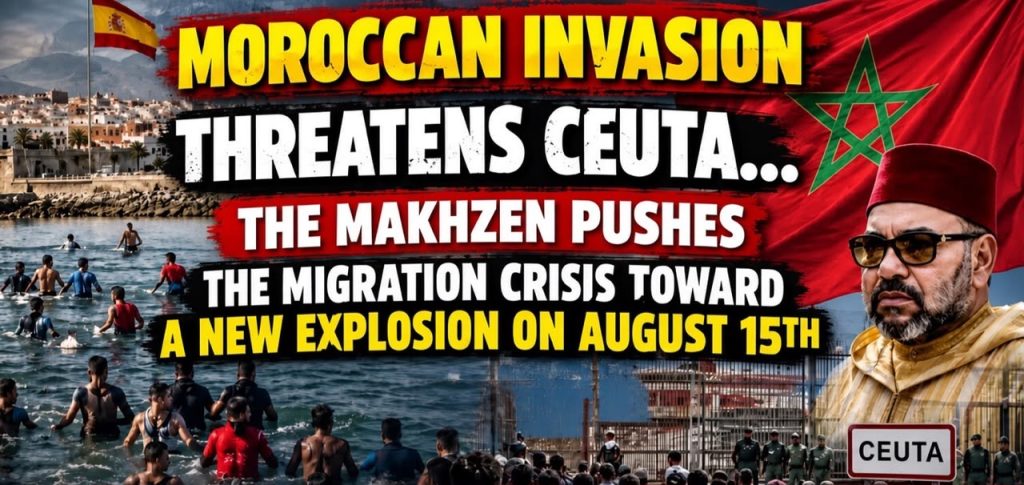
Moroccan invasion threatens Ceuta… The Makhzen pushes the migration crisis toward a new explosion on August 15th

Moroccan invasion threatens Ceuta… The Makhzen pushes the migration crisis toward a new explosion on August 15th

Algeria Gate: Barely had the dust settled from the recent mass crossing toward Ceuta when calls began resurfacing from within Morocco to prepare for a new attempt to reach the city on August 15 of this year.

This development once again throws the border file wide open and confronts the Makhzen with the hard reality of its failure to control the migration crisis; a crisis that, under its watch, has repeatedly been turned into a pressure card against its Spanish neighbor.

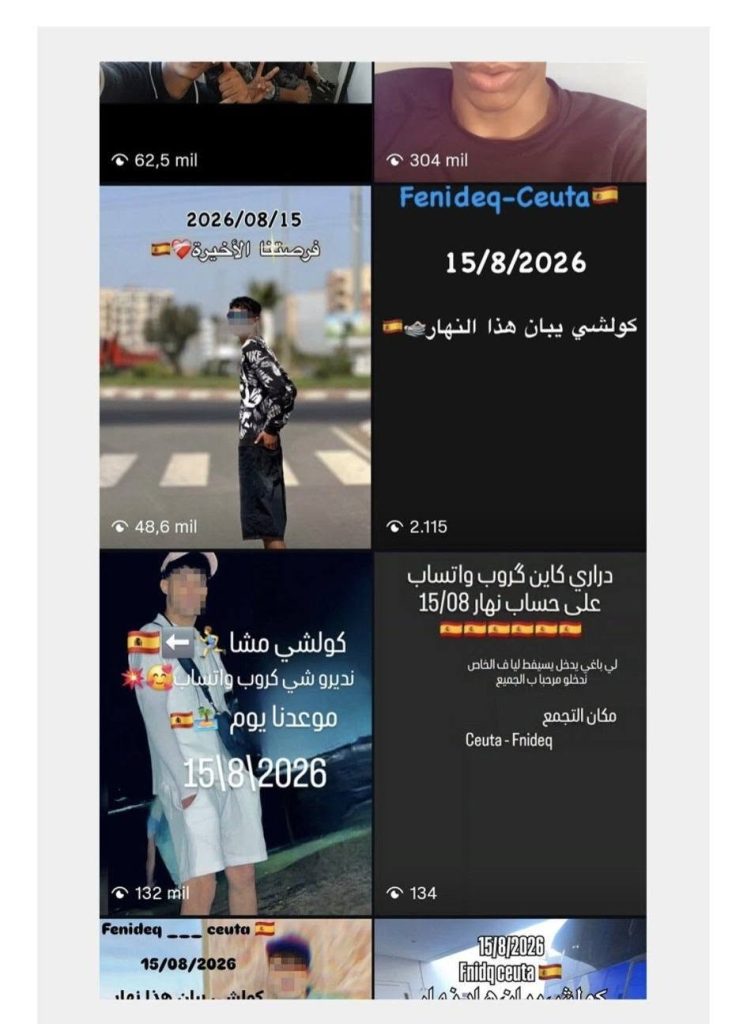
Widely circulated posts and messages on Moroccan accounts call for joining closed groups and coordinating a move toward Ceuta, setting the night of August 15th, 2026 as a possible date. Some posts spoke of a “last chance,” while others carried direct messages suggesting that something is being prepared for that date.

https://twitter.com/ElImperialEsp/status/2084634225509110153?s=20

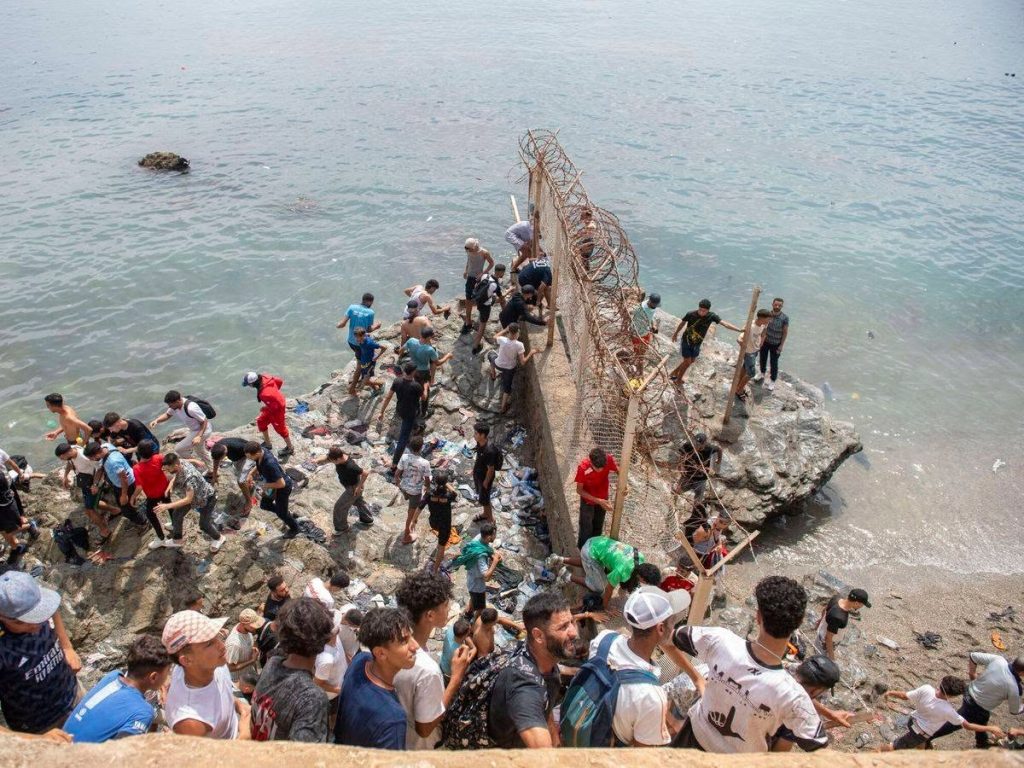
What is striking about these calls is not merely their existence, but their return after such a short period following the previous crossing wave, which saw more than 70,000 people enter Ceuta according to Spanish authorities’ figures, before most of them returned to Morocco. This makes talk of a new attempt more than mere fleeting noise on social media, especially with the continued circulation of the calls inside closed groups.

Spanish media reports indicate that some of the new calls intersect with accounts that participated in promoting the previous move, while other reports speak of intensive digital activity being monitored to track potential preparations.

Here the paradox emerges that places the Makhzen in an extremely awkward position: a regime that presents itself to Europe as a security partner in the fight against irregular migration, yet repeatedly proves incapable of stopping its own border areas from becoming a launch point for crowds heading toward Ceuta.

If the Makhzen possesses all the security control tools it talks about before Madrid and Brussels, how do the calls keep recurring? How do closed groups spread, set dates, and circulate movement plans with such speed? And if it is capable of stopping these movements and does not do so, then the question becomes more dangerous regarding the nature of using the migration file as a political pressure card.
The issue is no longer merely the tragedy of Moroccan youth trying to escape a stifling economic and social reality. It has come to reveal another face of the Makhzen’s management of crises: allowing situations to worsen, then dealing with their consequences when they turn into a border crisis or a problem with Europe.

What is happening around Ceuta also exposes the size of the gap between the official Moroccan discourse and reality. While Rabat talks about security cooperation, border control, and fighting irregular migration, the ground shows repeated waves of crowds and mass crossing attempts, as if the border turns every time into a new negotiation card.

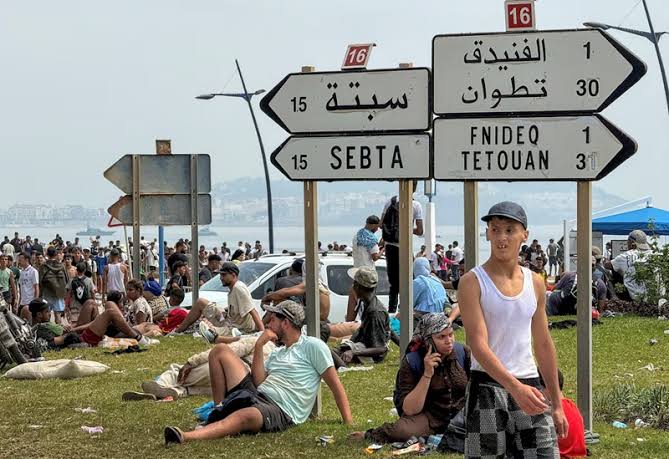
Most telling is that the Fnideq area is returning once again to the forefront of events as a potential gathering point for those wishing to reach Ceuta. This is a scenario that recalls previous movements and raises heavy question marks about the Moroccan authorities’ ability to contain the situation before it explodes.

In light of these facts, Ceuta appears to face a new date of security anticipation, while the Makhzen finds itself before a test that cannot be hidden by slogans: either it proves that these calls are merely a digital campaign with no capacity to turn into reality, or the chaos on the border is repeated and once again exposes the fragility of the Moroccan approach to the migration file.

#Morocco#Spain
Author
Lys Iwannughen
Maghrebi files
Share this post

Morocco opens its doors to homosexuals… Mohammed VI violates the sanctities of God!

Morocco opens its doors to homosexuals… Mohammed VI violates the sanctities of God!

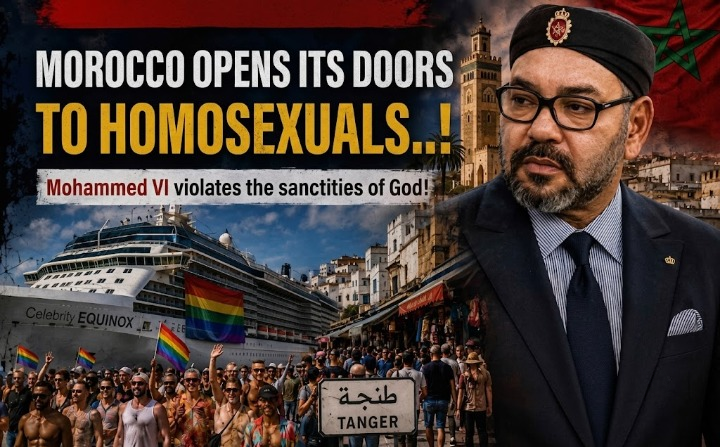
Algeria Gate: The one nicknamed the Commander of the Faithful, Mohammed VI, has crossed every red line in violating the sanctities of God and the teachings of the Islamic religion by allowing a ship packed with homosexuals, the Celebrity Equinox, to dock on Sunday morning at the port of Tangier as part of a tourist cruise organized by the company VACAYA, which specializes in the gay and lesbian community. This was its first stop on the Moroccan coast.

At a time when Morocco was supposed to declare national mourning for the souls of the victims of the mass escape from the hell of Morocco toward the Spanish city of Ceuta, the streets of the city turned into a playground for homosexuals; a moral catastrophe for someone who claims to be a descendant of the Prophet Muhammed, peace be upon him.

It is worth noting that a similar cruise was banned in both Turkey and Egypt, but the Makhzen had a different opinion. The ship arrived at the port around 7 a.m. and left around 4 p.m. after its passengers spent several hours in the city.

Hundreds of tourists wandered through the old city of Tangier, the Casbah, and the Grand Square. They also visited the traditional markets, and some of them ate in local restaurants and cafés.

The scene sparked anger and disgust among social media users, who described the incident and the policies pursued by the Makhzen on issues of Islamic identity as a catastrophe and a crime.

#Morocco
Author
Lys Iwannughen
Algeria
Share this post

Algerian petroleum product tops Europe’s imports… record shipments in 14 months

Algerian petroleum product tops Europe’s imports… record shipments in 14 months

Algeria Gate: Europe’s naphtha imports surged in July 2026, largely due to increased supplies from Algeria. The rise came as escalating geopolitical tensions in the Middle East and disruptions to maritime shipping redirected some trade flows toward the European continent.

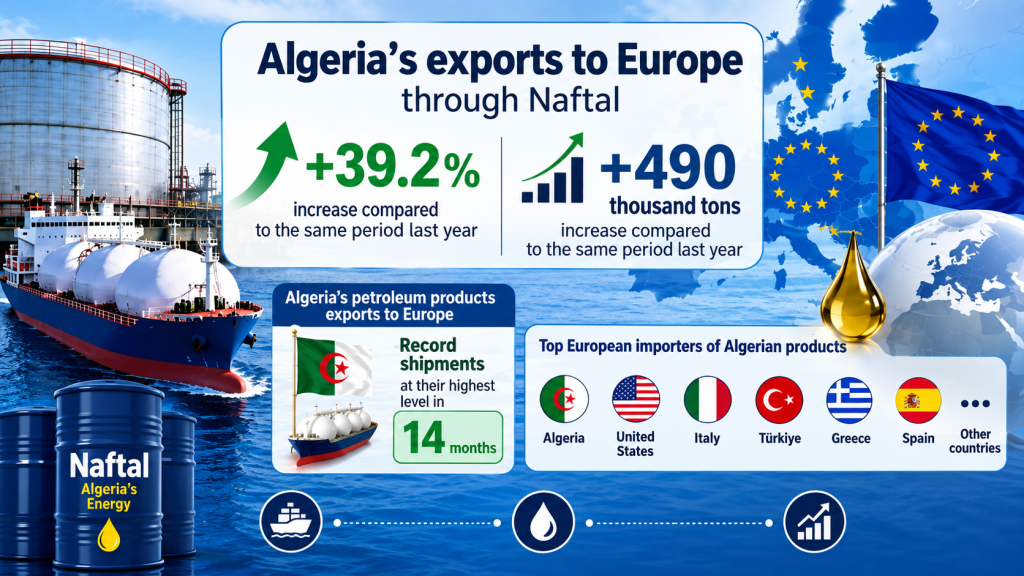
Europe’s total naphtha imports rose by 39.2% month-on-month in July, an increase of around 490,000 tonnes compared with June levels, according to data monitored by the specialised energy platform.

Algeria topped the list of naphtha suppliers to Europe last month after its shipments jumped to their highest level in nearly 14 months, while the list of major suppliers also included several Mediterranean countries as well as the United States.

Algeria tops the suppliers list

Europe’s total naphtha imports reached around 1.74 million tonnes in July 2026, compared with nearly 1.25 million tonnes in June.

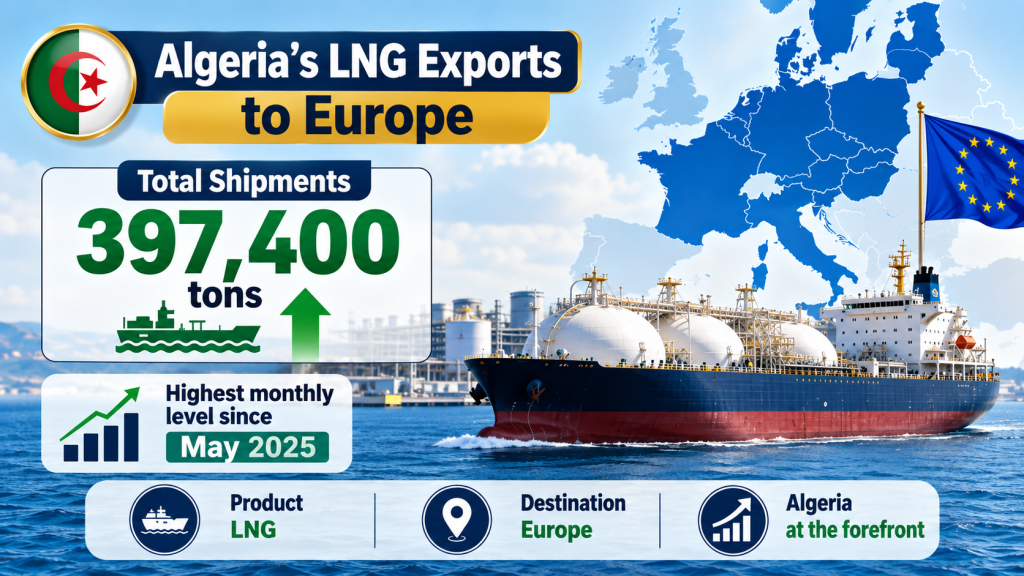
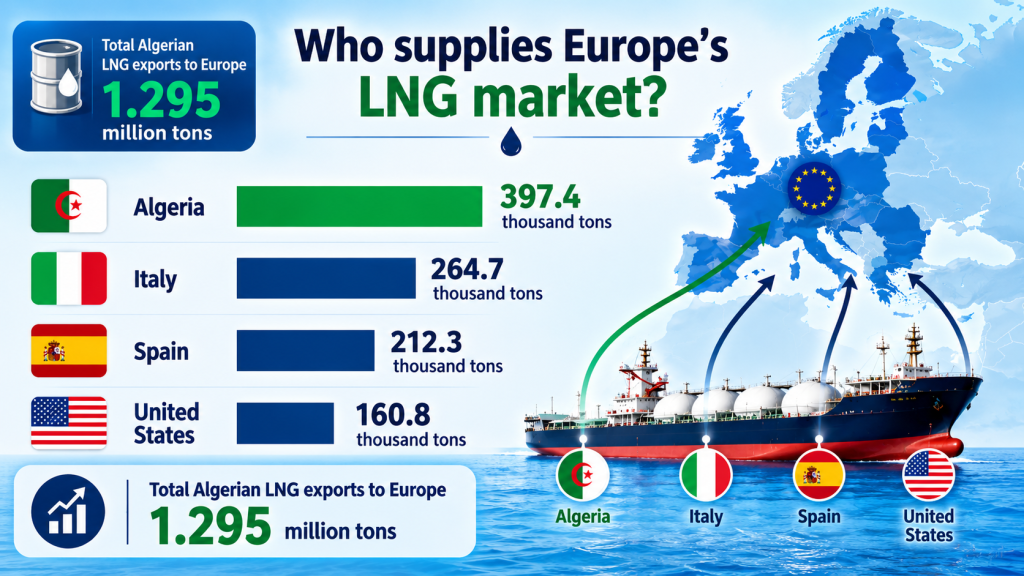
Algeria took the lead among suppliers with total shipments of around 397,400 tonnes, the highest monthly level of Algerian exports to Europe since May 2025, according to data reported by Argus Media, the energy specialist, citing Vortexa.

This rise reflects a striking shift in the trade routes of Algerian naphtha amid the changes that have affected maritime shipping movements as a result of the military and geopolitical escalation in the Middle East.

Geopolitical tensions redirect shipments

The repercussions of the US-Israeli war on Iran have increased the risks associated with navigation in the region, particularly in the Red Sea, prompting a number of naphtha suppliers to reconsider their shipping routes and target markets.

In this context, Algeria avoided routing naphtha shipments bound for Asia through the Bab el-Mandeb Strait amid escalating security threats and disruptions to maritime navigation.

No Algerian naphtha shipments to Asia passed through the strait in July, compared with around 132,000 tonnes in June.

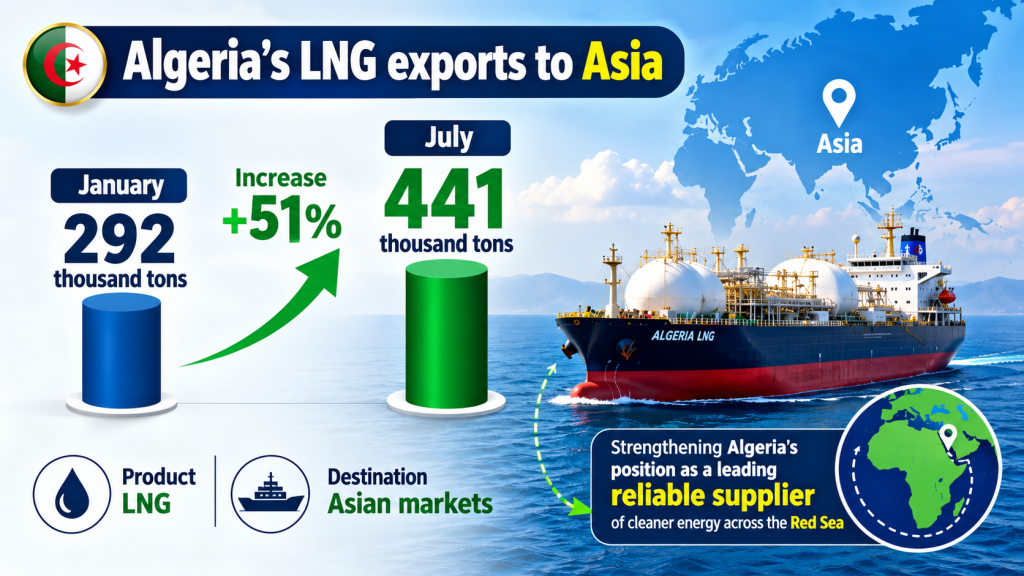
Nevertheless, Algerian naphtha exports to Asian markets overall rose from around 292,000 tonnes in June to 441,000 tonnes in July, with a longer route via the Cape of Good Hope being adopted to avoid the risks of the Red Sea.

These developments reveal a notable redistribution in the map of Algerian naphtha exports, as the rise in shipping costs and risks along traditional routes has pushed some suppliers to direct a larger share of supplies towards Europe, considered a closer and more logistically suitable market.

Who is competing with Algeria in the European naphtha market?

Algeria was not the sole supplier of naphtha to the European market in July, as several Mediterranean and other international markets featured among the major suppliers.

According to the available data, the main supplying countries were as follows:

– Algeria: 397.4 thousand tonnes  

– Italy: 264.7 thousand tonnes  

– Spain: 212.3 thousand tonnes  

– United States: 160.8 thousand tonnes  

US naphtha shipments to Europe recorded their highest levels in 11 months, since August 2025, providing a further indication of the growing supply flows to the European continent last month.

#Algeria#Europe
Author
Lys Iwannughen