Sunday, 18 October 2026 • 18:50 Algiers time
Algeria Gate
News Room
Cameron Hudson: UAE is virtually the sole backer of the RSF..without its support the war in Sudan would not continue Algeria-Niger: Official launch of Trans-Saharan fibre optic link Five minutes of lament over Algeria: Amar Belani exposes CNEWS’s real obsession Algerian courts hand down first death sentences under new drugs law Ségolène Royal’s masterclass on Algeria against an ignorant and demagogic journalist President Tebboune and senior officials receive the remains of Boualem Boualem in Algiers NAPEC 2026 in Oran: Algeria at the Heart of Africa’s and the Mediterranean’s New Energy Landscape Pegasus Files: Amnesty Uncovers Morocco’s Espionage Against Spain President Tebboune Orders Salary Increases in Algeria’s 2027 Budget, Rules Out New Taxes on Citizens Algeria Emerges as a Trusted Power for Regional Peace and Stability
Share this post

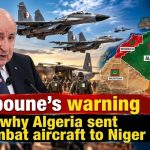
President Tebboune’s warning: why Algeria sent combat aircraft to Niger

• Author: Lys Iwannughen • 0 comments • 5 views
President Tebboune’s warning: why Algeria sent combat aircraft to Niger

Algeria Gate: President of the Republic Abdelmadjid Tebboune spoke publicly for the first time about the reasons that led Algeria to send combat aircraft to Niger at the end of August 2026. In extracts from his periodic interview with the national press broadcast on the night of 2–3 October, the head of state directly linked this decision to the attempt at destabilisation that occurred in Niamey.

According to Abdelmadjid Tebboune, the sequence of events was decisive. Nigerien Prime Minister Ali Mahamane Lamine Zeine had just carried out a working visit to Algeria on 26 and 27 August 2026. Shortly after his return to Niamey, an attempted coup took place on the night of 28–29 August, notably around Air Base 101 in the Nigerien capital.

https://twitter.com/algatedzEng/status/2106384974278484023?s=20

The Algerian president considered that the timing of this attempt constituted a “provocation” toward Algeria. He declared that aircraft had been sent because “some people had gone too far,” without, however, publicly identifying the actors to whom he was referring.

Four Algerian Su-30s sent to Niamey

The Algerian Ministry of National Defence had announced on 30 August the dispatch of two patrols composed of four Sukhoi Su-30 fighter aircraft, accompanied by a tanker aircraft. The planes landed the same day in Niamey.

According to the official communiqué of the ministry, this mission had been decided on the instruction of President Tebboune and at the request of the Nigerien authorities, in order to support the Nigerien army after the events aimed at destabilising the country.

The Nigerien prime minister himself welcomed the Algerian deployment on its arrival and expressed his thanks to President Tebboune as well as to the Algerian people for this support.

Algeria directly links Niger’s stability to its own security

This intervention illustrates the strategic importance that Algiers attaches to Niger and to the stability of the Sahel. Algeria shares a long border with Niger and has for several years considered instability in this region, terrorism and political upheavals as issues directly linked to its national security.

The dispatch of fighters to Niamey was also noted because it constitutes a particularly visible use of Algerian military means beyond national borders. Le Monde noted that the deployment included four Su-30s as well as transport and refuelling aircraft, seeing in it a notable evolution in Algeria’s regional posture.

For Abdelmadjid Tebboune, the decision therefore appears as a signal of support for the Nigerien authorities and of firmness in the face of any attempt at destabilisation liable to affect Algeria’s security environment.

The president did not, however, name the parties he suspects of being behind the “provocation.” At this stage, it is therefore appropriate to distinguish his political assessment from the officially established facts concerning the authors and the motivations of the attempted coup.

#Algeria#Niger#President tebboune
Author
Lys Iwannughen
View my articles

Leave a comment

Your email address will not be published. Required fields are marked *

African coast
Share this post

High-ranking American official receives Polisario Front delegation… Emergency in Morocco!

High-ranking American official receives Polisario Front delegation… Emergency in Morocco!

Algeria Gate: In a major diplomatic development that undermines the Moroccan regime’s continuous misleading of public opinion regarding the true American position on the Western Sahara issue, the halls of the United Nations in New York hosted a notable American-Saharan meeting.

High-ranking American official receives Polisario Front delegation… Emergency in Morocco!

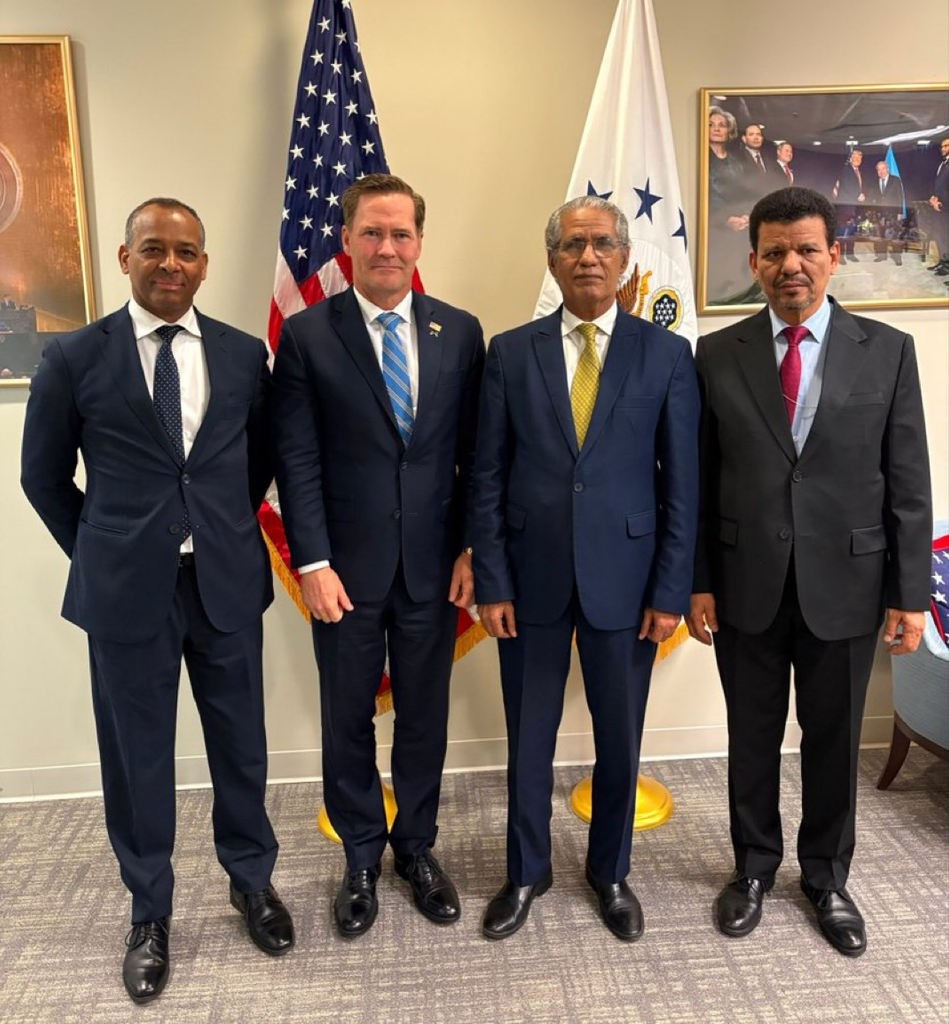
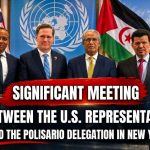
The Permanent Representative of the United States to the United Nations, Ambassador Mike Waltz, received a high-level delegation from the Polisario Front, the sole and legitimate representative of the Sahrawi people.

The Sahrawi delegation included prominent figures: Mohamed Salem Ould Salek, Advisor to the President of the Republic for Diplomatic Affairs; Mohamed Yeslem Beissat, Minister of Foreign Affairs; and Sidi Mohamed Omar, the Front’s representative to the United Nations and coordinator with the MINURSO mission. This official reception clearly reflects the status of the Sahrawi side as a key and serious partner in any future negotiation process, and deals a painful blow to Moroccan propaganda aimed at marginalizing the realities on the ground.

https://twitter.com/algatedzEng/status/2105321705455419760?s=20

The impact of this significant meeting did not take long to become public. After meeting the delegation, U.S. Ambassador Mike Waltz posted a tweet on his official account on the X platform that constituted a strong slap in the face of the Moroccan occupation.

Waltz explicitly acknowledged that Sahrawi refugees in the camps have been enduring the fire of waiting for five full decades, affirming that these people who have suffered the hardships of displacement and exile deserve “real options” that guarantee their legitimate rights.

#USA#Western Sahara
Author
Lys Iwannughen
View my articles
African coast
Share this post

Algeria Gate Exposes Secret Netanyahu–Saddam Haftar Meeting in Abu Dhabi, Confirmed by Il Foglio.. Morocco Mentioned

Algeria Gate Exposes Secret Netanyahu–Saddam Haftar Meeting in Abu Dhabi, Confirmed by Il Foglio.. Morocco Mentioned

Algeria Gate: New information published on September 29th, 2026, by Algeria Gate and confirmed by the Italian daily Il Foglio reports a discreet meeting in Abu Dhabi between Israeli Prime Minister Benjamin Netanyahu and Saddam Haftar, son of Khalifa Haftar and number two of the Libyan eastern forces.

According to Algeria Gate, several official flights from countries in the region converged on Al Bateen Airport in Abu Dhabi at the time of Netanyahu’s visit. Among them was an Airbus A319 registered P4-KH5I9, an aircraft presented as being usually used by Saddam Haftar. The plane is said to have landed at 12:40 p.m., about twenty minutes after Netanyahu’s arrival.

Saddam Haftar seeking political support

Il Foglio cites in particular Mohamed Buisier, a former political adviser to Khalifa Haftar, who states that Saddam Haftar met Netanyahu in order to seek political support for his ambitions for the Libyan presidency. The Times of Israel also relayed the information concerning the arrival of Saddam Haftar’s aircraft shortly after that of the Israeli Prime Minister.

The Italian daily also notes the presence, in the same time slot, of flights coming notably from Morocco, Saudi Arabia, and Qatar, without publicly establishing in the article consulted the identity of all the officials who were on board.

The name of Yassine Mansouri mentioned

According to the information relayed by Algeria Gate, Yassine Mansouri, Director General of the DGED (Moroccan external intelligence), is said to have participated in the meeting on the Moroccan side. This participation is not, however, confirmed by name in the Il Foglio article consulted, which limits itself to noting the arrival of a flight from Morocco. Mansouri’s presence must therefore, at this stage, be presented as information still to be confirmed by other independent sources.

This sequence occurs at a time when Saddam Haftar is multiplying international contacts concerning the political future of Libya.

Il Foglio also states that he is seeking to consolidate his relays in Washington and with other foreign partners.

The Abu Dhabi episode thus fuels questions about the regional dealings surrounding the future of Libyan power and about the role played by the United Arab Emirates in these discreet diplomatic exchanges.

#Israel#Libya#Morocco
Author
Lys Iwannughen
View my articles
African coast
Share this post

Unjust Representation for 81 years… Why is Africa still outside permanent membership of the Security Council?

Unjust Representation for 81 years… Why is Africa still outside permanent membership of the Security Council?

Algeria Gate: Political analyst and international relations expert Ayoub Arfi said that the demand for permanent and equitable African representation on the Security Council, which Algeria has reaffirmed in the highest UN forums, goes beyond being a temporary continental demand and raises a fundamental question about the legitimacy of the structure of the international system itself.

Arfi explained that the Security Council, in its current composition dating back to 1945, still reflects the balance of power that followed the Second World War, at a time when the map of the world has changed radically since then. He considered that the continued absence of Africa from permanent membership constitutes a historical and institutional anomaly that cannot be justified by contemporary political or legal logic.

He stressed that the African demand cannot be regarded as a mere symbolic aspiration, but represents a real stake capable of redrawing the balances of representation within the most important international institution. He pointed out that any modification of the composition of permanent membership would open the door to a deeper review of the decision-making mechanism, including the veto right, which he described as remaining the greatest obstacle to any fundamental reform.

Arfi believes that the African demand, although it appears on the surface to be a representational demand, is in essence a real test of the willingness of the current permanent powers to accept an actual sharing of power within the UN system.

In explaining the reasons for Africa’s continued exclusion from the circle of permanent membership, despite its demographic, geographical, and political weight, Arfi attributed this primarily to a historical legacy that reflects the structure of colonial power on the basis of which the UN system was formulated at its founding, when most African countries were still under occupation and had no voice in shaping the international system.

He added that this founding legacy was not subsequently corrected despite the independence of the continent, due to the resistance of the permanent powers to any real expansion that would affect the balances of their influence within the Council.

The international relations expert pointed to a current political factor consisting of the absence of collective international will on the part of some major parties to carry out genuine reform that touches the core of their privileges. He explained that these parties often content themselves with formally supportive discourse regarding African representation, without translating it into actual initiatives within the corridors of the United Nations.

He noted that the African continent remains one of the regions most linked to the Security Council’s agenda, as the majority of the files listed on its agenda are African files. This highlights, in his view, a clear contradiction: the continent whose crises and conflicts are managed by Council decisions: from peacekeeping operations to sanctions, remains absent from the table where those decisions are made.

Arfi considered that this situation enshrines the logic of “decision without participation” and fundamentally contradicts the principles of representative justice on which any democratic UN institution is supposed to be based.

Regarding the repercussions of Africa obtaining permanent seats with full powers, including the veto right, Arfi explained that this would bring about a qualitative shift in the way African files are handled within the Security Council. Decisions relating to conflicts and peacekeeping operations on the continent would no longer be formulated exclusively according to the calculations of external major powers, but would take into account the African continent’s own vision of crises, based on the principle of “African solutions to African problems.”

He believes that this presence would enhance the chances of finding more sustainable settlements closer to the reality of the peoples concerned, in addition to contributing to the rebalancing of broader files that go beyond the continent, such as issues of disarmament, international economic reform, and climate change.

He clarified that a permanent and effective African presence would enable the continent to defend the interests of the countries of the South in general with a stronger voice and with real powers, instead of being content with the role of “observer” on issues of international peace and security, despite being the party most affected by them.

In this context, Arfi put forward Algeria as a natural and qualified candidate to represent the African continent in the event of the establishment of a permanent seat, based on its accumulated diplomatic record over decades of involvement in peace and security issues, support for liberation movements and paths of decolonization, as well as its current role in mediation and de-escalation in the Sahel and Libya files.

He also pointed to Algeria’s repeated presence as a non-permanent member of the Security Council, considering that it has demonstrated its ability to defend collective African positions with steadfastness and responsibility.

He added that Algeria’s commitment to the principles of sovereignty, non-interference, and the peaceful settlement of disputes gives it, in his estimation, additional credibility as a balanced voice capable of defending the interests of the continent without aligning itself with any international axis, which qualifies it to be among the African voices most agreed upon to assume this historic responsibility.

#Africa
Author
Lys Iwannughen
View my articles