Tuesday, 6 October 2026 • 10:33 Algiers time
Algeria Gate
News Room
NAPEC 2026 in Oran: Algeria at the Heart of Africa’s and the Mediterranean’s New Energy Landscape Pegasus Files: Amnesty Uncovers Morocco’s Espionage Against Spain President Tebboune Orders Salary Increases in Algeria’s 2027 Budget, Rules Out New Taxes on Citizens Algeria Emerges as a Trusted Power for Regional Peace and Stability Prison of Tanezrouft: When the French Right Meddles in Algerian Affairs European Union: Algeria is a reliable partner in the gas sector and has strong potential to become a key partner in energy projects! Raw materials: Algeria benefits from the energy shock, Morocco’s trade deficit soars Hana Mansour denounces the use of her image by Le Point to illustrate an article by Kamel Daoud President Tebboune’s warning: why Algeria sent combat aircraft to Niger Algerian Diplomat: UAE Has Built a Military and Logistical Network Stretching from the Red Sea to Tigray
Share this post

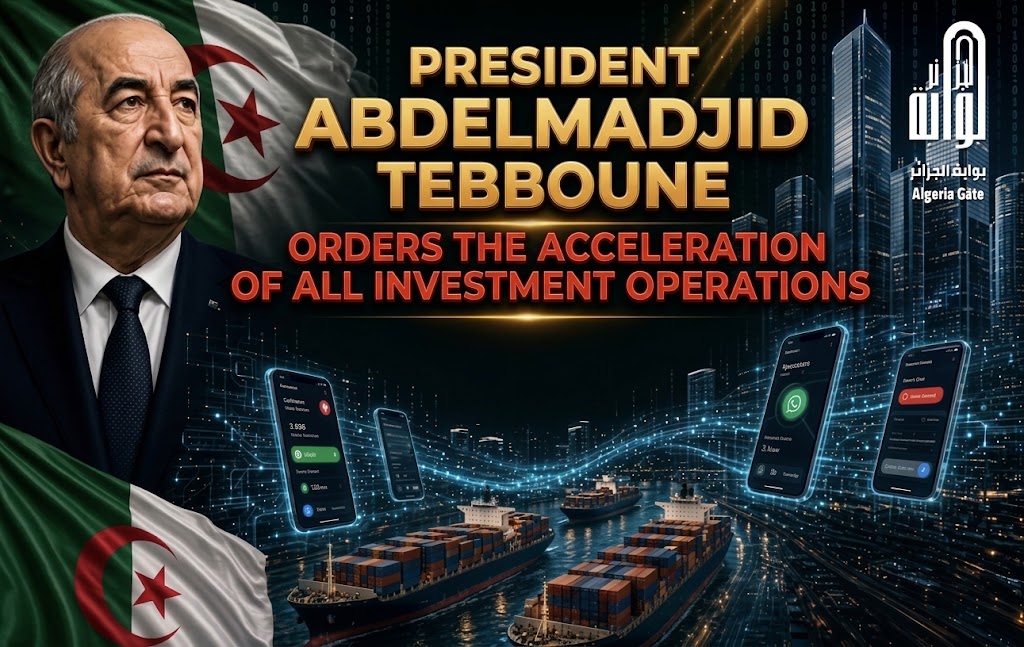
President Tebboune Orders the Acceleration of Digitization of Investment Operations

• Author: Lys Iwannughen • 0 comments • 38 views
President Tebboune Orders the Acceleration of Digitization of Investment Operations

Algeria Gate: President of the Republic, Abdelmadjid Tebboune ordered today, Wednesday, the acceleration of the digitization of all investment operations with the sectors concerned, particularly with the tax, state property, and customs services.

This came during the President of the Republic’s chairing of a working meeting devoted to the investment sector and the activation of the one-stop shop.

#Algeria#President tebboune
Author
Lys Iwannughen

Leave a comment

Your email address will not be published. Required fields are marked *

Algeria
Share this post

The World Is Watching Algeria: What Makes Tebboune’s Position So Strong?

The World Is Watching Algeria: What Makes Tebboune’s Position So Strong?

“The Geopolitical Desk” (GPD)… These are the reasons for the success of Algeria’s policies since 2020

Algeria Gate: Algeria is increasingly imposing itself as a central actor on the regional chessboard in the fields of energy, diplomacy, and security, to the point that the specialized media outlet “The Geopolitical Desk” (GPD); the media arm of one of the largest research centers in international relations, has announced the expansion of its coverage dedicated to the country, noting that serious analyses in English about Algeria remain extremely rare, at a time when the country’s weight on the international stage continues to grow.

A country at the heart of four strategic files

According to GPD, Algeria deserves treatment that goes beyond superficial reports, as its influence today extends on several fronts:
• An offensive energy policy, with continuous updating of regulatory laws and new rounds of tenders that attract the attention of major international companies.
• Diplomacy in an active phase of reshaping with Europe and the United States, which are multiplying their initiatives toward Algeria.
• A pioneering geopolitical role across the Sahara and expanded Africa, where Algeria is imposing itself as an indispensable regional hub.
• An active internal institutional dynamism, with a renewed parliament and political developments that are closely followed.

Algeria, a driver of a new global energy cycle

The media outlet specifically addressed the new round of oil and gas tenders launched by Algeria under the name “Algeria Bid Round 2026,” which follows the 2024 round that already allowed the awarding of five exploration and production licenses to international companies. GPD emphasizes that this initiative comes at a crucial moment for the global hydrocarbons sector, in a context of tensions on energy supply chains, placing Algeria in a position to benefit from its proactive vision and the growing confidence of investors coming from both East and West.

Algerian diplomacy under the spotlight in Europe

On the diplomatic front, GPD notes that Algeria is multiplying its strategic partnerships with Madrid and Berlin, consolidating its position as an indispensable partner for Europe in the fields of investment and political cooperation.

The media outlet also analyzed how the regional dynamism in the Sahara is bringing Algeria and Mali closer again; two countries whose relations had experienced a cooling, illustrating the stabilizing role that Algeria continues to play in a region suffering from turbulence.

Institutional life closely followed on the internal front

GPD devoted an analysis to the new Algerian parliament, emerging from the second legislative elections since 2019, which was particularly marked by the arrival of the first woman to its presidency.

On the other hand, the media outlet closely followed the preparations for the American-Algerian Business Forum, considering it a strong signal of Algeria’s will to deepen its economic and energy relations with Washington, paving the way for a renewed bilateral relationship.

Free access suggested for subscribers

“The Geopolitical Desk” invites professionals and observers for whom Algeria is a field of work, but who find it difficult to find serious coverage in English about the country, to subscribe for free to access this full analysis.

#Algeria
Author
Lys Iwannughen
Algeria
Share this post

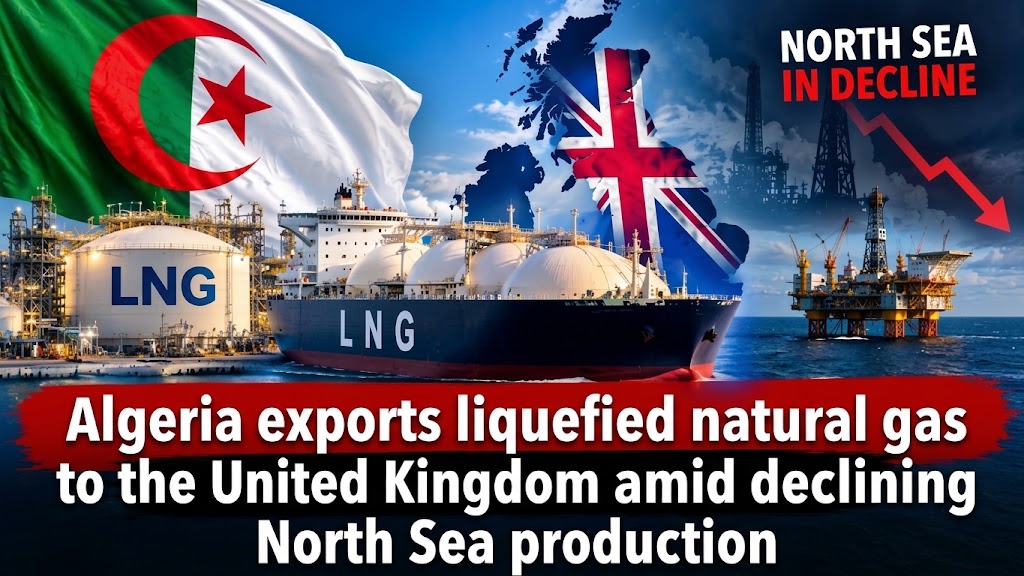
Algeria exports liquefied natural gas to the United Kingdom amid declining North Sea production

Algeria exports liquefied natural gas to the United Kingdom amid declining North Sea production

Algeria Gate: Algeria is establishing itself as one of the suppliers of liquefied natural gas (LNG) to the United Kingdom at a time when North Sea gas production is experiencing a clear decline, pushing London to strengthen its dependence on imports to cover its energy needs.

A marked decline in British production

According to data reported by the website of the Algerian daily Echorouk, British North Sea gas production stood at around 28 billion cubic meters in 2025, covering nearly 41% of the country’s needs. However, this production is expected to fall to 14 billion cubic meters over the next four years, before dropping to only 6 billion cubic meters by 2035.

Growing dependence on imports

This structural decline in national production should mechanically increase British dependence on gas imports. According to the same forecasts, the share of imports in covering the United Kingdom’s gas needs should exceed 70% by 2030, before rising to 85% by 2035.

Faced with this announced decline in domestic production, recourse to liquefied natural gas appears to be an unavoidable solution to bridge the growing gap between local supply and the country’s energy demand.

Algeria, an increasingly present supplier on the British market

It is in this context that Algeria has emerged among the United Kingdom’s LNG suppliers. The country, which has significant liquefaction capacities through its historic gas complexes, notably at Arzew and Skikda, as well as the Medgaz pipeline directly linking Algeria to Spain, is seeking to diversify its export outlets in a European energy market that has been undergoing major recomposition for several years.

This development illustrates how the progressive decline of certain historic production basins, such as the North Sea, is opening new opportunities for gas-producing countries capable of responding rapidly to demand, such as Algeria, regularly cited among Europe’s main gas suppliers.

#Algeria#UK
Author
Lys Iwannughen
Algeria
Share this post

Imports: President Tebboune Orders Tough Action Against Fraudulent Declarations

Imports: President Tebboune Orders Tough Action Against Fraudulent Declarations

Algeria Gate: President of the Republic, Abdelmadjid Tebboune is taking a tougher stance over irregularities identified in declarations related to import programs. Following revelations by the Ministry of Foreign Trade and Export Promotion, the President called in the Prime Minister along with several senior officials from the Trade and Finance sectors to closely examine the data submitted.

The Presidency considers that certain declarations could directly harm the national economy and public funds. Measures are therefore expected against operators accused of submitting false declarations or attempting to divert state resources.

https://twitter.com/algatedzEng/status/2096993184559591653?s=20

The decision comes as digital tools introduced to monitor provisional import programs have uncovered several irregularities. The ministry has notably flagged suspicious files, duplicate applications, and companies whose actual existence could not be verified on the ground.

The issue has taken on a new dimension following figures revealed in recent days: 3,961 operators employing between zero and five workers submitted import requests worth more than $130 billion for the second half of 2026.

Through this intervention, Abdelmadjid Tebboune is sending a clear message: protecting Algeria’s foreign reserves and public funds will now require much stricter oversight of imports, coupled with firm sanctions against fraudulent practices.

#Algeria#Economy#President tebboune
Author
Lys Iwannughen