
Friday, 12 June 2026 06:25 Algiers time
Algeria Gate
Share this post

U.S. Seeks Stability in Trade Ties with China Ahead of Trump-Xi Meeting

Published on 7 April 2026 at 20:24 (local time) Author: بوابة الجزائر 0 comments 18 views
U.S. Seeks Stability in Trade Ties with China Ahead of Trump-Xi Meeting

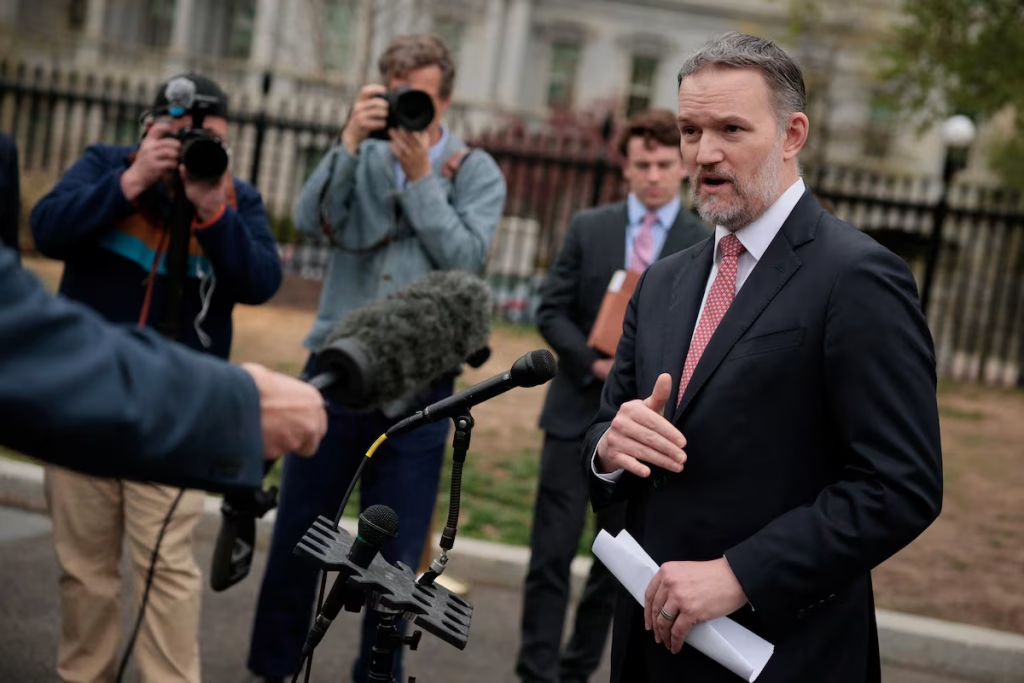
WASHINGTON, April 7 (Reuters) – The United States aims to maintain stable economic ties with China ahead of a planned meeting between President Donald Trump and President Xi Jinping next month, U.S. Trade Representative Jamieson Greer said.

Greer stated that Washington is not seeking confrontation and is focused on ensuring continued access to Chinese rare earth minerals. He noted that discussions on the issue have continued at ministerial and staff levels, despite the postponement of an earlier summit.

He added that both countries have reached a relatively stable arrangement, with the U.S. maintaining tariffs on Chinese goods while securing access to key resources.
Author
بوابة الجزائر
Algeria
Share this post

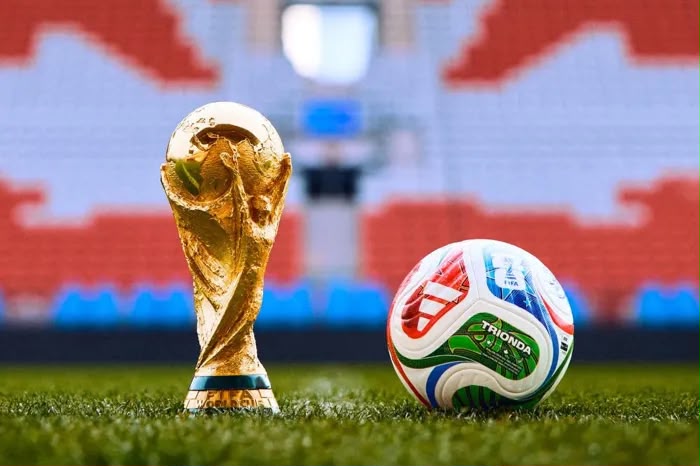
The World Awaits the Biggest Event: FIFA World Cup 2026 Kicks Off Today in Mexico

The World Awaits the Biggest Event: FIFA World Cup 2026 Kicks Off Today in Mexico

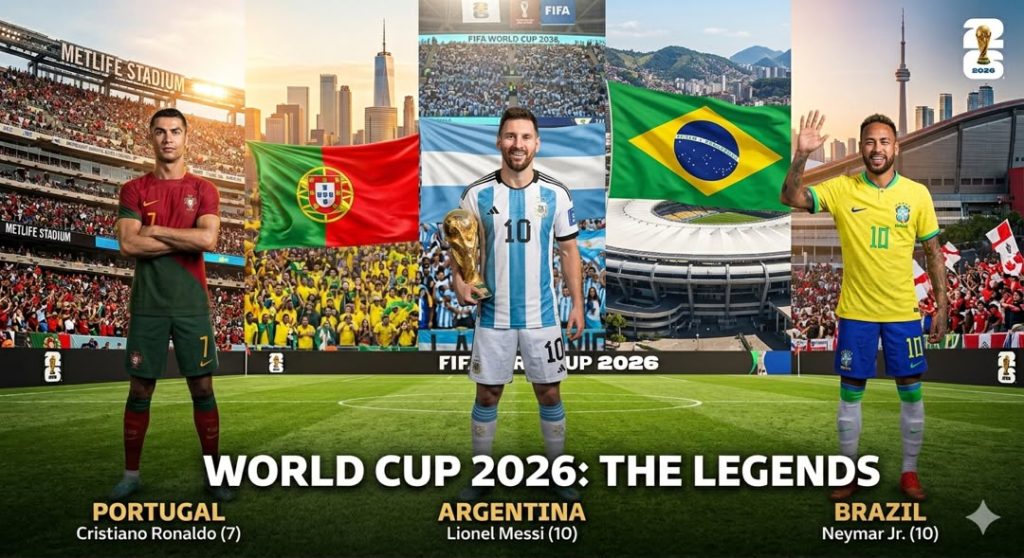
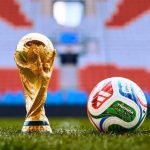
The 2026 FIFA World Cup officially gets underway this Thursday with an opening match between Mexico and South Africa at Mexico City Stadium, with kick-off scheduled for 19:00 GMT. The most-watched sporting event on the planet enters a new era, becoming the first World Cup in history to feature 48 national teams, marking the tournament’s largest expansion since its inception.

Over the next month, the United States, Canada, and Mexico will become the global stage for football’s biggest stars

and the dreams of millions of fans. A total of 48 nations will battle for the most prestigious trophy in world football across 104 matches. The tournament will conclude on July 19 at New York New Jersey Stadium in front of 82,500 spectators, while the champions will receive a record-breaking prize of $50 million.

Attention will naturally focus on traditional powerhouses such as defending champions Argentina, Brazil, France, Spain, Germany, and England. However, this edition will also showcase new faces on football’s biggest stage. Cape Verde, Curaçao, Jordan, and Uzbekistan will make their historic World Cup debuts, highlighting the profound impact of the tournament’s expansion.

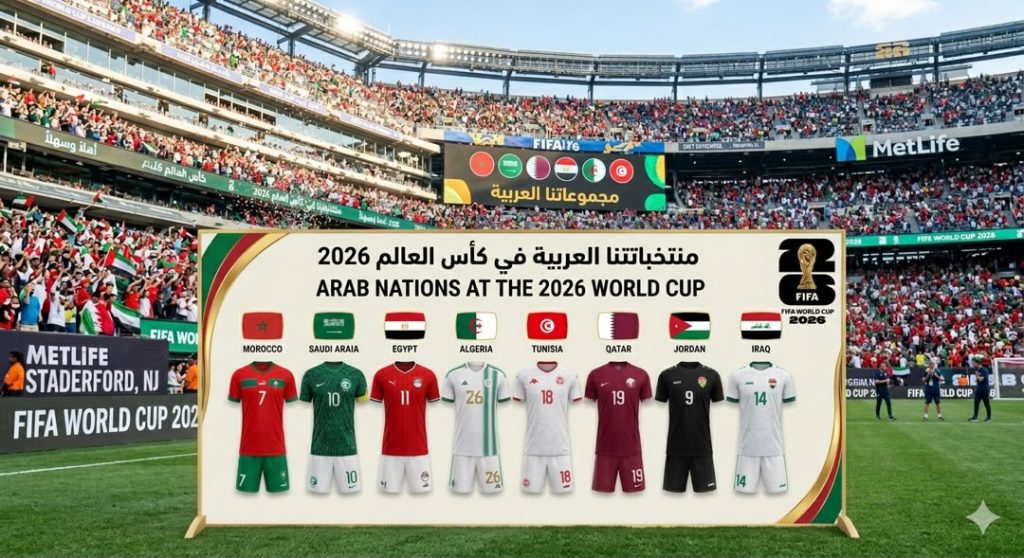
On the Arab front, this World Cup features an exceptional Arab representation with eight participating nations: Egypt, Morocco, Saudi Arabia, Algeria, Tunisia, Iraq, Qatar, and Jordan. It marks one of the largest Arab contingents in the history of the competition.

Algeria’s return to the global stage carries renewed hopes among supporters, with a talented generation eager to add a new glorious chapter to the legacy of the Desert Warriors also On the Algerian front, the return of the Desert Warriors to the World Cup stage is set to be accompanied by one of the most passionate and colourful fan bases in world football. Algerian supporters, renowned for their thunderous atmosphere and unwavering loyalty,

are expected to travel in their tens of thousands to stadiums across the United States, Canada, and Mexico. Whether draped in the iconic green and white or waving the crescent and star with pride, Les Fennecs’ faithful have always transformed every venue into a second home a tradition that began with the legendary 1982 Gijón moment and lives on through every generation.

As the opening whistle blows, the dream begins for 48 nations, but only one will ultimately lift football’s most coveted trophy. Between dreams of glory and heartbreak, one thing is certain: the world is set to witness another unforgettable chapter in the history of the beautiful game.

Author
yasmine ouazib
China
Share this post

UAE Withdrawal from OPEC+ A Sovereign Move or a “Last Pressure Card” in a High-Risk Moment?

UAE Withdrawal from OPEC+ A Sovereign Move or a “Last Pressure Card” in a High-Risk Moment?

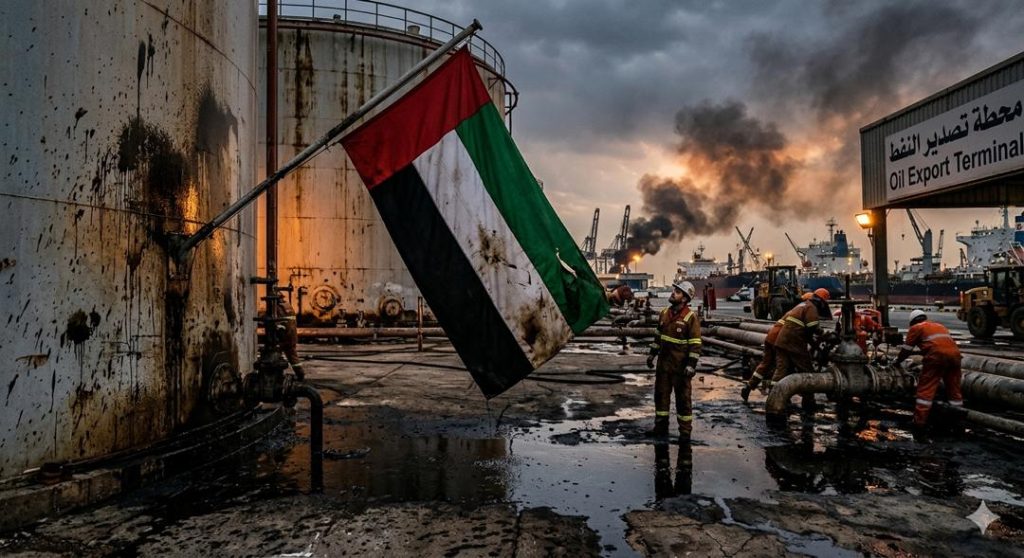
The UAE’s announcement of its withdrawal from OPEC and OPEC+ starting May 1, 2026 cannot be treated as a technical adjustment or a routine shift in oil policy. At its core, it is a major move by a state of the UAE’s scale an important global energy player that now appears to be gambling with its tools of influence rather than reinforcing them.

Exiting OPEC+ effectively means stepping away from one of the most important collective frameworks in the oil market, in favor of a fully exposed individual path subject to global price volatility and major alliances. In the energy world, size alone is not enough it is how that size is managed that determines whether it translates into influence or vulnerability.

The message sent to markets is not neutral
a major supplier choosing to break from a collective framework when conditions shift. This is not only read as flexibility, but also as unpredictability in decision-making behavior. In a market built on long-term trust, such signals can trigger serious reassessments from importers.

In this context, the move can be interpreted as a “last pressure card” in a complex regional environment. However, the problem is that this card is being played at a time when strategic room for maneuver is narrowing rather than expanding.

Over the medium term, the risk is not limited to immediate reactions, but to the cumulative perception effect. Decisions that are increasingly seen as abrupt or unilateral may gradually shape a broader narrative about the country’s economic policy behavior. Over time, such perceptions can directly affect trust, investment confidence, and positioning within the global energy market.

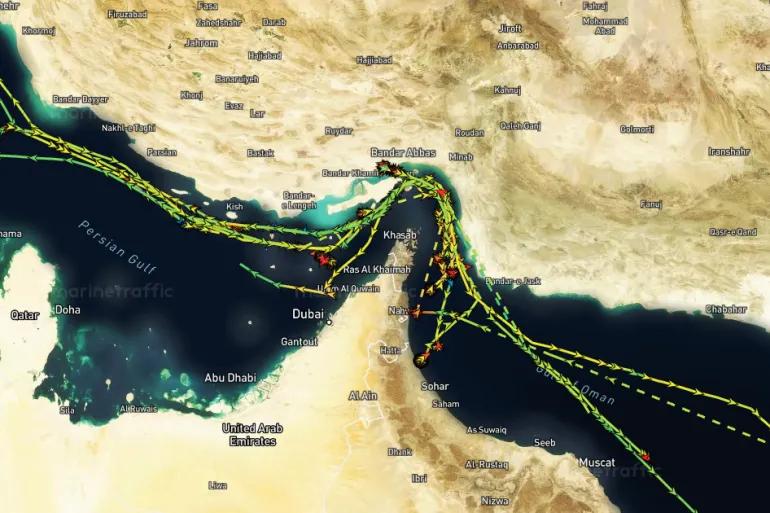
Geopolitically, the Strait of Hormuz remains a permanent pressure point that cannot be ignored. While Article 38 of the UN Convention on the Law of the Sea (UNCLOS) guarantees the theoretical right of transit passage, realities in the Gulf are governed more by power dynamics than legal texts.

Iran, in multiple crises, has demonstrated its ability to use the Strait as leverage through threats or the seizure of tankers, reinforcing the idea that “risk neutralization” in the region is largely theoretical rather than practical.

Within the Gulf itself, withdrawing from OPEC+ also implies a recalibration of coordination with Saudi Arabia, a central pillar of oil market stability. This is not a minor policy divergence, but a sensitive shift in the balance of roles within one of the world’s most important energy-producing regions

Ultimately, between the discourse of “sovereignty” and the realities of geography and markets, the UAE appears to be entering a phase of high-risk decision-making one that may offer short-term leverage but could carry long-term consequences for trust, stability perception, and strategic positioning in global energy markets.

Author
yasmine ouazib
Algeria
Share this post

How algeria built a pwoerful Diplomacy while preserving its sovereignty

How algeria built a pwoerful Diplomacy while preserving its sovereignty

Algeria Gate

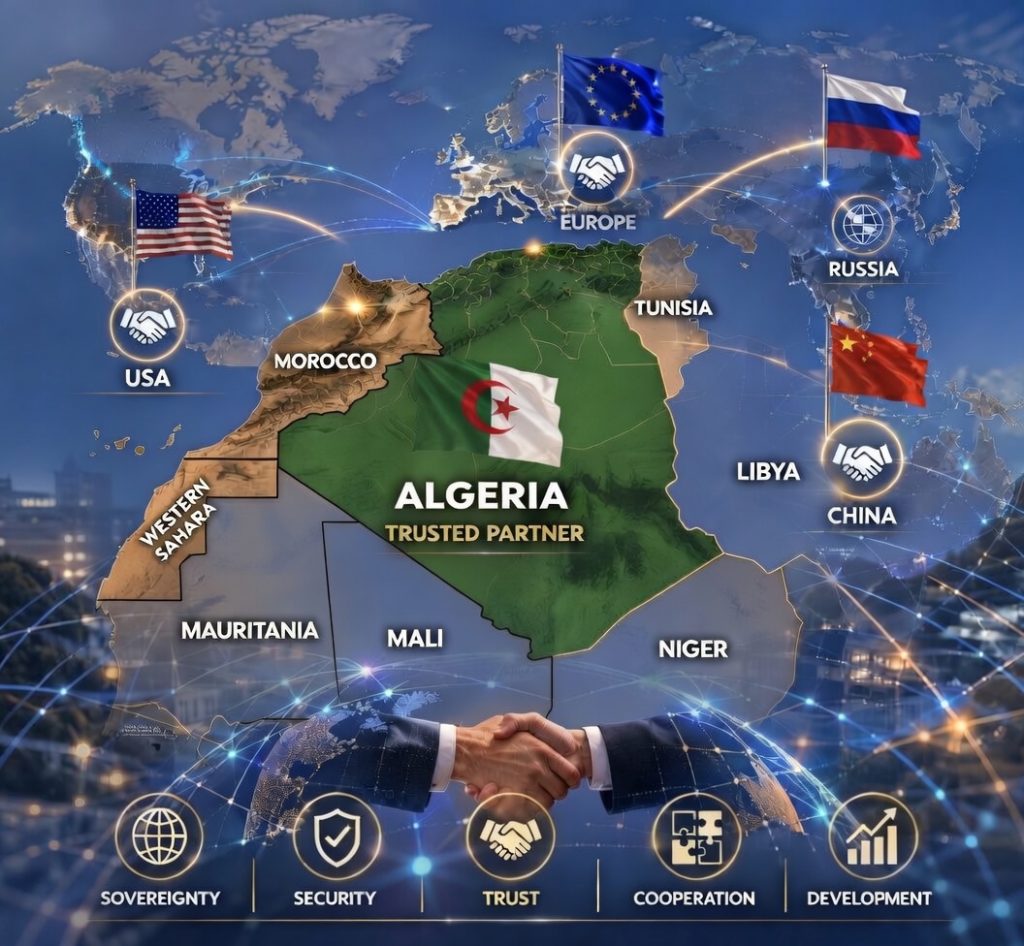
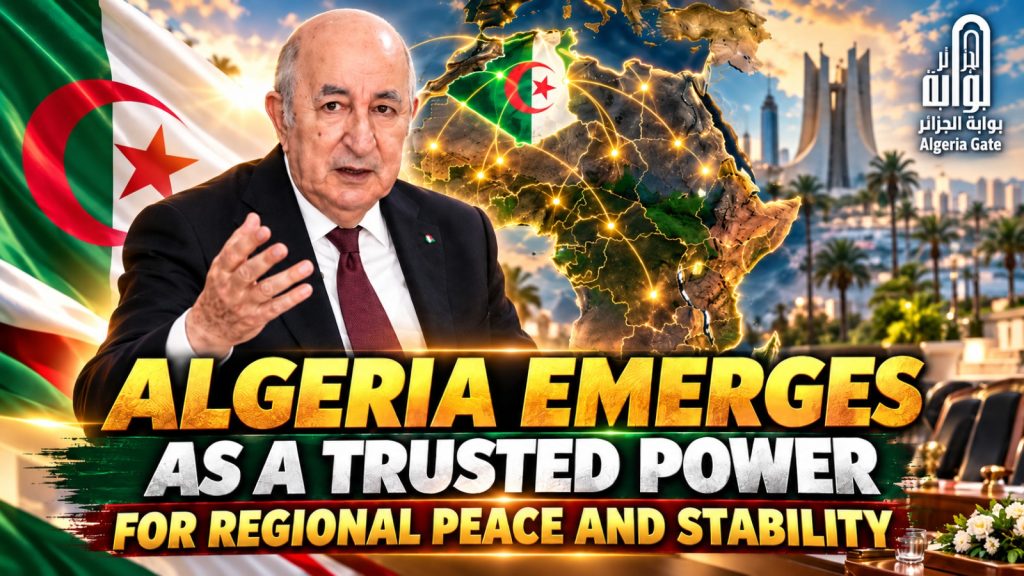
In an international landscape shaped by shifting alliances, Algeria’s recent diplomatic activity is no longer routinet it reflects a clear positioning as a regional power capable of asserting itself as a key player in the equations of security and energy.

The visit of U.S. Deputy Secretary of State Christopher Landau to Algiers was far from symbolic. It came within the framework of strengthening political coordination and expanding cooperation, particularly on regional stability and energy. For the United States, which is seeking reliable partners in North Africa and the Sahel, Algeria stands out as a country capable of playing a stabilizing role without falling into chaos or rigid alignment.

This dynamic was further reinforced on the security front with the visit of AFRICOM Commander General Michael Langley, reflecting direct interest in Algeria’s experience in counterterrorism. The message is clear: Algeria is not just another partner, but a trusted security actor in one of the world’s most sensitive regions.

On another front, the reception of a special envoy of the Russian President highlights Moscow’s commitment to maintaining a strategic partnership with Algiers, particularly in military and political fields. Russia recognizes Algeria as a point of balance in the region, and preserving this relationship ensures it a stable foothold in North Africa.

From the European side, the picture is equally telling. The visit of the Belgian Special Envoy for Energy Security and Critical Raw Materials reflects a growing European awareness of Algeria’s importance as a reliable energy supplier and a partner in strategic supply chains. Belgium, as part of the broader European framework, is acting within a vision focused on reducing risks and securing long-term stability.

At the same time, ties with Italy continue to deepen significantly, evolving into a model partnership that goes beyond gas to include investment and infrastructure. Rome no longer sees Algeria as merely a supplier, but as a long-term strategic partner in its energy security.

Taken together, these developments point to a single reality:
Algeria is not in the position of a follower waiting for initiativesit is a country whose doors are being knocked on by major powers, each with its own agenda, yet all converging on one fact: Algeria matters.

What stands out even more is how these relationships are managed without sharp contradictions. Algeria coordinates with Washington, maintains its strategic ties with Moscow, and strengthens its presence in Europe without compromising its independent decision-making. This balance is not accidental; it reflects political maturity and the ability to navigate

https://twitter.com/algatedzeng/status/2049170525608366361?s=46&t=xgw4Y5KQnjyzciUwde5llQ

complex global dynamics
In a turbulent international environment, Algeria is proving that it is not merely part of the equation it is an actor shaping it.

A partner that is sought after, a voice that carries weight. Through this approach, Algeria is consolidating its position as a reliable partner and a regional power capable of influencing the balance of calculations, rather than simply adapting to them.

#Algeria
Author
yasmine ouazib