
Sunday, 6 September 2026 12:20 Algiers time
Algeria Gate
News Room
$50B Revival: Algeria Spearheads Africa’s Economic Awakening Tiny Emirate Trapped by Hormuz, Continental Algeria’s Oil Crushes UAE’s Fragile India Bet 5.6 Million Cubic Meters per Day by 2030… Algeria Moves Desalination to the Heart of the Economy Algerian “INATEL” Enters the New Kinshasa City Project Covering 43,300 Hectares From VIP Glitter on Screens… to the Dark Shadows of Drug Networks! Tiny Companies, Astronomical Figures: AI Exposes $130 Billion Import Scam in Algeria Algeria Declares War on Cartels: Cutting Supply Lines and Choking Cash Flow After Algeria… Morocco tries to flood Spain with 3 tons of cocaine! Emirati fixer in Spain on a last-ditch bid to rescue Ayoub Aissiou! UAE falls into the trap… Algerian retaliation is coming hard! Algeria-Qatar’s Baladna project pumps $1.2 billion into the treasury every year… and buries the French import lobby!
Share this post

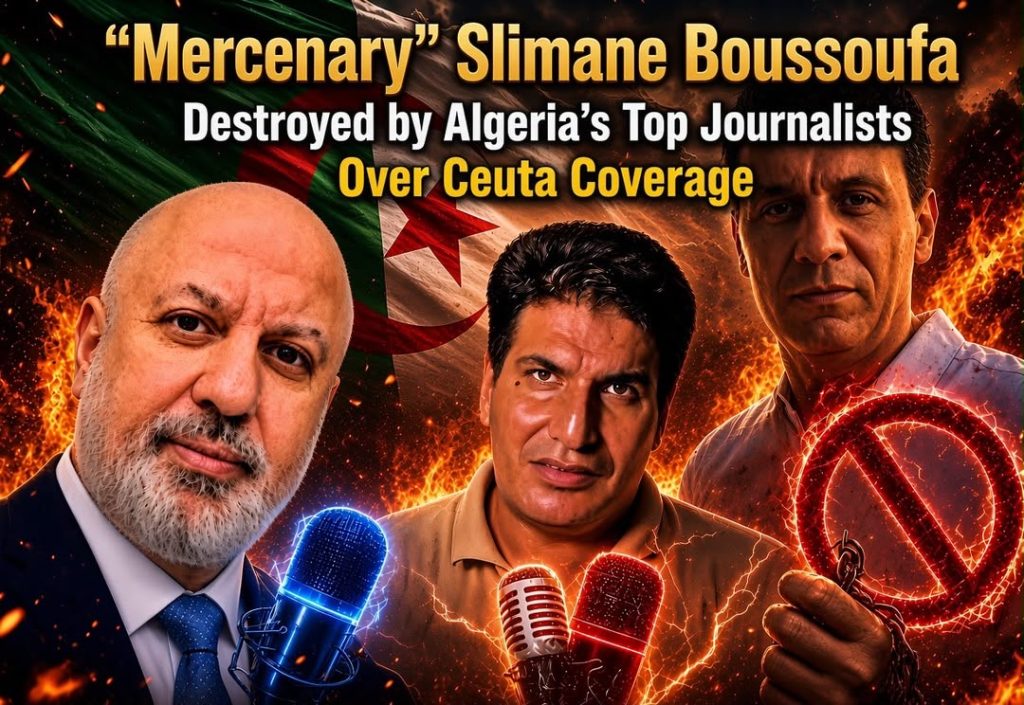
“Mercenary “Slimane Boussoufa Destroyed by Algeria’s Top Journalists Over Ceuta Coverage

Author: بوابة الجزائر 0 comments 106 views
“Mercenary “Slimane Boussoufa Destroyed by Algeria’s Top Journalists Over Ceuta Coverage

Slimane Boussoufa, “the Mercenary,” Under Heavy Fire from Algerian Journalists

Algeria Gate: Former Hespress and France 24 journalist Slimane Boussoufa has provoked widespread fury among Algerian journalists both inside the country and abroad.

His coverage of the Ceuta events has been condemned as unprofessional, crude, and driven by a clear anti-Algerian agenda laced with personal revenge.

Two heavyweights of Algerian media Mourad Chebine and Mustapha Bounif have led the charge.

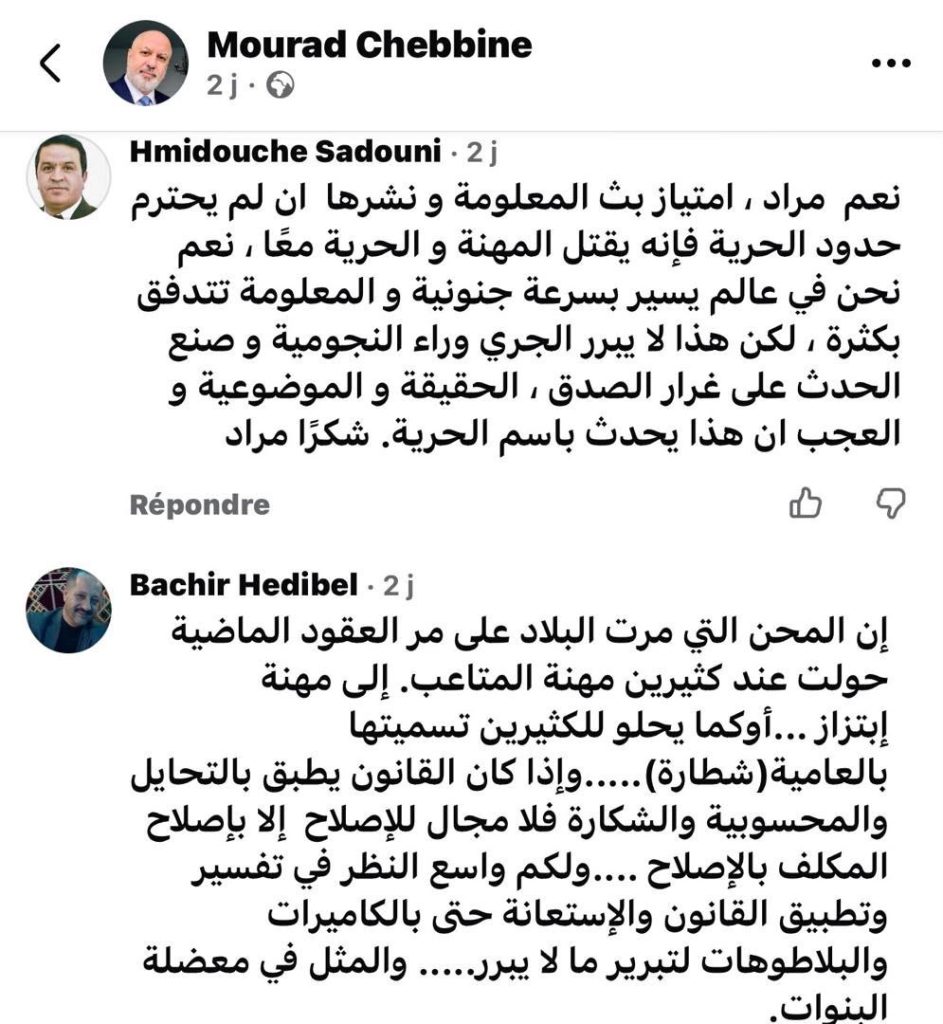
Mourad Chebine’s Brutal Professional Lesson

Mourad Chebine, the iconic face of Algerian television in the 1990s and a former senior figure at Sky News Arabia, delivered a masterclass in journalistic ethics without ever naming Boussoufa the classic method of heavyweights who refuse to elevate the unworthy.

He opened with a series of devastating questions:
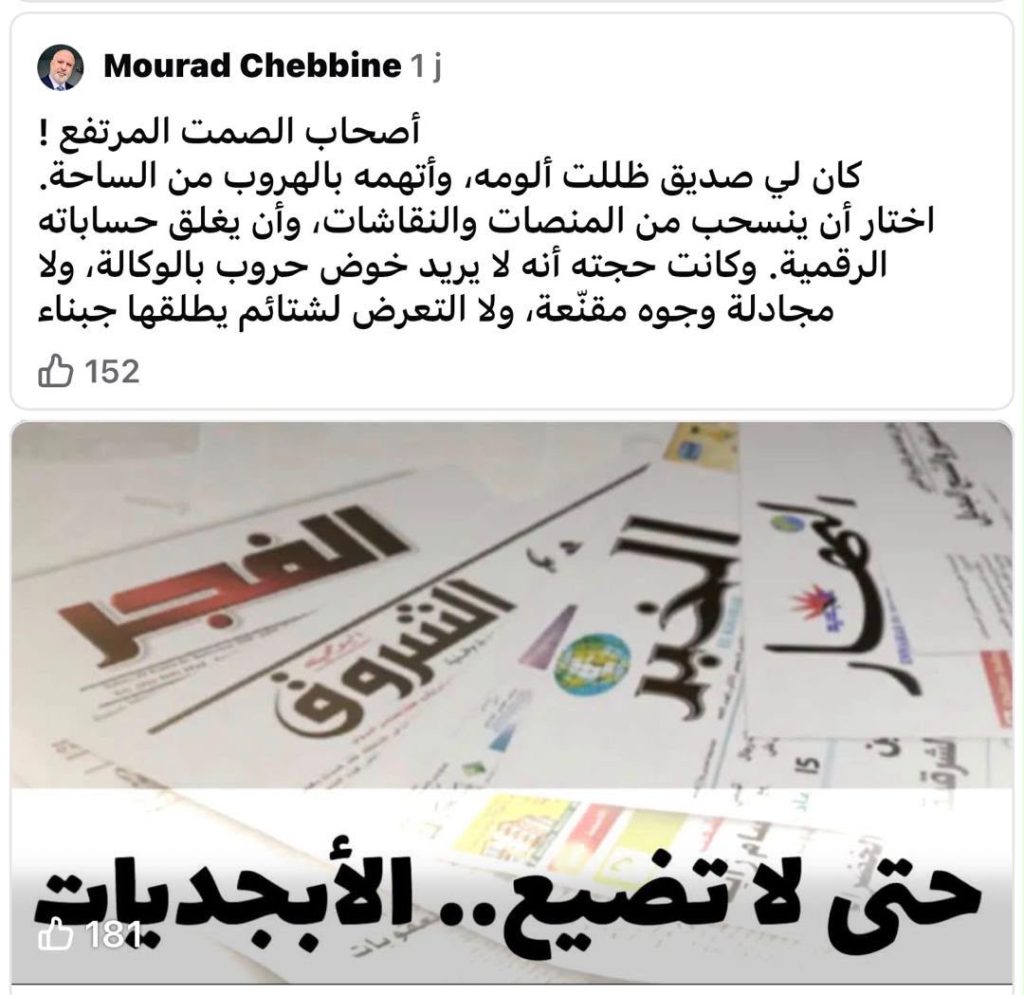
“Is press freedom the right to cross the sea hunting for ‘harraga’ from your own country among tens of thousands of Moroccans who stormed Ceuta?

Is freedom of expression the right to threaten someone with exposing their private secrets simply because they disagree with your political stance?
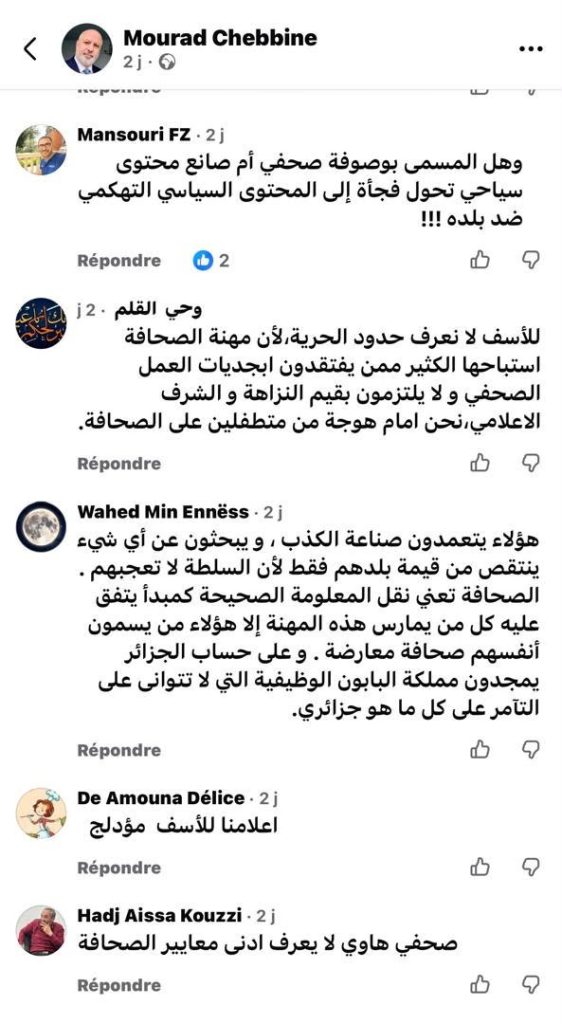
Is it freedom to publish dubious information about a case still before the courts in order to steer public opinion or influence the course of justice?

Has lying become a point of view, blackmail investigative journalism, defamation courage, and the violation of privacy a right?”

Chebine continued with uncompromising clarity:

“These questions do not require lengthy answers.

They require a constant reminder that freedom is not a privilege without limits.

Journalism is not built by turning platforms into courts, nor by using people’s reputations and private lives as fuel for scoops and sensationalism.
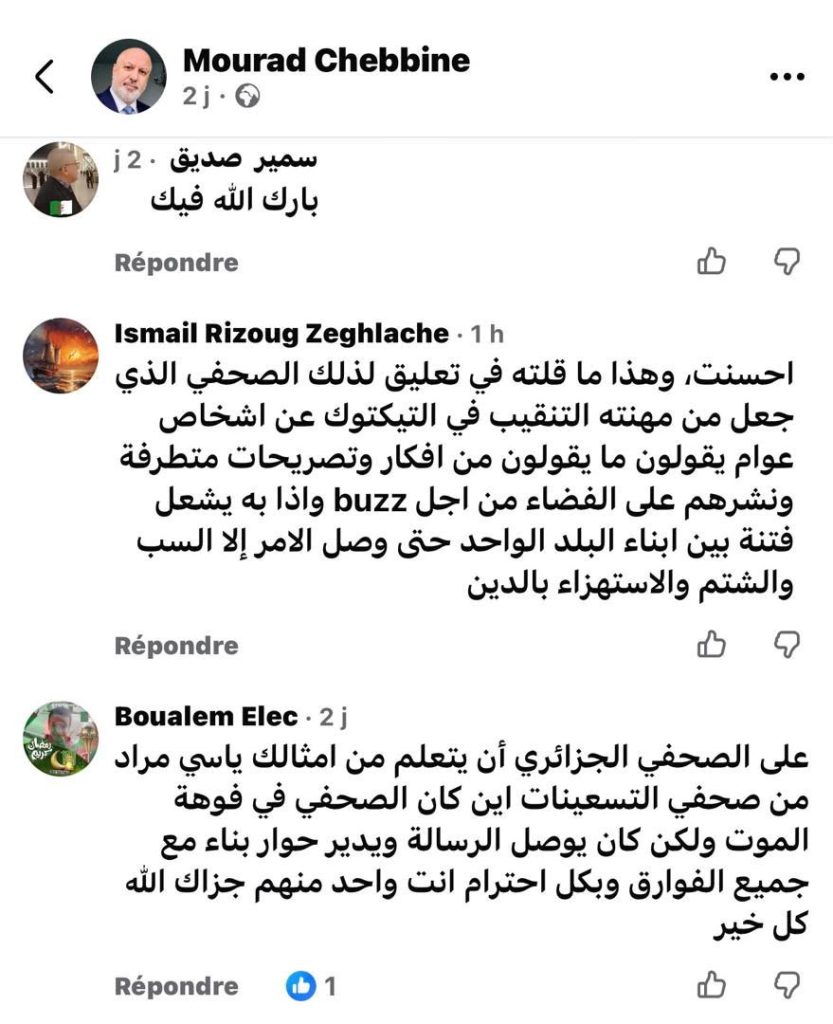
Freedom of expression does not mean inventing facts, spreading lies, manufacturing hatred, forging images and documents, or exploiting information for blackmail.”

He concluded with a line that cuts deep:

“These are not restrictions invented by any authority to muzzle journalists.

They are the most basic foundations of a press that understands its mission.

Professional ethics are not measured by what others do, but by what we ourselves have sworn to respect.

Governments change, laws change, balances of power shift.

One thing must never change: a journalist does not derive the honour of the profession from how far he is willing to go, but from how much he deliberately chooses not to cross.
There are lines that, once crossed, do not merely bring down journalism — they destroy the very meaning for which freedom was created.”

Chebine’s post was met with near-unanimous support from fellow journalists.

Mustapha Bounif Delivers the Final Blow

Influential journalist Mustapha Bounif finished the job with a video that leaves little room for escape.

He asked Boussoufa a simple, devastating question: where is the proof that the young man he interviewed in Ceuta was actually Algerian?
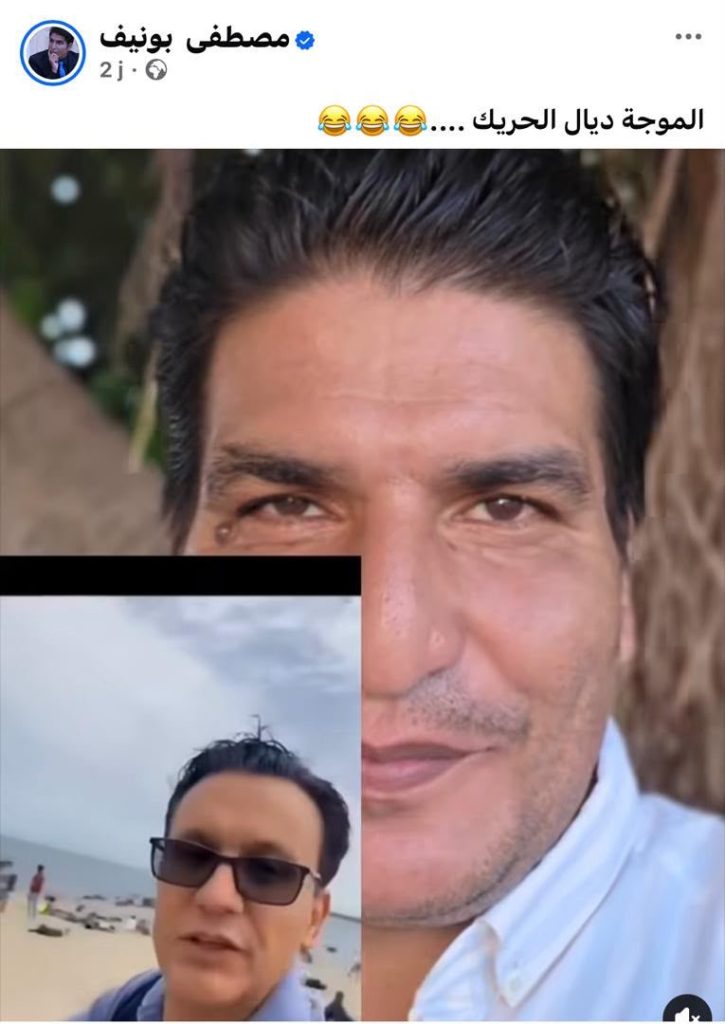
The man’s accent was unmistakably Moroccan.

The T-shirt he was wearing carried the word

“Casablanca” in Latin letters.

Bounif forced viewers to confront the obvious: why would an Algerian “harraga” wear a shirt bearing the name of a Moroccan city?

And would that detail have worked in his favour if Spain had decided to send him back with the rest of the group?

Boussoufa, it seems, never noticed.

A Journalist Against His Own Country

There is a reason this kind of coverage is possible.
When Moroccan authorities grant an Algerian journalist access to cover such a sensitive event on their soil, it is rarely an act of journalistic neutrality.

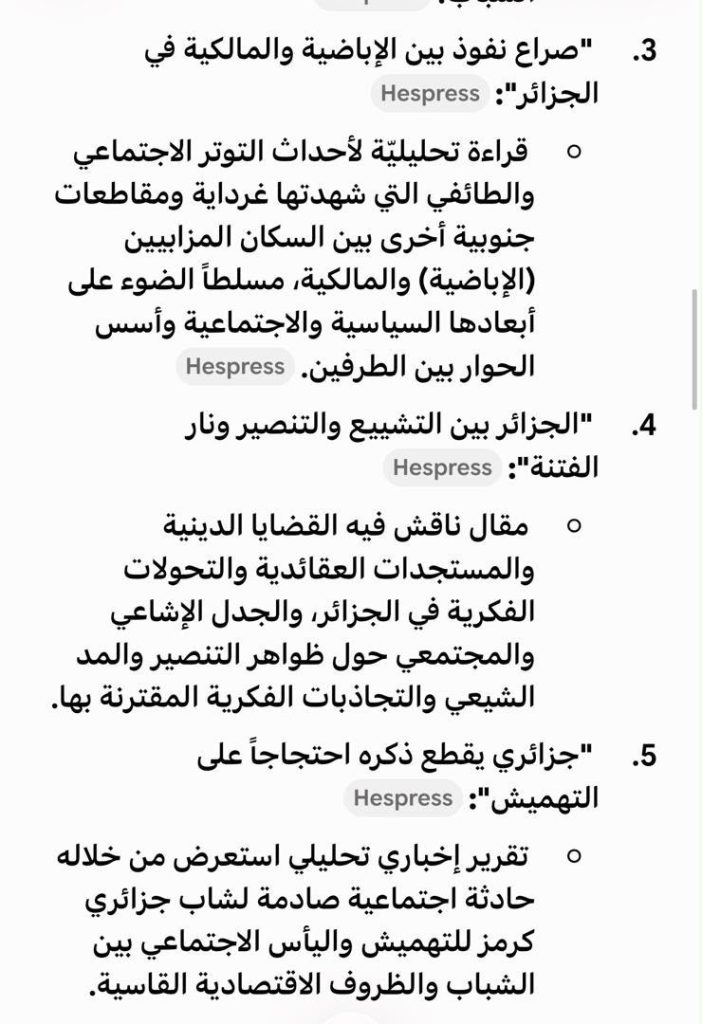
Boussoufa’s earlier work for Hespress between 2008 and 2010 particularly his articles on communal tensions in Algeria  already revealed a pattern of extreme hostility.

A journalist from the Mozabite community of Ghardaïa who left Algeria and then used hostile foreign platforms (Moroccan and French) to pour fuel on internal divisions is not a common occurrence.

In Boussoufa’s case, it appears unique.

There is a clear difference between a professional journalist and an unethical one.

The professional works within the rules, without tricks.

The other needs a certain cunning to obscure the absence of ethics and to confuse the public.

But that cunning rarely fools actual professionals.

In this case, it did not

#Algeria#Morocco
Author
بوابة الجزائر

Leave a comment

Your email address will not be published. Required fields are marked *

African coast
Share this post

Tebboune’s Southern Rail Vision: Algeria’s 2,400-Km Push into the Sahara

Tebboune’s Southern Rail Vision: Algeria’s 2,400-Km Push into the Sahara

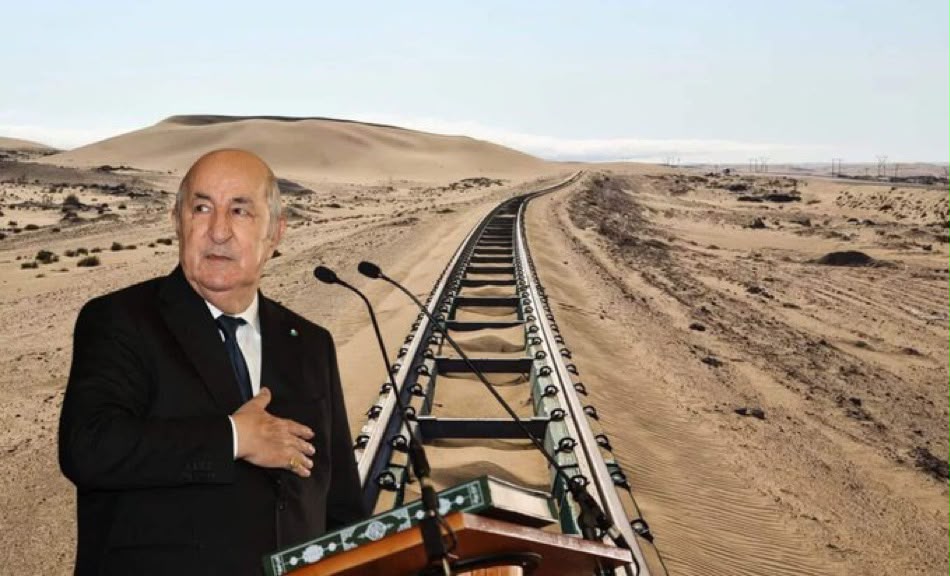
Algeria is moving ahead with one of the most ambitious infrastructure projects of President Abdelmadjid Tebboune’s development agenda: the extension of the national railway network deep into the country’s southern territories, culminating in Tamanrasset.

https://twitter.com/algatedzEng/status/2086425036554940795?s=20

The Algiers–Tamanrasset railway project is designed to connect the capital with the deep South through Laghouat, Ghardaia, El Meniaa, In Salah and Tamanrasset. President Tebboune announced that the line is expected to enter service by the end of 2028, placing the project at the heart of Algeria’s strategy to strengthen territorial integration and accelerate development in the Sahara.

A Railway Across 676 Kilometres of Desert

One of the most important sections is the In Salah–Tamanrasset segment, stretching 676 kilometres. It forms part of the broader railway corridor linking northern Algeria with Tamanrasset, which spans more than 2,400 kilometres across several sections. Another major section, between El Meniaa and In Salah, covers approximately 410 kilometres.

According to specifications published in Algeria’s Official Gazette on August 6, 2026, and confirmed in reporting by TSA-Algérie, the In Salah–Tamanrasset section is planned to include seven railway stations, 12 crossing stations and 26 viaducts, alongside major road and hydraulic structures.

Passenger trains are expected to reach speeds of up to 220 km/h, while freight trains could operate at speeds of around 100 km/h, giving the project both a passenger-transport and economic-logistics dimension.

More Than a Railway Project

For Tebboune, the railway is not simply about connecting distant cities. It is part of a broader vision aimed at integrating Algeria’s vast southern territory into the national economy.

The project is expected to facilitate the movement of people and goods, improve access to markets and services, and support investment in the South. The railway has also been described as a potential logistics corridor linking northern Algeria with its African hinterland, strengthening the country’s position as a continental transport hub.

The strategic importance becomes even clearer when viewed alongside Algeria’s other major southern infrastructure projects, particularly the Trans-Saharan Highway and the development of industrial, mining and agricultural activities across the Sahara.

Financing the Corridor: An African Development Partnership

The project’s financing strategy also highlights the importance of African financial institutions in Algeria’s long-term infrastructure plans.

On July 13, 2026, the African Development Bank’s Board approved a $878.09 million loan for the second phase of the Laghouat–Ghardaïa–El Meniaa railway line, covering the approximately 230-kilometre Ghardaïa–El Meniaa segment.

This follows a €747.32 million AfDB loan approved in December 2025 for the first phase of the project. Together, the two commitments represent major AfDB support for the development of the railway corridor.

According to the African Development Bank, the financing is aimed at supporting Algeria in building strategic railway infrastructure capable of driving economic transformation, territorial connectivity and regional integration.

The role of African development financing is particularly significant given President Tebboune’s longstanding position on foreign borrowing. While his government has maintained a cautious approach toward conventional external debt, Algeria has continued to pursue financing partnerships with African and multilateral institutions for major, long-term infrastructure projects.

Tebboune’s Bet on the Grand South

The railway reflects a central element of President Tebboune’s development approach: reducing the geographic and economic distance between Algeria’s northern population centres and its immense southern territory.

In April 2026, Tebboune’s decision to extend the railway toward Tamanrasset was welcomed in the region, with local residents describing the project as an opportunity to open a new phase of sustainable development.

Preparatory work has since accelerated. In June, the authorities announced preparations for the Ouargla–In Salah–Tamanrasset railway section, while a dedicated monitoring committee was established to oversee implementation.

With construction scheduled to begin by September 2026 at the latest, the project is emerging as one of the defining infrastructure bets of Tebboune’s second-term development agenda.

https://twitter.com/algatedzEng/status/2086184138969665740?s=20

From National Integration to African Connectivity

Ultimately, the Algiers–Tamanrasset railway could represent more than the extension of Algeria’s rail network into the Sahara.

By connecting the northern economic centres with the deep South, the project could create a stronger internal logistics chain while reinforcing Algeria’s geographic position as a gateway between the Mediterranean and sub-Saharan Africa.

The railway could also facilitate the movement of agricultural and mining products from southern production zones toward national and regional markets, while strengthening connections with the wider Trans-Saharan transport network.

For President Tebboune, the railway is therefore not merely a transport project. It is a strategic bet on the South and on Algeria’s future role as a continental economic and logistics hub.

Author
yasmine ouazib
Algeria
Share this post

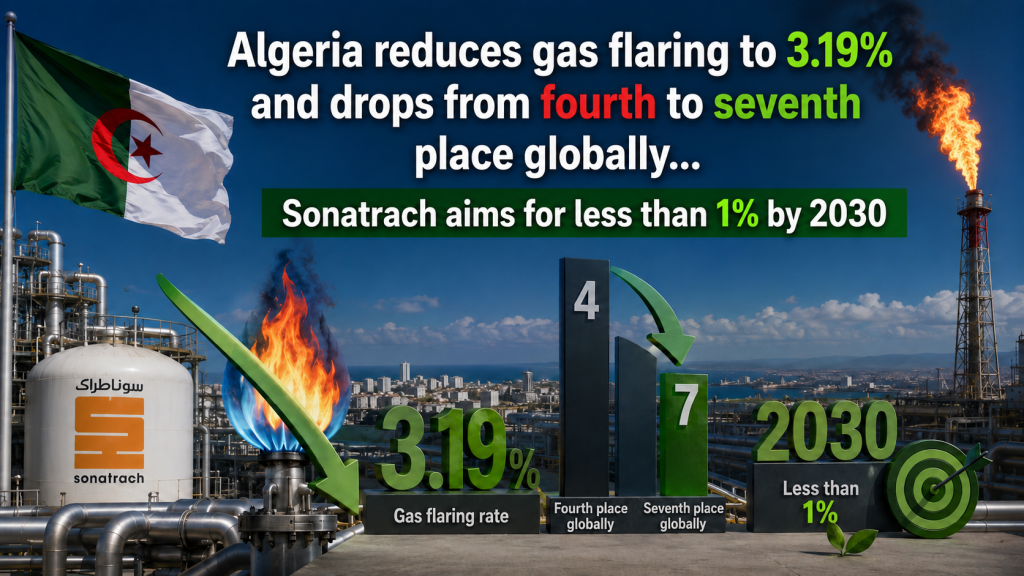
Algeria reduces gas flaring to 3.19% and drops from fourth to seventh place globally… Sonatrach aims for less than 1% by 2030

Algeria reduces gas flaring to 3.19% and drops from fourth to seventh place globally… Sonatrach aims for less than 1% by 2030

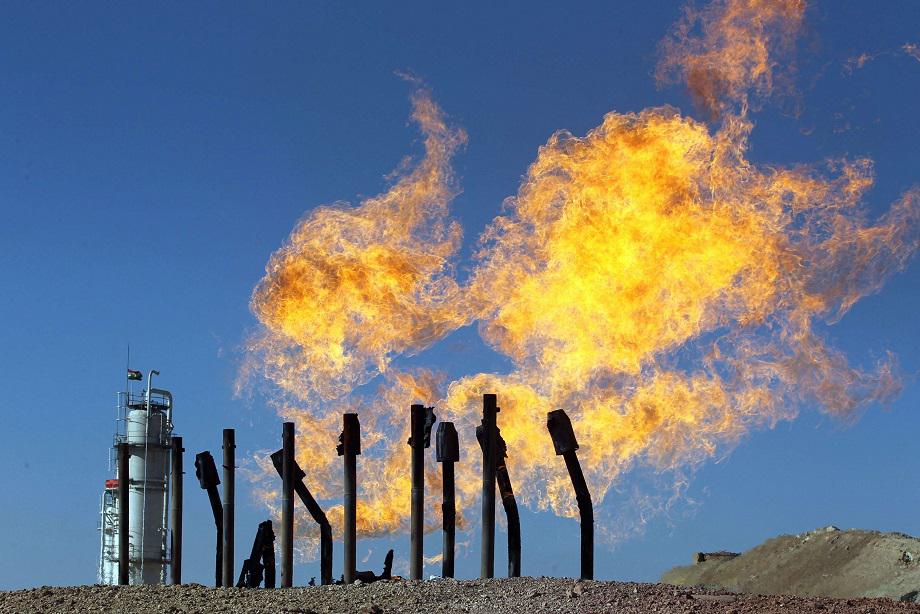
Algeria Gate: Sonatrach has reduced the associated gas flaring rate to 3.19%, compared with 5.43% in 2020. At the same time, Algeria improved its position on the list of the world’s largest gas-flaring countries, moving from fourth place in 2022 to seventh in 2025, according to the latest World Bank data. This reflects a continuous path of recovering gas and converting it from quantities wasted in flares into a resource that can be reinjected, consumed, or marketed.

This improvement runs counter to the global trend. The volume of gas flared worldwide rose for the third consecutive year, reaching 167 billion cubic metres in 2025, compared with 151 billion in 2024, 148 billion in 2023, and 139 billion in 2022.

The World Bank estimated the economic value of gas flared globally in 2025 at around $54 billion; an indicator that places the flaring issue within the equation of energy economic efficiency, not solely within environmental commitments and emissions reduction.

Sonatrach has set a more ambitious target for the next phase: reducing the flaring rate to less than 1% and eliminating routine flaring by 2030, as part of its commitment to the “Zero Routine Flaring by 2030” initiative led by the World Bank.

Algeria improves by three places in the global ranking

The Global Gas Flaring Tracker 2026 report showed that Algeria ranked seventh worldwide in the volume of associated gas flared during 2025, after Russia, Iran, Iraq, Venezuela, Mexico, and Libya, and ahead of Nigeria and the United States.

This position represents an improvement compared with 2022 data, when Algeria was the fourth-largest gas-flaring country globally after Russia, Iraq, and Iran.

This development takes on greater significance when placed within the trajectory of recent years. The World Bank recorded that Algeria achieved the largest global decline in gas flaring volume in 2023, for the third consecutive year of reduction.

Flaring intensity in Algeria also fell by around 3% that year, despite a roughly 2% decline in oil production. This means the improvement was not solely the result of lower production activity but was also linked to better gas recovery and reduced diversion to flares.

The World Bank ranking is not based solely on nationally announced figures; it relies on satellite monitoring in cooperation with the Payne Institute at the Colorado School of Mines.

The 2026 edition also introduced an improved methodology using data from three National Oceanic and Atmospheric Administration (NOAA) satellites, along with an updated flaring-sites database, allowing for more consistent measurement across countries.

The world flares more while Algeria moves in the opposite direction

International comparison highlights the distinctiveness of Algeria’s path in recent years.

While global flaring rose from 139 billion cubic metres in 2022 to 167 billion in 2025, Algeria continued to improve its ranking and reduce the flaring rate at Sonatrach facilities.

The nine largest gas-flaring countries accounted for about 83% of the global total in 2025, even though they represent less than half of world oil production.

The World Bank estimates that the investments required globally to eliminate routine flaring range between $70 billion and $100 billion. These investments relate to building compression and processing units, pipelines, power generation, and the necessary infrastructure to reuse the gas.

From this perspective, reducing flaring is not merely an environmental cost but an investment that allows a previously wasted resource to be converted into energy, feedstock, or additional volumes available for sale.

Sonatrach recovers gas instead of losing it

Sonatrach’s programme focuses on converting associated gas from the flare to economic use by building and operating recovery units in several production areas.

This path has reduced the flaring rate from 5.43% in 2020 to 3.19%, with a cumulative decline of about 28% compared with 2020 levels.

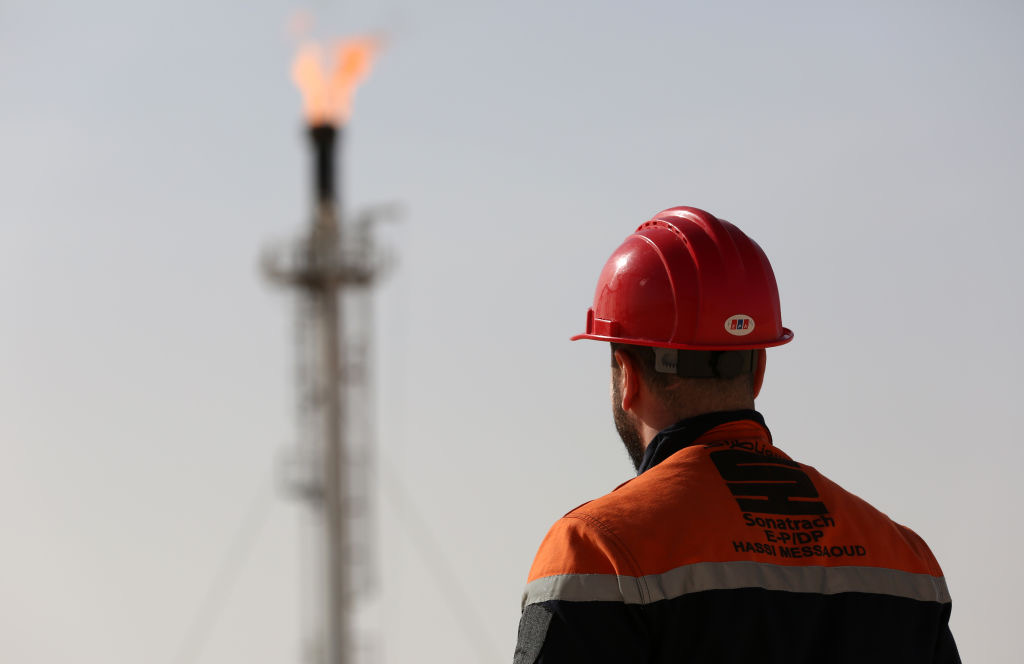
Projects have particularly covered the Hassi Messaoud and Ourhoud areas, where part of the gas previously sent to flaring is now recovered and redirected within the production system.

Recovered gas can be used in three main ways:
– The first is to process it and inject it into the gas network as additional volumes available for consumption or marketing.
– The second is to reinject it into reservoirs to support pressure and maintain production levels.
– The third is to use the gas as fuel within the oil and gas facilities themselves.

This diversity gives Sonatrach the ability to choose the most viable use according to the nature of the field, its location, the volume of available gas, and nearby infrastructure.

International study places Algeria among improvable gas-recovery cases

Sonatrach’s trajectory coincides with the publication in the journal Petroleum Research of an international scientific review titled:
“Advancing gas flaring mitigation: A comprehensive review of progress and future directions.”

The study carries the digital identifier DOI: 10.1016/j.ptlrs.2026.07.011 and reviews the development of research and technologies related to reducing gas flaring and recovering it over more than four decades.

The researchers relied on 359 studies published between 1981 and 2024 and indexed in the Scopus database, in addition to analysing 32 quantitative studies that addressed mathematical optimisation models between 2014 and 2024.

The analysis showed annual growth of 8.47% in studies related to gas flaring, with scientific interest gradually shifting from measuring emissions to determining the best way to recover gas and convert it into economic value.

The review included Algeria among the countries that have previously been subjected to quantitative models to determine the theoretical potential for reducing flaring and selecting the optimal use of associated gas.

A mathematical model estimates a theoretical reduction potential of 83.11%

The scientific review revisited a 2021 mathematical model that used the Inverse Data Envelopment Analysis methodology to estimate the maximum theoretical reduction possible in gas flaring for six producing countries.

For Algeria, the model estimated a theoretical reduction potential of 83.11%.
The figure was 78.35% for Indonesia, 91.62% for Iraq, 91.24% for Nigeria, 55.76% for the United Arab Emirates, and 95.06% for Venezuela.

The model also estimated the optimal size of a Gas-to-Wire system in Algeria as equivalent to eight turbine units—a technology that uses recovered gas to generate electricity directly instead of flaring it.

The original study estimated the potential to save a combined 36.11 billion cubic metres of gas across the six countries, with a potential return of up to $3.8 billion according to the prices and assumptions used when the model was prepared.

However, the 83.11% figure does not represent an official Sonatrach target or a forecast of the actual reduction volume in Algeria during 2026. It is a theoretical result that the new study presented again within a review of the mathematical tools used to analyse flaring-reduction alternatives.

The researchers also emphasised the need to compare these models with actual project data, investment costs, recovered gas volumes, and reduced emissions before adopting them as a basis for investment decisions.

Three pathways to convert flared gas into value

The review identifies three main technological options for utilising gas that was previously directed to flares.

The first is Gas-to-Wire, which converts gas into electricity using generation units or turbines near production sites.
The second is Gas-to-Liquids, which converts gas into transportable and consumable liquid products.
The third relies on compressing and processing the gas and connecting it to existing transport and consumption networks.

There is no single solution suitable for all fields, because the choice is determined by flow volume, gas composition, distance to the pipeline network and processing facilities, investment cost, and the markets to which the product can be directed.

Consequently, the decision to reduce flaring has become a matter of economic optimisation alongside the technical and environmental dimensions.

The study reviews the use of genetic algorithms, multi-objective optimisation, integer programming, and inverse analysis to identify the most profitable option.
Among the quantitative studies reviewed, ten used genetic algorithms, six used inverse DEA analysis, and three used integer programming.

Gas infrastructure gives Algeria an advantage in recovery

Algeria possesses an important element for implementing gas-recovery projects: the existence of a wide network for production, processing, transport, and liquefaction.

This infrastructure allows, in a number of areas, recovered gas to be directed to existing facilities rather than building an entirely new chain to dispose of it.

Recovered volumes can also be linked to domestic consumption, reinjection into reservoirs, or industrial activities, in addition to the possibility of including them in commercial volumes when technical and economic conditions are met.

This reduces the cost of some recovery projects compared with isolated sites that require long pipelines or independent processing and generation units.

This factor makes reducing flaring part of a broader strategy to raise the efficiency of the hydrocarbons chain by extracting greater value from every cubic metre produced.

Satellites enter the emissions-reduction system

Sonatrach has also incorporated digital monitoring into its climate programme by using satellite data to map methane emissions across the oil and gas chain.

It also applies leak detection and repair programmes, along with optical gas imaging cameras to detect leaks that are difficult to discover by traditional methods.

This approach intersects with the direction recommended by the new scientific review, which is based on integrating continuous measurement systems, data analysis, predictive models, and machine learning into the operation of gas-recovery units.

Real-time data improves estimation of gas flow and composition, selection of operating timing, and detection of any change in volumes, thereby raising unit efficiency and reducing losses.

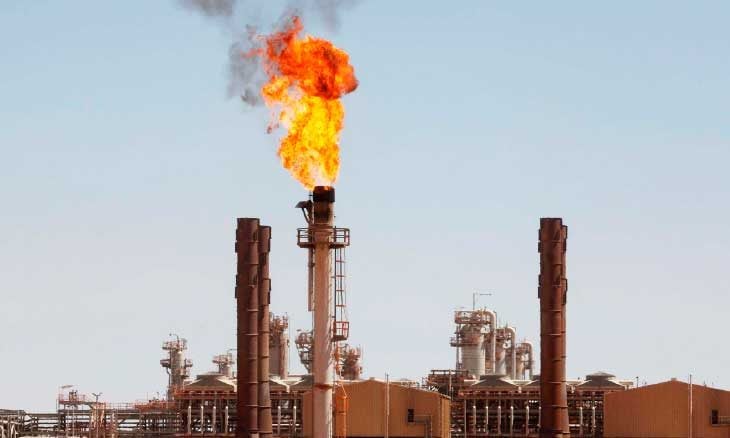
HGA Sud separation and compression center – Hassi Messaoud (Ouargla), affiliated with the Sonatrach group, in Algeria on February 22, 2023, this important center will have to produce 60,000 barrels of crude/day and almost 2 million m3 of natural gas, coming Fields located in the southern region of Hassi Messaoud, notably the fields of Hassi Tarfa, Hassi Dzabat and Hassi Guettar, this project, the cost of which is estimated at more than a billion dollar, benefits from the recovery of tied gas which are Sent to the fields of Hassi Messaoud to separate condensates, LPG and natural gas. (Photo by Billel Bensalem / App) (Photo by APP/NurPhoto via Getty Images)

From an environmental indicator to an economic resource

Algeria’s path reveals that the gas-flaring file has begun to shift from being treated as an environmental indicator to being regarded as part of energy-asset management.

Every quantity recovered instead of flared can be turned into electricity, fuel for facilities, gas reinjected to support production, or volumes added to the network.

This means that reducing flaring achieves dual gains: cutting emissions on the one hand, and recovering economic value that was previously lost in the flare on the other.

With the global value of flared gas reaching around $54 billion in 2025, recovery efficiency becomes a direct element in the competitiveness of oil and gas companies.

Sonatrach possesses an advantage in this field through the combination of production volume, transport networks, processing and liquefaction facilities, and the ability to redirect recovered gas toward several uses.

2030 is the decisive milestone

Algeria enters the next phase from a better position than it occupied years ago.

From fourth place globally in 2022, it moved to seventh in 2025, in parallel with the decline in Sonatrach’s flaring rate from 5.43% to 3.19%.

Algeria also recorded the largest global decline in flaring in 2023 and has continued to develop gas-recovery units, satellite monitoring, and leak-detection programmes.

The most important target over the next four years remains reducing the rate to less than 1% and eliminating routine flaring by 2030.

Achieving this will depend on expanding recovery units, linking production sites to appropriate infrastructure, and determining the most profitable use for every quantity of gas that can be saved from the flares.

Thus, seventh place alone does not reflect the full reality of Algeria’s path. The more significant indicator lies in the direction in which the country is moving: from the fourth-largest gas-flaring country in 2022 to seventh place in 2025, and from a rate of 5.43% to 3.19%, heading toward a target of less than 1%.

It is a transformation that places Algeria before an opportunity to convert one of the oldest sources of waste in the oil industry into an additional contributor to energy efficiency, production, and commercial value by the 2030 horizon.

#Algeria
Author
Lys Iwannughen
Algeria
Share this post

Algeria Takes Custody of German Citizen Kidnapped in Niger

Algeria Takes Custody of German Citizen Kidnapped in Niger

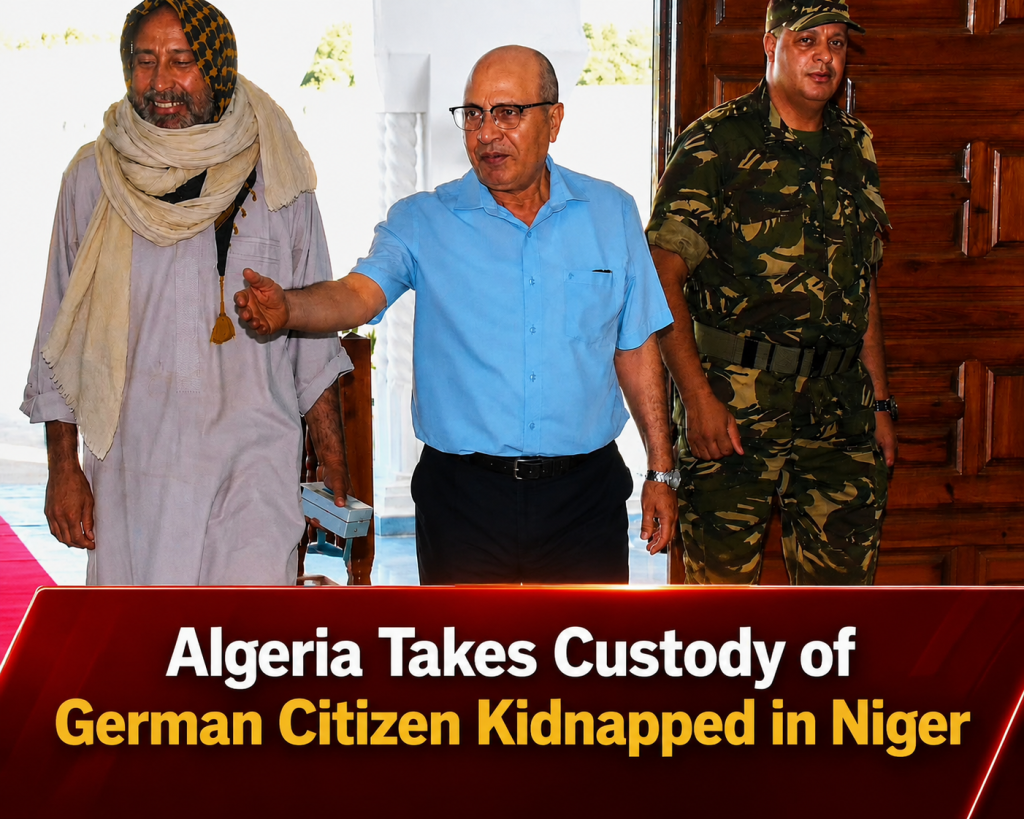
Algeria Gate: The Algerian Army’s security services received, yesterday evening (Friday), the German national “ULUMASKAN SINAN”, who had been in Niger, where he was kidnapped by an armed criminal group, according to a statement from the Algerian Ministry of National Defense.

The German national, who is currently in good health, was transported aboard a special aircraft from the secondary deployment base in In Guezzam (Sixth Military Region) to the air base in Boufarik (First Military Region). He will later be handed over to the German authorities.

https://twitter.com/mdnGovDz/status/2086129492536221890?s=20

In his statements, the German national recounted the circumstances of his kidnapping by the armed criminal group that held him for approximately two weeks. He also thanked the Algerian military authorities for the warm welcome and care he received, and expressed his sincere appreciation for the efforts made by the highest authorities of the country, headed by the President of the Republic, Supreme Commander of the Armed Forces and Minister of National Defense, to ensure his safe return to his homeland.

#Algeria
Author
Lys Iwannughen