
Sunday, 6 September 2026 12:59 Algiers time
Algeria Gate
News Room
$50B Revival: Algeria Spearheads Africa’s Economic Awakening Tiny Emirate Trapped by Hormuz, Continental Algeria’s Oil Crushes UAE’s Fragile India Bet 5.6 Million Cubic Meters per Day by 2030… Algeria Moves Desalination to the Heart of the Economy Algerian “INATEL” Enters the New Kinshasa City Project Covering 43,300 Hectares From VIP Glitter on Screens… to the Dark Shadows of Drug Networks! Tiny Companies, Astronomical Figures: AI Exposes $130 Billion Import Scam in Algeria Algeria Declares War on Cartels: Cutting Supply Lines and Choking Cash Flow After Algeria… Morocco tries to flood Spain with 3 tons of cocaine! Emirati fixer in Spain on a last-ditch bid to rescue Ayoub Aissiou! UAE falls into the trap… Algerian retaliation is coming hard! Algeria-Qatar’s Baladna project pumps $1.2 billion into the treasury every year… and buries the French import lobby!
Share this post

Spanish newspaper Moncloa: Morocco ranks among the world’s largest hashish producers and fuels international drug trafficking

Author: Lys Iwannughen 0 comments 69 views
Spanish newspaper Moncloa: Morocco ranks among the world’s largest hashish producers and fuels international drug trafficking

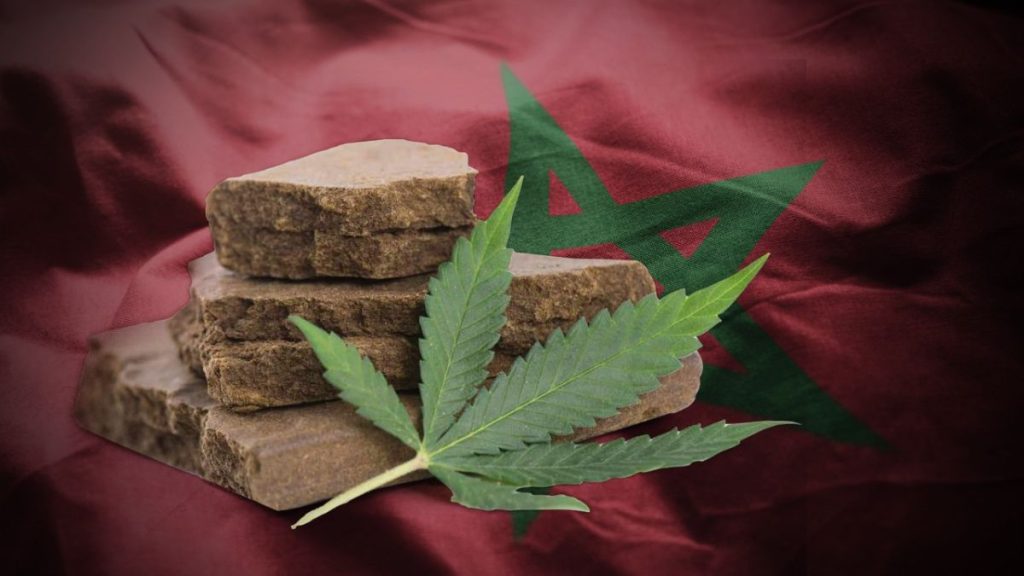
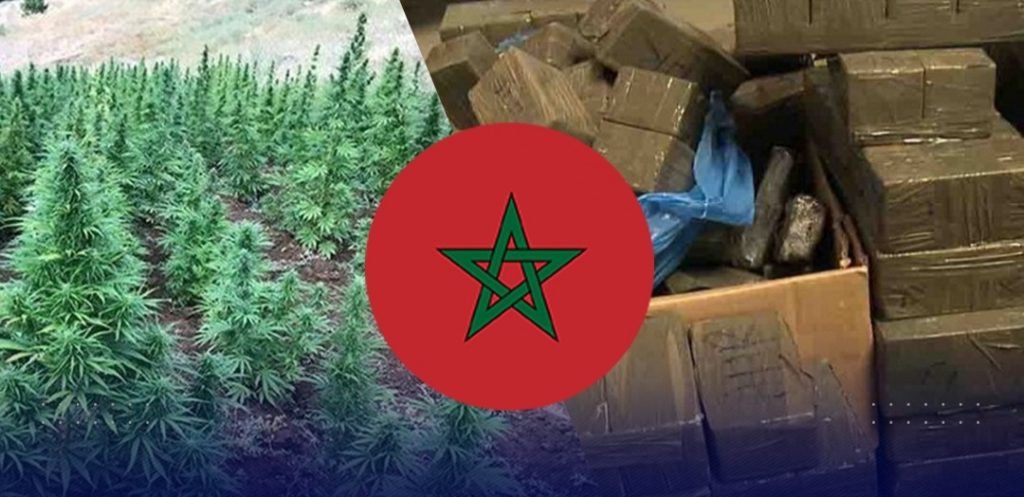
Algeria Gate: In a recent report, the Spanish newspaper Moncloa revealed that Morocco’s continued position as one of the world’s top hashish producers remains a major driver of international drug trafficking networks. The illicit trade, the report stresses, has significantly strengthened criminal gangs and expanded both their logistical reach and financial power.

Titled “How the disappearance of Spain’s anti-drug trafficking unit is affecting the situation,” the report notes that Morocco is still among the leading global producers of cannabis. As a result, the bulk of the hashish crossing the Strait of Gibraltar originates in the north of the kingdom, cementing Morocco’s role as a primary source of this illegal trade.
Oplus_131072

The newspaper points out that the Strait of Gibraltar: only 14 kilometres wide at its narrowest, has become a strategic corridor for Moroccan hashish. Criminal networks have since exploited the same logistical routes to smuggle other drugs, particularly cocaine, sharply increasing the scale of criminal activity linked to these Moroccan pathways.

According to the report, the enormous profits generated by Moroccan hashish have allowed criminal organisations to develop their capabilities on an unprecedented scale. They now operate with ultra-fast boats, advanced navigation systems, encrypted communications, and drones to monitor security forces. They can also rapidly replace seized equipment and recruit new members within a short time.

Moncloa further observes that these networks increasingly function like major corporations, managing complex financial operations and expanding money-laundering activities, all sustained by the vast revenues from the Moroccan hashish trade.

The expansion of this trade, the report adds, has entrenched the influence of criminal gangs in several Moroccan coastal areas. Visible signs of illicit enrichment and growing money-laundering networks point to the rise of a criminal economy built on drug trafficking from the kingdom.
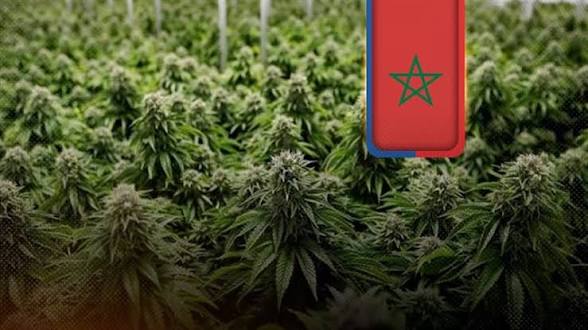
The newspaper notes that criminal organisations are no longer limited to smuggling hashish shipments from Morocco. They are continuously investing in technology and long-term planning, enabling them to refine their methods and broaden their criminal operations.

Moncloa concludes that as long as Morocco remains one of the world’s largest hashish producers, it will continue to feed international drug trafficking networks and flood countries with these drugs.


#Morocco
Author
Lys Iwannughen

Leave a comment

Your email address will not be published. Required fields are marked *

African coast
Share this post

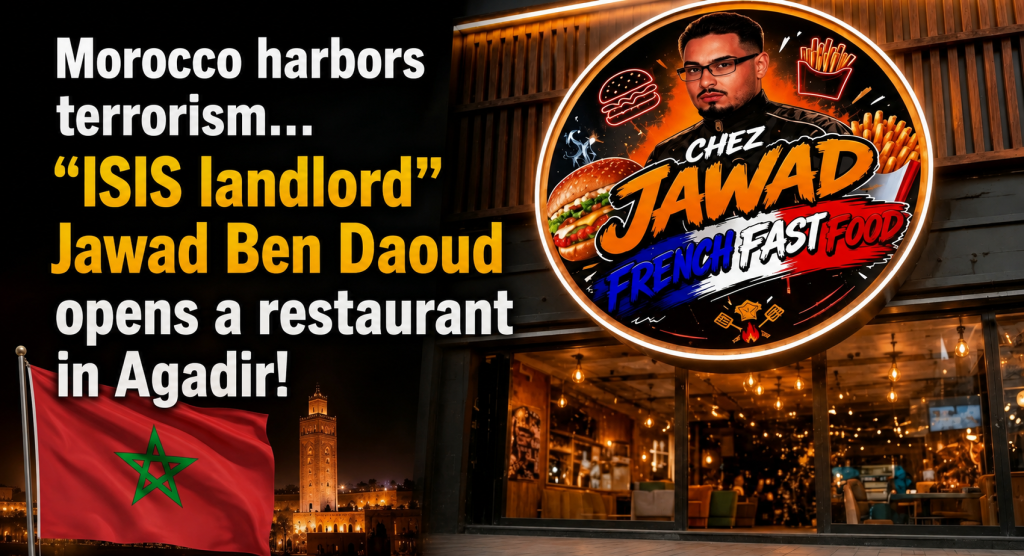
Morocco harbors terrorism… “ISIS landlord” Jawad Ben Daoud opens a restaurant in Agadir!

Morocco harbors terrorism… “ISIS landlord” Jawad Ben Daoud opens a restaurant in Agadir!

Algeria Gate: In a shocking scene from the heart of the Moroccan city of Agadir that illustrates the country’s transformation into a haven for criminals and terrorism, videos circulating on social media; and documented by the “Algeria Gate” platform, show the opening of a fast-food restaurant bearing the name and image of Jawad Ben Daoud.

The Frenchman of Moroccan origin, nicknamed the “ISIS landlord,” had rented an apartment to shelter two of the perpetrators of the 2015 terrorist attack in Saint-Denis, France, which left 130 people dead. Among them were the mastermind of the attack, Abdelhamid Abaaoud, and his accomplice Chakib Akrouh; both Belgians of Moroccan origin.

Jawad Ben Daoud was sentenced by the French courts to four years in prison for his proven involvement in sheltering terrorists on the run from justice.

#Morocco
Author
Lys Iwannughen
African coast
Share this post

Official Morocco Speaks of Security. Real Morocco Drowns in Fnideq.”

Official Morocco Speaks of Security. Real Morocco Drowns in Fnideq.”

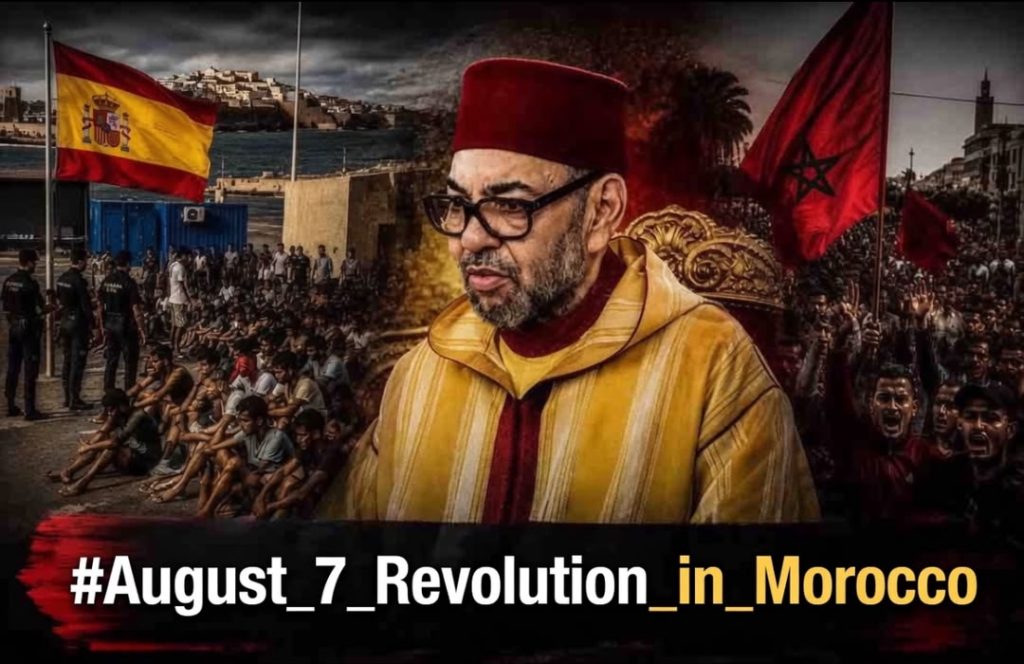
Just twenty four hours. That’s the gap that exposed the real distance between official rhetoric and lived reality in Morocco. On the evening of July 29, King Mohammed VI delivered his 27th Throne Day speech, touting 4.9% economic growth, a “good” agricultural season that reinforced “water and food security,” and a kingdom “admired by the world” for its “security, stability, and institutional efficiency.” Before the ink on that speech had dried, thousands of Moroccan families were fleeing on foot and swimming toward occupied Ceuta, escaping the very country just described as a rising model.

A Contradiction That Needs No Interpretation

The Throne speech spoke of a “trajectory of economic ascent,” “reinforcing national sovereignty,” and “strong capacity to confront disasters and crises.” But the real crisis that exploded in the state’s face hours later was not a natural flood requiring “proactive management” it was a human flood of despair: between 50,000 and 60,000 people crossed into Ceuta in under a day, including thousands of minors and families, amid a death toll approaching ninety according to Spanish sources, with Moroccan authorities still failing to issue a unified official count as of this writing.

https://twitter.com/algatedzEng/status/2083514107458687009?s=20

Where? is the “food security” the speech spoke of, in scenes of young men abandoning their motorbikes on Fnideq’s beaches, choosing the risk of drowning over staying? Where is “institutional efficiency” in an outright failure to even count the dead and missing days after the disaster? The royal speech spoke of growth nearing 5%, yet that growth did not translate into a horizon real enough to stop tens of thousands of Moroccans from choosing the sea over the homeland.

https://twitter.com/algatedzEng/status/2082826522780410317?s=20

At the same time, despite the speech’s praise for the “excellent organization of continental and international events” that “stirred envy among some,” renewed popular calls are hitting the streets under the banner “No to corruption, no to high prices, yes to change” revealing that the “envy” the speech speaks of is not necessarily admiration, but sometimes a question about the point of investing billions in an international façade while the interior burns.

Legitimay Isn’t Manufactured Through Speeches

The deeper paradox is that the speech itself framed “security and stability” as the foundation of “economic ascent.” But what stability is this, that drives broad segments of youth into collective, mortal risk-taking, while pushing others into the streets demanding change? When temporary graves in Tetouan and Fnideq intersect with voices chanting against high prices and corruption, the gap between the official narrative and lived reality can no longer be dressed up with macroeconomic figures.

https://twitter.com/algatedzEng/status/2084025367665238298?s=20

Ultimately

Official Morocco delivers speeches about ascent, while street-level Morocco drowns and protests. As long as the state keeps reading the crisis through the lens of grand achievements instead of acknowledging the depth of despair driving its children to flee or take to the streets, what is unfolding is not a passing crisis that another ceremonial speech can contain it is a marker of an accelerating collapse of a social contract that has already lost its power to persuade.

Author
yasmine ouazib
African coast
Share this post

Ceuta Drowns in Humanitarian Crisis While Official Morocco Exports Its Youth Instead of Employing Them

Ceuta Drowns in Humanitarian Crisis While Official Morocco Exports Its Youth Instead of Employing Them

Ceuta is facing unprecedented security alert after more than 1,500 Moroccan migrants swam into the Spanish enclave within just days a scene the city’s governor, Juan Jesús Vivas, bluntly called “a full-blown humanitarian and social emergency.” The official numbers no longer hide one uncomfortable truth: Morocco’s youth are fleeing their country with their bodies before the state can exhaust what’s left of them.

https://twitter.com/algatedzEng/status/2082827309325631671?s=20

Numbers That Leave No Room for Spin

Rights organizations have documented 2,826 arrivals in Ceuta since the start of 2026 alone a 149% surge over the same period last year, with land and sea routes toward Ceuta and Melilla combined jumping 140%. The human toll: between 17 and 26 confirmed drowning deaths this year, according to multiple sources a figure almost certainly lower than reality.

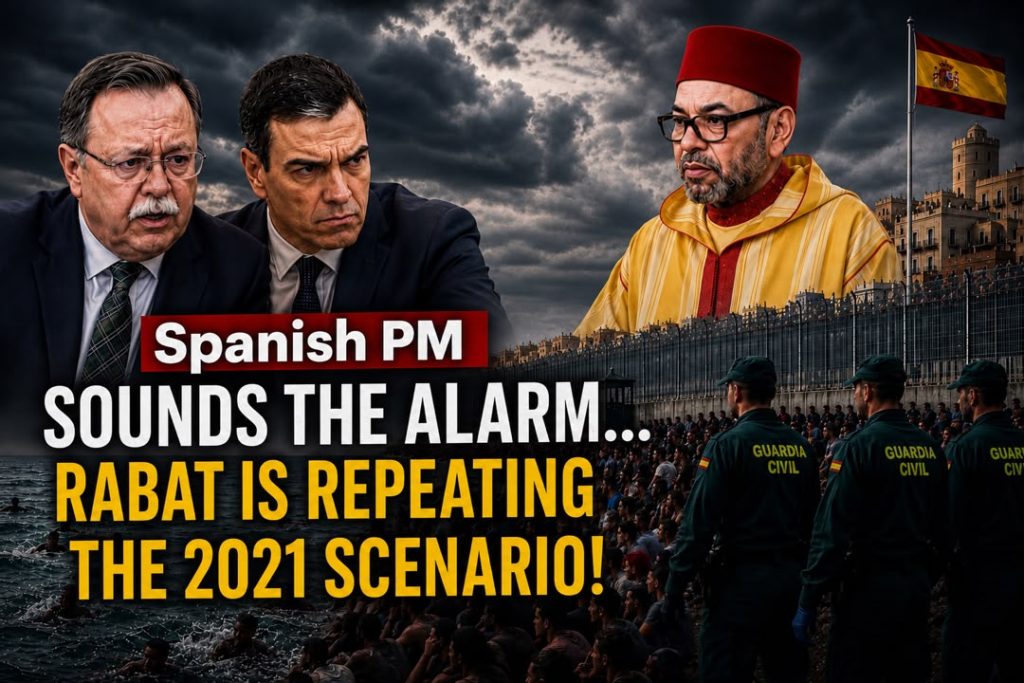
Ceuta’s own governor warned that if the current pace continues, the city risks a repeat of the May 2021 chaos. Reception centers, he said, are “completely overwhelmed and unable to take in more.” Yet Madrid refused Ceuta’s request to declare a national state of emergency, insisting the migrant surge poses no “threat to national security” a statement that exposes a jarring gap between the scale of the humanitarian catastrophe and the scale of the official response.

The Numbers Rabat’s Rhetoric Won’t Confront

While Spain’s Interior Ministry keeps issuing statements praising “ideal cooperation” with Rabat on returns, the essential question goes unanswered: why are thousands of young Moroccans choosing to risk their lives swimming across the Strait of Gibraltar rather than staying home?

https://twitter.com/algatedzEng/status/2082821383499792549?s=20

The answer sits in the Moroccan state’s own statistics agency, the High Commission for Planning. Youth unemployment for ages 15–24 is nearing 40%. Urban unemployment tops 17%. And the most damning figure of all: over 82% of Moroccan households report their living conditions have deteriorated in recent years. These aren’t opposition talking points or hostile propaganda they’re the Moroccan state’s own numbers.

This is the backdrop producing the scenes at Fnideq and Belyounech: minors and young adults abandoning school because there is no job waiting for them, then turning to the sea as the only “exit” from a reality where the state has shut every other door.

A Policy That Manages the Crisis Instead of Fixing Its Roots

Rabat treats migration as a bargaining chip with Madrid and Brussels far more than it treats it as a domestic development failure. Today’s security coordination between Morocco and Spain to return “all migrants who entered Ceuta” addresses the symptom, not the cause it sends these young people straight back into the same economic and social conditions that pushed them to risk their lives in the first place.

While the official establishment celebrates its national milestones, the reality on the streets of Fnideq, Belyounech, and Tetouan remains worlds away from the rhetoric of a “rising Morocco.” The gap between the official poverty and unemployment figures and the state’s narrative of ascent is the exact same gap these young people swim across every week.

The Ceuta crisis is not a passing migration story. It is the invoice for development policies that never reached the margins a bill now being paid in the bodies of young people who would rather risk drowning than face a future with no horizon.

Author
yasmine ouazib