

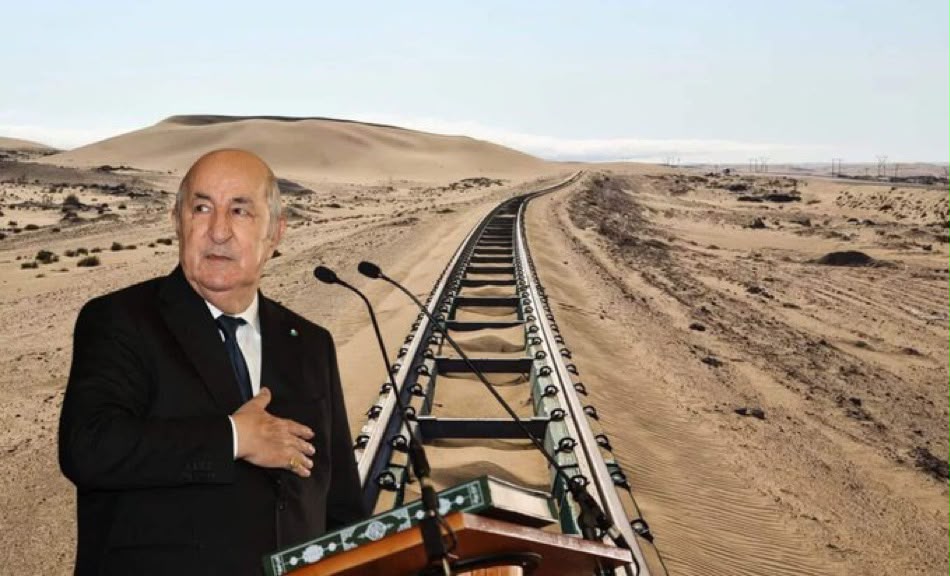
Algeria is moving ahead with one of the most ambitious infrastructure projects of President Abdelmadjid Tebboune’s development agenda: the extension of the national railway network deep into the country’s southern territories, culminating in Tamanrasset.
The Algiers–Tamanrasset railway project is designed to connect the capital with the deep South through Laghouat, Ghardaia, El Meniaa, In Salah and Tamanrasset. President Tebboune announced that the line is expected to enter service by the end of 2028, placing the project at the heart of Algeria’s strategy to strengthen territorial integration and accelerate development in the Sahara.
A Railway Across 676 Kilometres of Desert
One of the most important sections is the In Salah–Tamanrasset segment, stretching 676 kilometres. It forms part of the broader railway corridor linking northern Algeria with Tamanrasset, which spans more than 2,400 kilometres across several sections. Another major section, between El Meniaa and In Salah, covers approximately 410 kilometres.
According to specifications published in Algeria’s Official Gazette on August 6, 2026, and confirmed in reporting by TSA-Algérie, the In Salah–Tamanrasset section is planned to include seven railway stations, 12 crossing stations and 26 viaducts, alongside major road and hydraulic structures.
Passenger trains are expected to reach speeds of up to 220 km/h, while freight trains could operate at speeds of around 100 km/h, giving the project both a passenger-transport and economic-logistics dimension.
More Than a Railway Project
For Tebboune, the railway is not simply about connecting distant cities. It is part of a broader vision aimed at integrating Algeria’s vast southern territory into the national economy.
The project is expected to facilitate the movement of people and goods, improve access to markets and services, and support investment in the South. The railway has also been described as a potential logistics corridor linking northern Algeria with its African hinterland, strengthening the country’s position as a continental transport hub.
The strategic importance becomes even clearer when viewed alongside Algeria’s other major southern infrastructure projects, particularly the Trans-Saharan Highway and the development of industrial, mining and agricultural activities across the Sahara.
Financing the Corridor: An African Development Partnership
The project’s financing strategy also highlights the importance of African financial institutions in Algeria’s long-term infrastructure plans.
On July 13, 2026, the African Development Bank’s Board approved a $878.09 million loan for the second phase of the Laghouat–Ghardaïa–El Meniaa railway line, covering the approximately 230-kilometre Ghardaïa–El Meniaa segment.
This follows a €747.32 million AfDB loan approved in December 2025 for the first phase of the project. Together, the two commitments represent major AfDB support for the development of the railway corridor.
According to the African Development Bank, the financing is aimed at supporting Algeria in building strategic railway infrastructure capable of driving economic transformation, territorial connectivity and regional integration.
The role of African development financing is particularly significant given President Tebboune’s longstanding position on foreign borrowing. While his government has maintained a cautious approach toward conventional external debt, Algeria has continued to pursue financing partnerships with African and multilateral institutions for major, long-term infrastructure projects.
Tebboune’s Bet on the Grand South
The railway reflects a central element of President Tebboune’s development approach: reducing the geographic and economic distance between Algeria’s northern population centres and its immense southern territory.
In April 2026, Tebboune’s decision to extend the railway toward Tamanrasset was welcomed in the region, with local residents describing the project as an opportunity to open a new phase of sustainable development.
Preparatory work has since accelerated. In June, the authorities announced preparations for the Ouargla–In Salah–Tamanrasset railway section, while a dedicated monitoring committee was established to oversee implementation.
With construction scheduled to begin by September 2026 at the latest, the project is emerging as one of the defining infrastructure bets of Tebboune’s second-term development agenda.
From National Integration to African Connectivity
Ultimately, the Algiers–Tamanrasset railway could represent more than the extension of Algeria’s rail network into the Sahara.
By connecting the northern economic centres with the deep South, the project could create a stronger internal logistics chain while reinforcing Algeria’s geographic position as a gateway between the Mediterranean and sub-Saharan Africa.
The railway could also facilitate the movement of agricultural and mining products from southern production zones toward national and regional markets, while strengthening connections with the wider Trans-Saharan transport network.
For President Tebboune, the railway is therefore not merely a transport project. It is a strategic bet on the South and on Algeria’s future role as a continental economic and logistics hub.