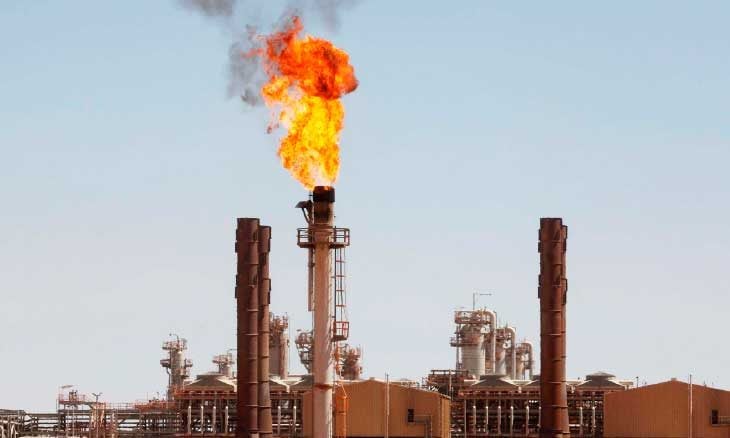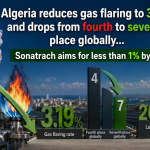


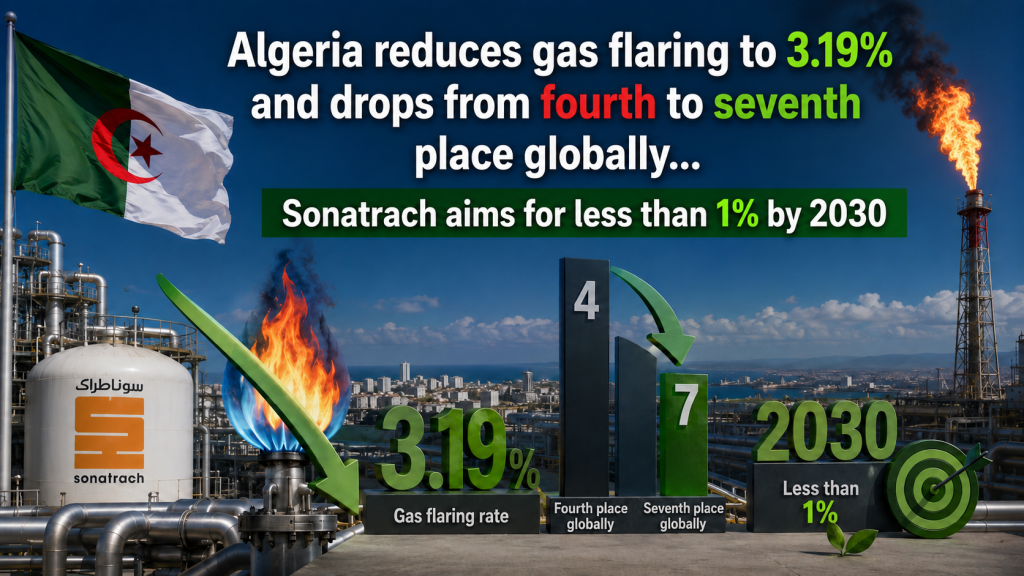
Algeria Gate: Sonatrach has reduced the associated gas flaring rate to 3.19%, compared with 5.43% in 2020. At the same time, Algeria improved its position on the list of the world’s largest gas-flaring countries, moving from fourth place in 2022 to seventh in 2025, according to the latest World Bank data. This reflects a continuous path of recovering gas and converting it from quantities wasted in flares into a resource that can be reinjected, consumed, or marketed.
This improvement runs counter to the global trend. The volume of gas flared worldwide rose for the third consecutive year, reaching 167 billion cubic metres in 2025, compared with 151 billion in 2024, 148 billion in 2023, and 139 billion in 2022.
The World Bank estimated the economic value of gas flared globally in 2025 at around $54 billion; an indicator that places the flaring issue within the equation of energy economic efficiency, not solely within environmental commitments and emissions reduction.
Sonatrach has set a more ambitious target for the next phase: reducing the flaring rate to less than 1% and eliminating routine flaring by 2030, as part of its commitment to the “Zero Routine Flaring by 2030” initiative led by the World Bank.
Algeria improves by three places in the global ranking
The Global Gas Flaring Tracker 2026 report showed that Algeria ranked seventh worldwide in the volume of associated gas flared during 2025, after Russia, Iran, Iraq, Venezuela, Mexico, and Libya, and ahead of Nigeria and the United States.
This position represents an improvement compared with 2022 data, when Algeria was the fourth-largest gas-flaring country globally after Russia, Iraq, and Iran.
This development takes on greater significance when placed within the trajectory of recent years. The World Bank recorded that Algeria achieved the largest global decline in gas flaring volume in 2023, for the third consecutive year of reduction.
Flaring intensity in Algeria also fell by around 3% that year, despite a roughly 2% decline in oil production. This means the improvement was not solely the result of lower production activity but was also linked to better gas recovery and reduced diversion to flares.
The World Bank ranking is not based solely on nationally announced figures; it relies on satellite monitoring in cooperation with the Payne Institute at the Colorado School of Mines.
The 2026 edition also introduced an improved methodology using data from three National Oceanic and Atmospheric Administration (NOAA) satellites, along with an updated flaring-sites database, allowing for more consistent measurement across countries.
The world flares more while Algeria moves in the opposite direction
International comparison highlights the distinctiveness of Algeria’s path in recent years.
While global flaring rose from 139 billion cubic metres in 2022 to 167 billion in 2025, Algeria continued to improve its ranking and reduce the flaring rate at Sonatrach facilities.
The nine largest gas-flaring countries accounted for about 83% of the global total in 2025, even though they represent less than half of world oil production.
The World Bank estimates that the investments required globally to eliminate routine flaring range between $70 billion and $100 billion. These investments relate to building compression and processing units, pipelines, power generation, and the necessary infrastructure to reuse the gas.
From this perspective, reducing flaring is not merely an environmental cost but an investment that allows a previously wasted resource to be converted into energy, feedstock, or additional volumes available for sale.
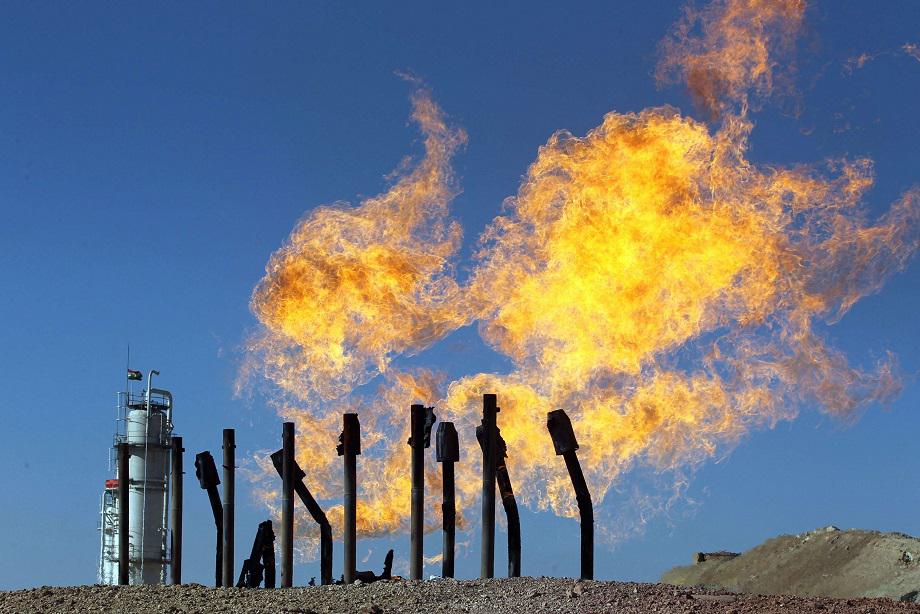
Sonatrach recovers gas instead of losing it
Sonatrach’s programme focuses on converting associated gas from the flare to economic use by building and operating recovery units in several production areas.
This path has reduced the flaring rate from 5.43% in 2020 to 3.19%, with a cumulative decline of about 28% compared with 2020 levels.
Projects have particularly covered the Hassi Messaoud and Ourhoud areas, where part of the gas previously sent to flaring is now recovered and redirected within the production system.
Recovered gas can be used in three main ways:
– The first is to process it and inject it into the gas network as additional volumes available for consumption or marketing.
– The second is to reinject it into reservoirs to support pressure and maintain production levels.
– The third is to use the gas as fuel within the oil and gas facilities themselves.
This diversity gives Sonatrach the ability to choose the most viable use according to the nature of the field, its location, the volume of available gas, and nearby infrastructure.
International study places Algeria among improvable gas-recovery cases
Sonatrach’s trajectory coincides with the publication in the journal Petroleum Research of an international scientific review titled:
“Advancing gas flaring mitigation: A comprehensive review of progress and future directions.”
The study carries the digital identifier DOI: 10.1016/j.ptlrs.2026.07.011 and reviews the development of research and technologies related to reducing gas flaring and recovering it over more than four decades.
The researchers relied on 359 studies published between 1981 and 2024 and indexed in the Scopus database, in addition to analysing 32 quantitative studies that addressed mathematical optimisation models between 2014 and 2024.
The analysis showed annual growth of 8.47% in studies related to gas flaring, with scientific interest gradually shifting from measuring emissions to determining the best way to recover gas and convert it into economic value.
The review included Algeria among the countries that have previously been subjected to quantitative models to determine the theoretical potential for reducing flaring and selecting the optimal use of associated gas.
A mathematical model estimates a theoretical reduction potential of 83.11%
The scientific review revisited a 2021 mathematical model that used the Inverse Data Envelopment Analysis methodology to estimate the maximum theoretical reduction possible in gas flaring for six producing countries.
For Algeria, the model estimated a theoretical reduction potential of 83.11%.
The figure was 78.35% for Indonesia, 91.62% for Iraq, 91.24% for Nigeria, 55.76% for the United Arab Emirates, and 95.06% for Venezuela.
The model also estimated the optimal size of a Gas-to-Wire system in Algeria as equivalent to eight turbine units—a technology that uses recovered gas to generate electricity directly instead of flaring it.
The original study estimated the potential to save a combined 36.11 billion cubic metres of gas across the six countries, with a potential return of up to $3.8 billion according to the prices and assumptions used when the model was prepared.
However, the 83.11% figure does not represent an official Sonatrach target or a forecast of the actual reduction volume in Algeria during 2026. It is a theoretical result that the new study presented again within a review of the mathematical tools used to analyse flaring-reduction alternatives.
The researchers also emphasised the need to compare these models with actual project data, investment costs, recovered gas volumes, and reduced emissions before adopting them as a basis for investment decisions.
Three pathways to convert flared gas into value
The review identifies three main technological options for utilising gas that was previously directed to flares.
The first is Gas-to-Wire, which converts gas into electricity using generation units or turbines near production sites.
The second is Gas-to-Liquids, which converts gas into transportable and consumable liquid products.
The third relies on compressing and processing the gas and connecting it to existing transport and consumption networks.
There is no single solution suitable for all fields, because the choice is determined by flow volume, gas composition, distance to the pipeline network and processing facilities, investment cost, and the markets to which the product can be directed.
Consequently, the decision to reduce flaring has become a matter of economic optimisation alongside the technical and environmental dimensions.
The study reviews the use of genetic algorithms, multi-objective optimisation, integer programming, and inverse analysis to identify the most profitable option.
Among the quantitative studies reviewed, ten used genetic algorithms, six used inverse DEA analysis, and three used integer programming.
Gas infrastructure gives Algeria an advantage in recovery
Algeria possesses an important element for implementing gas-recovery projects: the existence of a wide network for production, processing, transport, and liquefaction.
This infrastructure allows, in a number of areas, recovered gas to be directed to existing facilities rather than building an entirely new chain to dispose of it.
Recovered volumes can also be linked to domestic consumption, reinjection into reservoirs, or industrial activities, in addition to the possibility of including them in commercial volumes when technical and economic conditions are met.
This reduces the cost of some recovery projects compared with isolated sites that require long pipelines or independent processing and generation units.
This factor makes reducing flaring part of a broader strategy to raise the efficiency of the hydrocarbons chain by extracting greater value from every cubic metre produced.
Satellites enter the emissions-reduction system
Sonatrach has also incorporated digital monitoring into its climate programme by using satellite data to map methane emissions across the oil and gas chain.
It also applies leak detection and repair programmes, along with optical gas imaging cameras to detect leaks that are difficult to discover by traditional methods.
This approach intersects with the direction recommended by the new scientific review, which is based on integrating continuous measurement systems, data analysis, predictive models, and machine learning into the operation of gas-recovery units.
Real-time data improves estimation of gas flow and composition, selection of operating timing, and detection of any change in volumes, thereby raising unit efficiency and reducing losses.
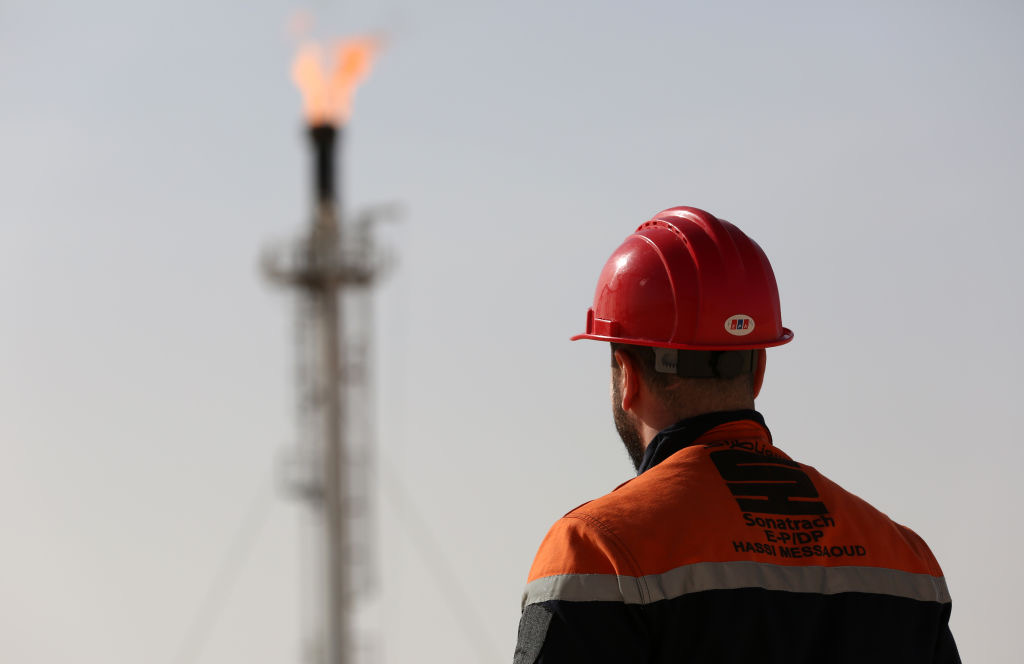
From an environmental indicator to an economic resource
Algeria’s path reveals that the gas-flaring file has begun to shift from being treated as an environmental indicator to being regarded as part of energy-asset management.
Every quantity recovered instead of flared can be turned into electricity, fuel for facilities, gas reinjected to support production, or volumes added to the network.
This means that reducing flaring achieves dual gains: cutting emissions on the one hand, and recovering economic value that was previously lost in the flare on the other.
With the global value of flared gas reaching around $54 billion in 2025, recovery efficiency becomes a direct element in the competitiveness of oil and gas companies.
Sonatrach possesses an advantage in this field through the combination of production volume, transport networks, processing and liquefaction facilities, and the ability to redirect recovered gas toward several uses.
2030 is the decisive milestone
Algeria enters the next phase from a better position than it occupied years ago.
From fourth place globally in 2022, it moved to seventh in 2025, in parallel with the decline in Sonatrach’s flaring rate from 5.43% to 3.19%.
Algeria also recorded the largest global decline in flaring in 2023 and has continued to develop gas-recovery units, satellite monitoring, and leak-detection programmes.
The most important target over the next four years remains reducing the rate to less than 1% and eliminating routine flaring by 2030.
Achieving this will depend on expanding recovery units, linking production sites to appropriate infrastructure, and determining the most profitable use for every quantity of gas that can be saved from the flares.
Thus, seventh place alone does not reflect the full reality of Algeria’s path. The more significant indicator lies in the direction in which the country is moving: from the fourth-largest gas-flaring country in 2022 to seventh place in 2025, and from a rate of 5.43% to 3.19%, heading toward a target of less than 1%.
It is a transformation that places Algeria before an opportunity to convert one of the oldest sources of waste in the oil industry into an additional contributor to energy efficiency, production, and commercial value by the 2030 horizon.