


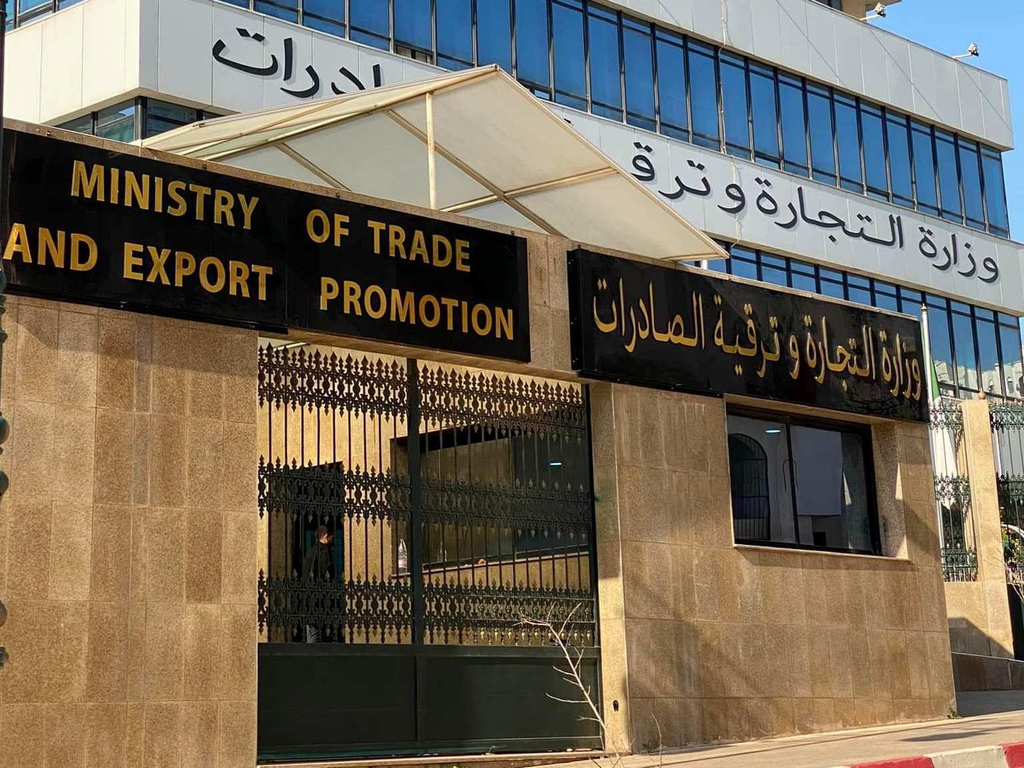
Algeria Gate: Processing of the estimated import program files for the second half of 2026 revealed that 3,961 economic operators, employing between zero and five workers, submitted import requests totaling $130.32 billion, according to a statement issued Saturday, by the Ministry of Foreign Trade and Export Promotion.
The ministry explained that these data, extracted from the digital platform for importing raw materials and production inputs, raise questions about the proportionality of some declared import estimates with the size of the institutions concerned and the number of workers declared.
In detail, the data indicate that 149 operators employing no workers submitted import requests totaling $48,458 million, while 949 operators employing one worker submitted requests worth $21.84 billion.
The value of import requests submitted by 851 operators employing two workers reached $88.76 billion, $15.52 billion for 722 operators employing three workers, and $1.74 billion for 641 operators employing four workers, while the value of requests submitted by 649 operators employing five workers reached $13.84 billion.
In this context, the Ministry of Foreign Trade and Export Promotion decided to open an investigation, in coordination with the relevant ministerial sectors, to audit the raw materials, production inputs, and equipment imported by these institutions during the first half of 2026 and previous years.

According to the ministry, the audit operations will cover the conformity of imported quantities and values with the nature of the declared activity, actual production capacities, and the number of declared workers, in addition to the actual economic activity volume of the institutions concerned.
The ministry stressed that the estimated nature of import programs does not mean that the estimates should be detached from the economic reality of the institution or disproportionate to its actual capacities and needs, noting that appropriate measures will be taken based on the results of the investigation and audit in accordance with the applicable legislation and regulations.
On the other hand, the digital platform, supported by artificial intelligence technologies, detected patterns that the ministry considered “unusual” in the declaration of workers at some of the institutions concerned, particularly the recording of worker declarations during periods coinciding with the stages of opening and submitting estimated import programs.
Data analysis showed that a number of institutions declared to the National Social Security Fund for Salaried Workers a number of workers during the period from January to March 31st 2026, before recording no worker declarations during the months of April, May, and June, then recording new worker declarations from July 1st to September 30th 2026, the period that coincides with the stages of submitting and studying estimated import programs.
The ministry announced in this regard the opening of an investigation into these cases and the taking of the necessary measures in light of the results of the investigation operations, in accordance with the applicable laws and regulations.