Monday, 23 November 2026 • 21:16 Algiers time
Algeria Gate
Share this post

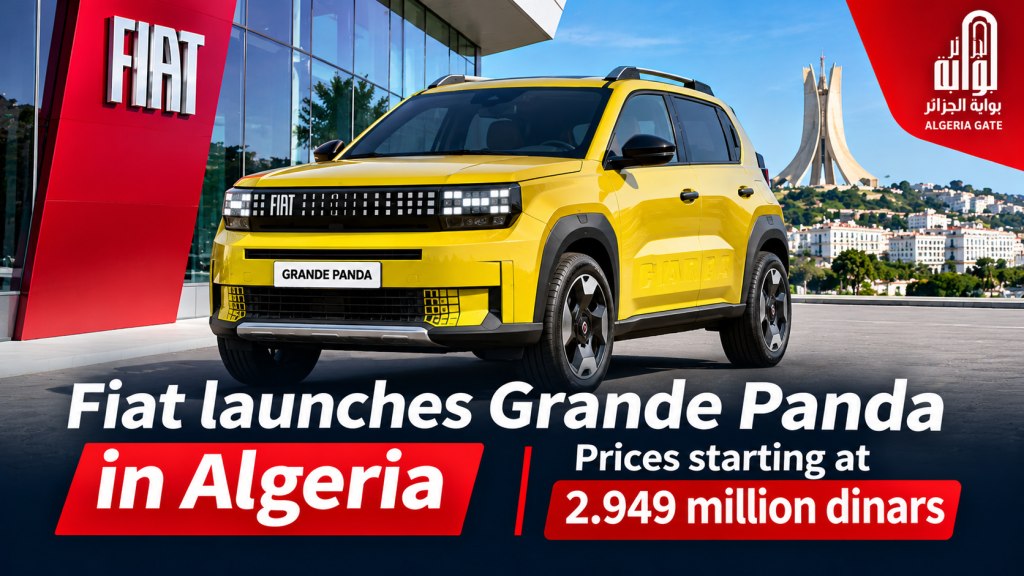
Fiat launches Grande Panda in Algeria, with prices starting at 2.949 million dinars

• Author: Y.R • 0 comments • 3 views
Fiat launches Grande Panda in Algeria, with prices starting at 2.949 million dinars

Algeria Gate: Fiat has launched the Grande Panda in Algeria, with prices starting at 2.949 million dinars, equivalent to 294.9 million centimes. The vehicle is manufactured at the Tafraoui plant in Oran and assembled locally using the CKD (Completely Knocked Down) system.

According to the company, the Grande Panda is among the first passenger cars manufactured in Algeria under this assembly system, with a local integration rate exceeding 20%.

The Grande Panda belongs to the B-segment category and is the first model in the Smart Car family developed by Stellantis. It is equipped with a 1.2-litre petrol engine producing 72 horsepower, paired with a five-speed manual gearbox.

The vehicle will be available in two trim levels, Pop and La Prima, with colour options including Lago Blue and Gelato White.

The launch marks another step in Fiat’s expansion of its locally manufactured vehicle lineup, as Algeria continues to encourage domestic automotive production and increase local integration in the industry.

#Algeria#Economy
Author

Leave a comment

Your email address will not be published. Required fields are marked *

Algeria
Share this post

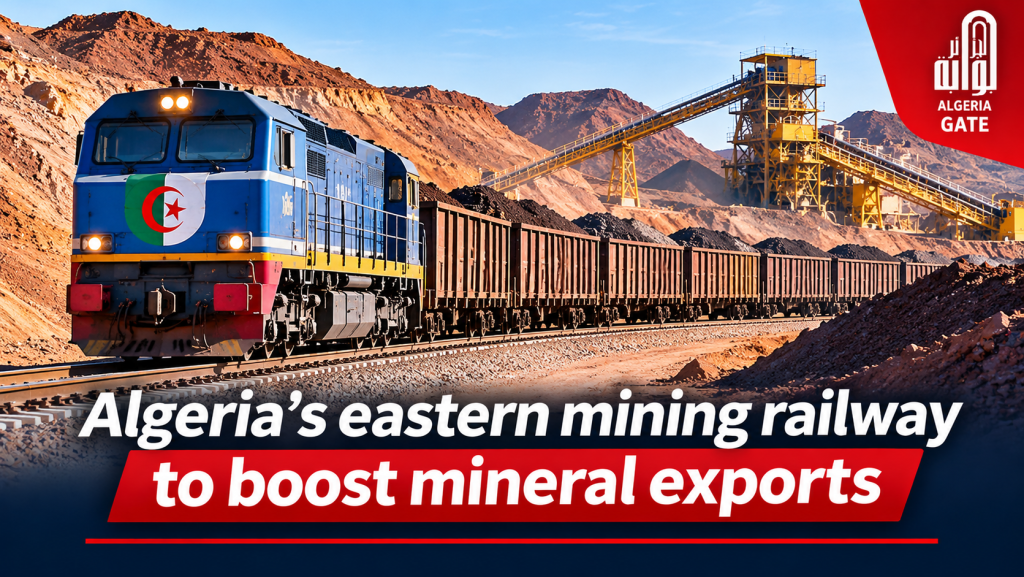
Algeria’s eastern mining railway to boost mineral exports

Algeria’s eastern mining railway to boost mineral exports

Algeria Gate: Algeria’s eastern mining railway project is emerging as a strategic infrastructure investment aimed at unlocking the country’s mineral wealth, strengthening industrial production and boosting non-hydrocarbon exports.

The project is expected to play a key role in transporting mining resources from extraction sites to processing facilities and export terminals, improving logistics and reducing transportation costs. It will also support the development of Algeria’s phosphate industry by facilitating the movement of raw materials and processed products to domestic and international markets.

Beyond its contribution to the mining sector, the railway is expected to strengthen the integration of industrial activities, create new economic opportunities and support the development of regions along its route.

By improving connectivity between mining sites, industrial complexes and ports, Algeria aims to increase the added value of its mineral resources, enhance the competitiveness of locally produced fertilizers and expand its presence in international markets.

The project forms part of Algeria’s broader strategy to diversify its economy, reduce dependence on hydrocarbon revenues and establish the mining industry as a major driver of economic growth and export development.

#Algeria#Economy
Author
Algeria
Share this post

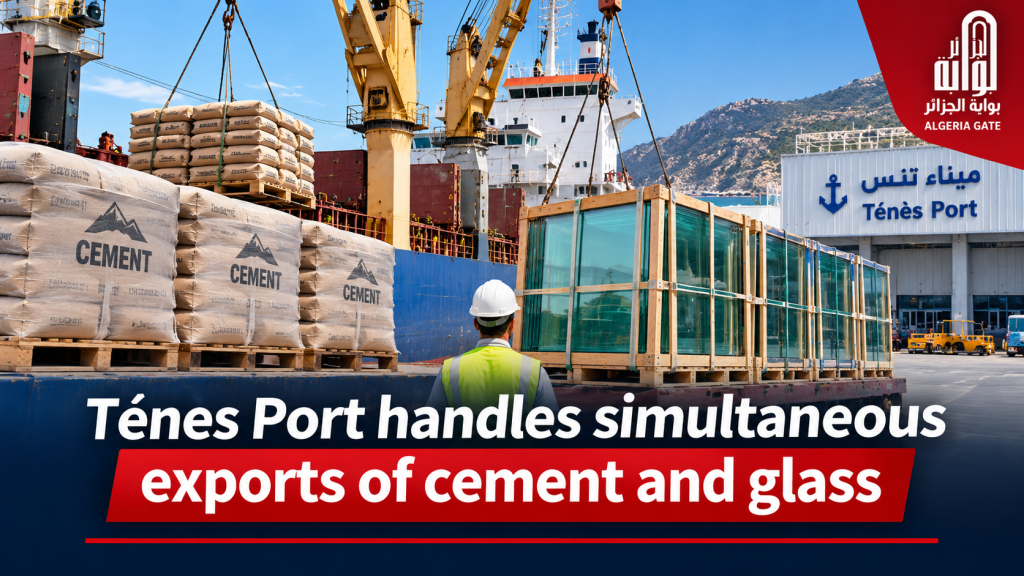
Ténès Port handles simultaneous exports of cement and glass

Ténès Port handles simultaneous exports of cement and glass

Ténès Port in Chlef Province has carried out two simultaneous export operations involving bulk cement and glass, highlighting the growing diversification of Algerian exports beyond hydrocarbons.

According to the port authority, the two operations are currently underway at the port’s docks. The cement is being shipped in bulk, while the glass is being exported in sheets placed on special racks known as “pupitres,” as well as in packaged boxes.

To ensure smooth operations, the port authority has mobilized its human, material and logistical resources, while coordinating with the relevant stakeholders to maintain safety standards and meet shipping deadlines.

The latest shipments underscore the importance of maritime infrastructure in facilitating exports and expanding access to international markets for Algerian industrial products.

Further details regarding the volumes shipped and their final destinations have yet to be announced.

#Algeria#Economy#Exports
Author
Algeria
Share this post

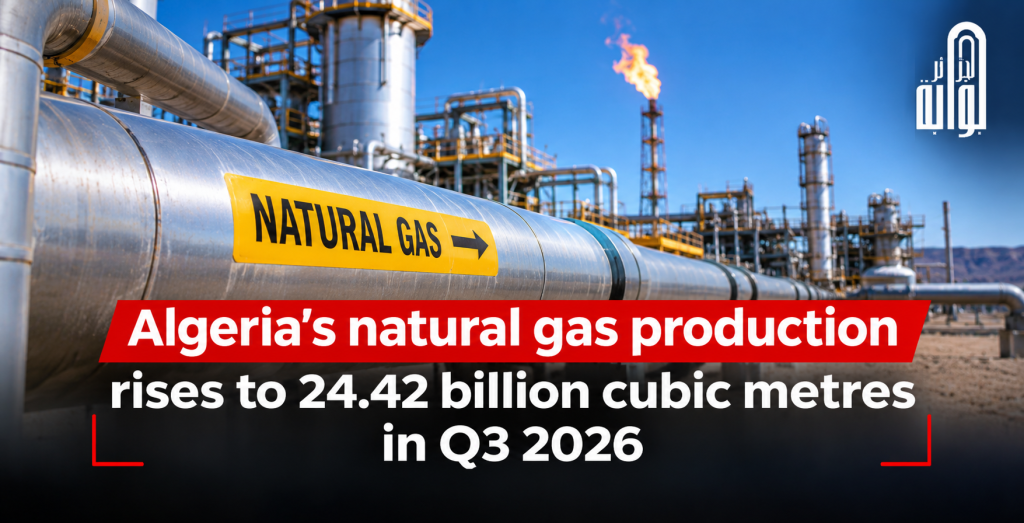
Algeria’s natural gas production rises to 24.42 billion cubic metres in Q3 2026

Algeria’s natural gas production rises to 24.42 billion cubic metres in Q3 2026

Algeria Gate: Algeria’s natural gas production increased by 3% year-on-year in the third quarter of 2026, reaching 24.42 billion cubic metres, compared with 23.66 billion cubic metres during the same period last year, according to data from the Joint Organisations Data Initiative (JODI), cited by Energy Research Unit.

The increase of approximately 760 million cubic metres marks Algeria’s highest third-quarter gas production level since 2023, reflecting continued growth in the country’s energy output.

Production exceeds 78 billion cubic metres in nine months

Algeria’s total natural gas production during the first nine months of 2026 reached 78.42 billion cubic metres, up from 75.47 billion cubic metres during the same period in 2025, representing an increase of nearly 4%.

January recorded the highest monthly production, at 10.44 billion cubic metres, while production stood at 8.61 billion cubic metres in July and 8.69 billion cubic metres in August. September output reached 7.11 billion cubic metres, compared with 6.92 billion cubic metres a year earlier.

Domestic consumption continues to rise

The increase in production comes amid growing domestic demand, particularly from the electricity generation sector.

Algeria’s gas consumption reached 13.28 billion cubic metres in the third quarter of 2026, compared with 12.05 billion cubic metres during the same period last year, representing an increase of more than 10%.

Electricity generation accounted for approximately 68% of total gas consumption, reaching 9.03 billion cubic metres, while electricity demand peaked at 21,830 megawatts on August 19, 2026.

Exports remain a key component of Algeria’s energy sector

Algeria exported approximately 10.50 billion cubic metres of gas through pipelines and LNG shipments during the third quarter, compared with 10.86 billion cubic metres a year earlier.

Pipeline exports accounted for the largest share, reaching 8.48 billion cubic metres, while LNG exports stood at 2.02 billion cubic metres.

LNG exports also recorded a notable increase in October, reaching 1.03 million tonnes, their highest monthly level in a year. France ranked as the leading importer, followed by Spain and Türkiye.

The latest figures highlight the strategic importance of natural gas to Algeria’s economy, as the country seeks to balance rising domestic demand with its role as a major energy supplier to international markets.

#Algeria#Economy#Natural Gas
Author