Thursday, 22 October 2026 • 21:09 Algiers time
Algeria Gate
Share this post

From VIP Glitter on Screens… to the Dark Shadows of Drug Networks!

• Author: Lys Iwannughen • 0 comments • 24 views
From VIP Glitter on Screens… to the Dark Shadows of Drug Networks!

Algeria Gate: Luxury cars, continuous travel, planes, luxury hotels, and a life that seems without financial limits… This is how some “influencer” accounts create an image of wealth on social media, turning display into content that attracts millions of views and creates the impression that quick money and sudden luxury have become a normal lifestyle.

From VIP Glitter on Screens… to the Dark Shadows of Drug Networks!

But behind this shiny image, heavy criminal cases have begun to impose a more embarrassing question: does everything we see of displays of wealth on social platforms really reflect clear and legitimate sources of money?

https://twitter.com/algatedz/status/2095804894624031036?s=20

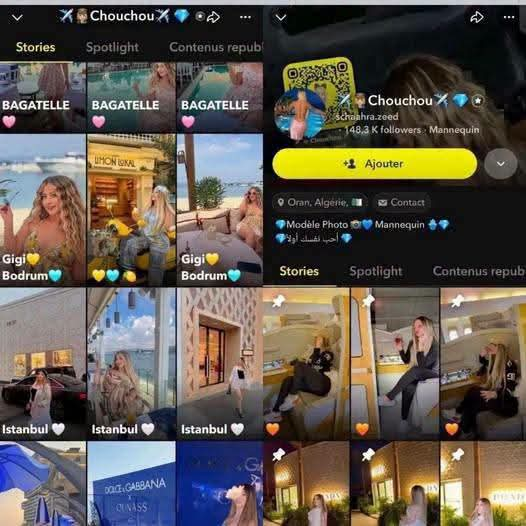
The case of the network involving 228 kilograms of cocaine seized in Oran brings this question forcefully back to the forefront, after the case was linked to names and personalities known on social media, including the influencer Hammadi Chahrazed, known by the nickname “Chouchou.”
From VIP Glitter on Screens… to the Dark Shadows of Drug Networks!

While the truth of any link to the criminal acts remains the competence of investigations and justice, the case has again highlighted the shocking gap between the image of luxury presented to the public and the reality that investigations may reveal in some files.

In this regard, information technology and artificial intelligence consultant Mohamed Cherif Zaidi said to “Algeria Gate” that the algorithms of social platforms such as TikTok do not judge whether content is good or bad, and do not necessarily know whether the wealth displayed by a person is real or artificial and fake, explaining that their work is based primarily on the logic of interaction.

From VIP Glitter on Screens… to the Dark Shadows of Drug Networks!

Zaidi said the algorithm measures indicators such as video viewing time, whether the user completed it or not, rewatching, comments, sharing, and interaction with it, stressing that “the algorithm does not understand and has no emotion; it understands numbers.”

From VIP Glitter on Screens… to the Dark Shadows of Drug Networks!

He added that the danger lies in the fact that content displaying a very luxurious life; cars, money, travel, and rapid and unusual success, arouses curiosity, comparison, and even controversy, and therefore obtains high viewing time and interaction. He noted that the more these signals increase, the more the algorithm may understand that the content is desirable and expand its reach.

Zaidi explained that the algorithm “is not built on what exists,” but on views and sharing, adding that the algorithm “does not ask the video owner: where did you get this money from?” but poses a technical question: “Is this video capable of keeping the user on the screen?”

He pointed out that content creators know what is called “value,” i.e., whether the content makes the viewer complete the video or not, considering that the matter can turn into a real social influence, especially on the youth category.

He said that young people’s daily exposure to dozens of models that link success to quick money, appearances, and sudden wealth “can, over time, reshape the hierarchy of values and social expectations,” so that studying, working, and building a project gradually; seen as a slow path; appear not to bring results, while rapid enrichment becomes the norm.

Regarding the description of the phenomenon as a “soft war,” Zaidi called for precise use of the term, stressing that “technically, we cannot consider every ostentatious piece of content as part of an organized war.”

However, he clarified that if it is established that there is organized and deliberate use of networks of accounts aimed at influencing public opinion, normalizing criminal behaviors, or luring young people into illegal activities, then the matter shifts, in his view, “from a mere social phenomenon to an issue related to digital security and even societal security.”

He added that if official investigations or judicial rulings prove that some owners of these accounts are linked to criminal networks, the problem becomes more serious, because the platform may have granted them; automatically or unintentionally, reach and influence over hundreds of thousands or millions of users.

On the legal and institutional side, Zaidi affirmed that there are already legal and institutional tools to deal with crimes committed using information and communication technologies, pointing to the existence of several laws related to the prevention and combating of crimes connected to information and communication technologies, in addition to the National Authority for the Prevention and Combating of these crimes, as well as the specialized national criminal hub for crimes related to information and communication technologies.

He also noted that the law includes provisions concerning the deliberate publication of false and malicious news and reports when the aim is to undermine public security or public order.

Yet Zaidi stressed that acting after the content has spread is no longer sufficient, saying: “We are in urgent need here of a shift to smart, risk-based monitoring, not comprehensive surveillance of users.”

From VIP Glitter on Screens… to the Dark Shadows of Drug Networks!

He explained that this means developing early detection systems, affirming that Algeria has the capacities to implement these ideas and innovations, which can detect coordinated campaigns, networks that republish the same messages, and accounts that use fraudulent patterns and suspicious links, especially suspicious links, through the use of artificial intelligence and network analysis.

He also emphasized the need for mechanisms of legal coordination with the platforms, with the aim of preserving digital evidence, stopping the spread, and removing content when there are legal grounds for doing so.

Zaidi believes that one of the points that must be developed in the future is dealing with accounts that have large mass influence differently from ordinary accounts, particularly when it involves commercial or financial activity, through greater transparency regarding advertisements, commercial partnerships, and the sources of the offers being promoted, in addition to strengthening identity verification and combating fake accounts and networks.

In concluding his statement, Zaidi affirmed that “the battle is not only technical,” because the best algorithms alone cannot protect society, stressing the need for “law, detection technologies, cooperation with platforms, and professional media that is quick in verifying information.”

He added that the most important element is “digital education that makes young people understand that what they see on the screen is not necessarily a true reflection of its owner’s life.”

From VIP Glitter on Screens… to the Dark Shadows of Drug Networks!

He concluded by saying that “the challenge today is not to ban social media, but to prevent the power of the algorithm from being turned from a tool of discovery,” clarifying that he means the discovery of content “into a tool exploited by misleaders, fraudsters, or criminal networks to reach young people and influence them.”


Author
Lys Iwannughen
View my articles

Leave a comment

Your email address will not be published. Required fields are marked *

Algeria
Share this post

Tiny Companies, Astronomical Figures: AI Exposes $130 Billion Import Scam in Algeria

Tiny Companies, Astronomical Figures: AI Exposes $130 Billion Import Scam in Algeria

Algeria Gate: Processing of the estimated import program files for the second half of 2026 revealed that 3,961 economic operators, employing between zero and five workers, submitted import requests totaling $130.32 billion, according to a statement issued Saturday, by the Ministry of Foreign Trade and Export Promotion.

The ministry explained that these data, extracted from the digital platform for importing raw materials and production inputs, raise questions about the proportionality of some declared import estimates with the size of the institutions concerned and the number of workers declared.

In detail, the data indicate that 149 operators employing no workers submitted import requests totaling $48,458 million, while 949 operators employing one worker submitted requests worth $21.84 billion.

Tiny Companies, Astronomical Figures: AI Exposes $130 Billion Import Scam in Algeria

The value of import requests submitted by 851 operators employing two workers reached $88.76 billion, $15.52 billion for 722 operators employing three workers, and $1.74 billion for 641 operators employing four workers, while the value of requests submitted by 649 operators employing five workers reached $13.84 billion.

In this context, the Ministry of Foreign Trade and Export Promotion decided to open an investigation, in coordination with the relevant ministerial sectors, to audit the raw materials, production inputs, and equipment imported by these institutions during the first half of 2026 and previous years.

Tiny Companies, Astronomical Figures: AI Exposes $130 Billion Import Scam in Algeria

According to the ministry, the audit operations will cover the conformity of imported quantities and values with the nature of the declared activity, actual production capacities, and the number of declared workers, in addition to the actual economic activity volume of the institutions concerned.

The ministry stressed that the estimated nature of import programs does not mean that the estimates should be detached from the economic reality of the institution or disproportionate to its actual capacities and needs, noting that appropriate measures will be taken based on the results of the investigation and audit in accordance with the applicable legislation and regulations.

On the other hand, the digital platform, supported by artificial intelligence technologies, detected patterns that the ministry considered “unusual” in the declaration of workers at some of the institutions concerned, particularly the recording of worker declarations during periods coinciding with the stages of opening and submitting estimated import programs.

Data analysis showed that a number of institutions declared to the National Social Security Fund for Salaried Workers a number of workers during the period from January to March 31st 2026, before recording no worker declarations during the months of April, May, and June, then recording new worker declarations from July 1st to September 30th 2026, the period that coincides with the stages of submitting and studying estimated import programs.

The ministry announced in this regard the opening of an investigation into these cases and the taking of the necessary measures in light of the results of the investigation operations, in accordance with the applicable laws and regulations.

#Algeria#Economy
Author
Lys Iwannughen
View my articles
Algeria
Share this post

Algeria Declares War on Cartels: Cutting Supply Lines and Choking Cash Flow

Algeria Declares War on Cartels: Cutting Supply Lines and Choking Cash Flow

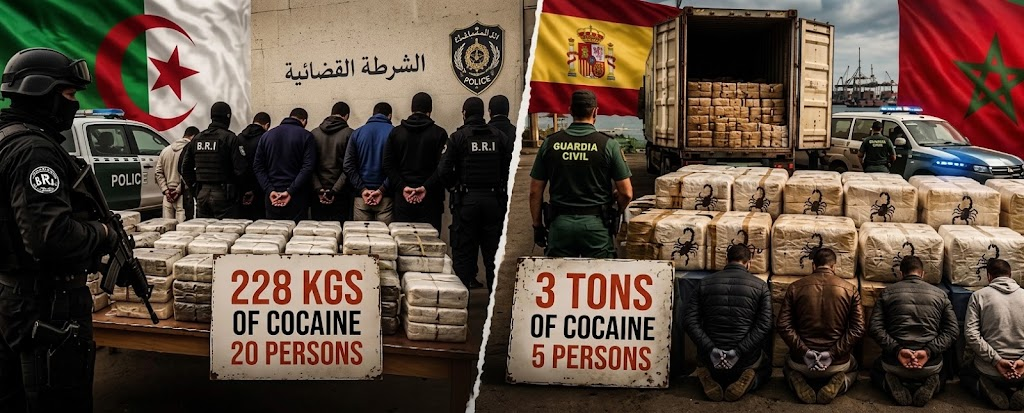
Algeria Gate: International relations researcher Oumnia Bougueras said to “Algeria Gate” that the recent security operation that resulted in the seizure of 228 kg of cocaine and the arrest of 20 people, including a Moroccan, along with the seizure of sums of money in various currencies, does not appear to be merely an operation to seize large quantities of drugs, but rather an indicator of a new and more complex nature of drug-trafficking networks in Algeria.

https://twitter.com/algatedz/status/2095804894624031036?s=20

Bougueras explained that what is striking in the operation is the diversity of the seized currencies, particularly the Moroccan dirham and the Emirati dirham, considering that this reflects the reliance of drug networks on diversifying their sources and cross-border financial channels in order to conceal the origin of the money.

The researcher added that this activity represents a form of transnational organized crime, as well as a new pattern of hybrid warfare targeting Algerian social security and human resources by targeting the youth category.

https://twitter.com/algatedz/status/2096243392355147880?s=20

In confronting this phenomenon, the researcher confirmed that Algeria is adopting a new security approach through activating and tightening border controls, in addition to legal treatment and the renewal of penalties, noting that the recent prison in Tanezrouft reflects the determination of the Algerian authorities to confront this dangerous scourge that targets the Algerian social fabric.

However, Bougueras stressed that the scale of the threat requires societal mobilization and the involvement of various actors, including parties and civil-society associations, in order to ward off this threat facing Algerian social security and affecting its national security.

#Algeria#Morocco
Author
Lys Iwannughen
View my articles
Algeria
Share this post

After Algeria… Morocco tries to flood Spain with 3 tons of cocaine!

After Algeria… Morocco tries to flood Spain with 3 tons of cocaine!

Algeria Gate: Just hours after Algerian security forces successfully seized 228 kilograms of cocaine originating from Morocco, Spanish authorities have struck again.

After Algeria… Morocco tries to flood Spain with 3 tons of cocaine!

In a major operation south of the island of Gran Canaria, Spanish security forces intercepted a high-speed boat equipped with multiple engines coming from Morocco. On board, they seized three tons of cocaine, equivalent to 3,360 kilograms, along with an arsenal of weapons, and arrested five Moroccan traffickers.

#Algeria#Morocco#Spain
Author
Lys Iwannughen
View my articles