

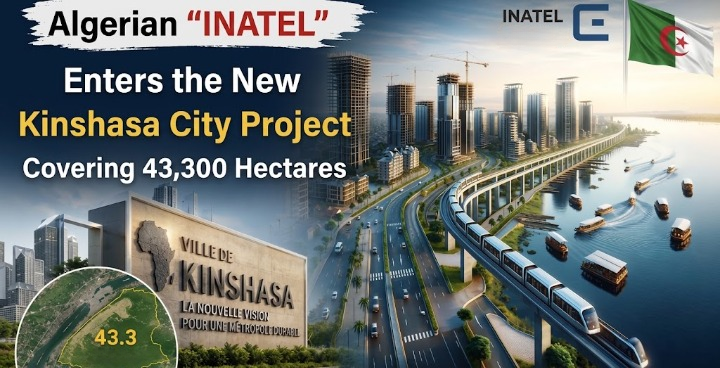
Algeria Gate: Algerian public company INATEL (based in Tlemcen) has joined the “Kinshasa Kia Mona” project, spanning over 43,300 hectares (433 km²) in the Democratic Republic of Congo’s Maluku municipality, as part of an African consortium with Senegal’s PGS Africa and DABYAN. The consortium will establish a local unit for assembling and producing digital equipment under the “Made in the Democratic Republic of Congo” label, plus a center for innovation, technological excellence, training, skills transfer, maintenance, engineering, and R&D in electronics, telecommunications, cybersecurity, payment systems, and applied artificial intelligence.
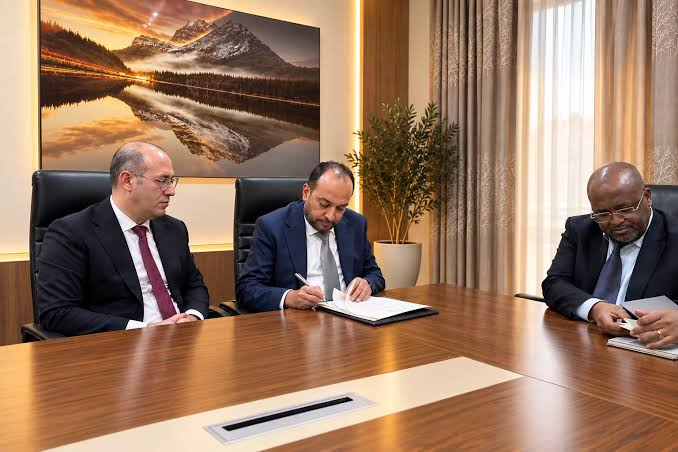
On August 30th 2026, the permanent coordination of the Strategic Supervisory Committee for the Kinshasa City Expansion Project signed a memorandum of understanding with the consortium in the presence of Algerian Ambassador Nassim Gouaoui. The agreement was announced on 1 September as part of Congo’s effort to link the new city to industrial and digital infrastructure rather than limiting it to urban and residential growth.
The document is only a memorandum of understanding, not a final implementation contract. Investment value, ownership shares, plant capacity, financing sources, and construction/entry-into-service timetable have not been announced. Technical and economic studies are still required to define the equipment to be produced locally, integration rates, component sources, and expected demand from government institutions, banks, telecom companies, and the private market. The MoU provides a negotiation framework but does not launch works or create final capital commitments.

The production unit will cover electronic payment devices, automated dispensers, computers, and communication/networking equipment, with installation, maintenance, and technical support. It aims to cut Congo’s reliance on imported ready-made digital products by localizing assembly, manufacturing, and maintenance, and could foster a local subcontracting network in plastic/metal components, packaging, transport, logistics, and software if clear local-integration rates are set.
The excellence center will train skills in IT, electronics, telecoms, cybersecurity, payment systems, and AI, while supporting financial institutions, telecom firms, and public administrations in transaction security, data protection, and network operations—areas of rising demand. It addresses Africa’s shortage of local skills for operating, maintaining, and updating equipment, reducing permanent dependence on foreign expertise.
PGS Africa handles digital infrastructure and tech solutions; DABYAN covers payment systems, banking technology, software, and human resources. INATEL contributes industrial and engineering expertise in telecom equipment, professional electronics, and security/control systems, plus studies, installation, and maintenance. Implementation could open markets for INATEL in assembly lines, components, systems, engineering, supervision, training, and maintenance. Algeria’s economic return will depend on INATEL’s work share, exported products/services value, number of Algerian experts involved, and the share of equipment manufactured or prepared in Algeria.
The full project allocates 19,511 ha to urban expansion, 9,200 ha to industry, 8,660 ha to agriculture, and 3,000 ha to green spaces. It seeks to ease pressure on Kinshasa (population ~20 million and still growing) by creating a new economic-urban pole that could house ~5 million people, develop up to 1,000 MW of electricity capacity, attract up to 2,500 factories, and generate about 1 million direct and indirect jobs long-term via industrial, real-estate, agricultural, technological, and service activities. These targets apply to the overall project, not the INATEL agreement specifically, and depend on mobilizing investments and completing roads, energy, water, telecoms, and public facilities.
The 9,200-ha industrial zone is one of the largest components, intended to host diverse factories and link local production to Kinshasa and other Congolese provinces. The agricultural allocation aims to combine urban growth with food production amid Kinshasa’s heavy reliance on distant or imported foodstuffs. Digital factories will need stable power, high-speed communications, logistics, and efficient payment systems, tying their success to basic infrastructure progress.
Related MoUs include one with France’s Dassault Systèmes (23 February 2026) for 3D modeling and digital-twin tools in planning and management, and one with Vietnam’s Vingroup (11 August 2026) to explore participation in infrastructure, real estate, industry, and technology. Congolese reports estimate the full project could cost up to $50 billion across all components and stages; this is not a finalized financed contract and is unrelated to the INATEL consortium’s investment. Key upcoming indicators will be specific implementation contracts, package values, financing sources, and related guarantees.
INATEL’s involvement differs from simple device exports by combining manufacturing, engineering, training, maintenance, and knowledge transfer, enabling recurring revenues from technical services rather than one-time equipment sales. It opens access to the Central African market, given Congo’s location, population, and growing demand for telecoms, digital finance, payment devices, and IT equipment. Other Algerian firms could join via subcontracting or supply of components, software, and engineering services if final contracts include them. Training itself is exportable, requiring programs, trainers, platforms, labs, equipment, and curricula. Success could give INATEL an external reference for similar African tenders.

External expansion requires managing risks around financing, transfers, exchange rates, payment guarantees, and transport/equipment costs. Ownership models must be defined: capital shareholder (share of profits but long-term financing), technology/equipment supplier, engineering/equipment contractor, or operator/maintenance-and-training provider (each with different risk-return profiles). Confirmed demand via purchase contracts with banks, telecoms, administrations, and local institutions is needed before finalizing production-line sizes. Local integration levels will shape impact: full assembly of imported components yields limited industrial effect, while gradual increases build supplier networks, transfer knowledge, and create more sustainable jobs.
For Algeria, returns will be measured by equipment and service export value, INATEL’s project share, participating Algerian institutions, and follow-on contracts in Congo and the region; not by signed agreements alone. The deal reflects a broader shift of Algerian firms in Africa from pure trade to investment, services, and industry, leveraging national expertise in telecoms, electronics, works, and engineering. Converting this into financial flows requires converting the MoU into contracts specifying investment value, capacity, financing, timetable, ownership, local content, and purchase guarantees. The next phase will decide whether INATEL secures a long-term industrial foothold in Central Africa’s technology market or remains at a preliminary stage needing more time before execution.