


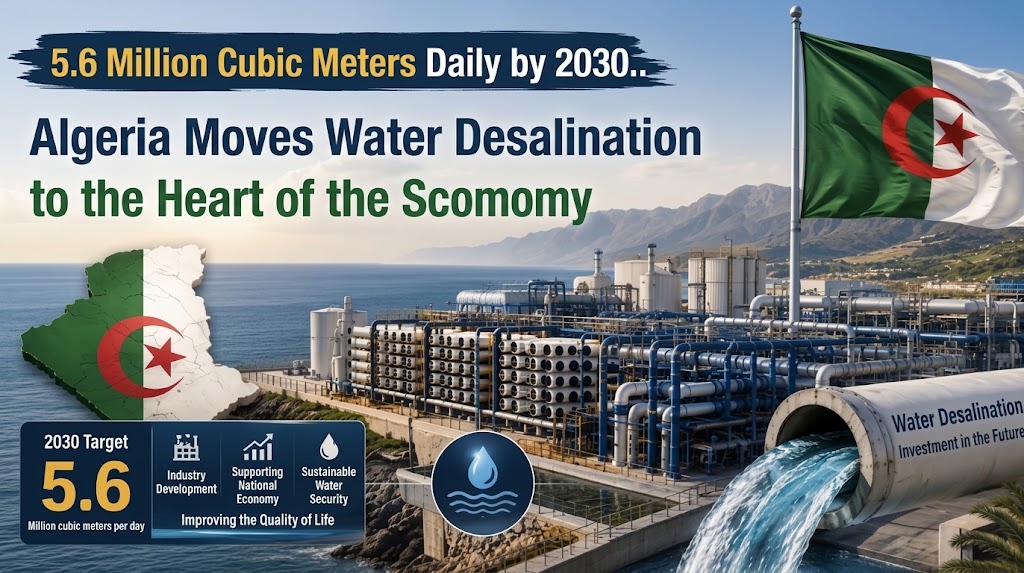
Algeria Gate: Algeria aims to produce about 5.6 million cubic meters of desalinated seawater per day by 2030, compared with a current capacity estimated at 3.76 million cubic meters, raising desalination from a means of securing drinking water to an economic investment that directly affects gas and electricity consumption, subsidy expenditures, the distribution of dam water, and the cost of industrial and agricultural activity.

Algeria currently operates 19 major plants with an annual capacity of approximately 1.37 billion cubic meters, in addition to 21 small single-block units with a total capacity of 57,500 cubic meters per day. This system supplies about 40% to 42% of drinking water needs, according to the date of calculation of the capacities that have actually entered service.
These figures mean that of every ten liters distributed for domestic consumption, more than four liters come from seawater after treatment. Coastal urban supplies are therefore no longer entirely dependent on dam stocks and rainfall cycles.
The National Land Planning Scheme issued in 2010 had targeted reaching 15 plants with a capacity of 938 million cubic meters per year by 2025. However, current capacity has exceeded that estimate by about 432 million cubic meters per year, or approximately 46%.
Investments have also moved from limited plants built at the beginning of the millennium to large programs executed by Algerian companies. According to previous statements by the CEO of the Algerian Energy Company to Reuters, the country has invested about $2.1 billion in this activity, with plans to inject another $2.4 billion to implement the program extending to 2030.
The ongoing program adds three major plants in Tlemcen, Chlef, and Mostaganem, each with a capacity of 300,000 cubic meters per day. Their operation will add 900,000 cubic meters per day, or 328.5 million cubic meters per year, to the production system.
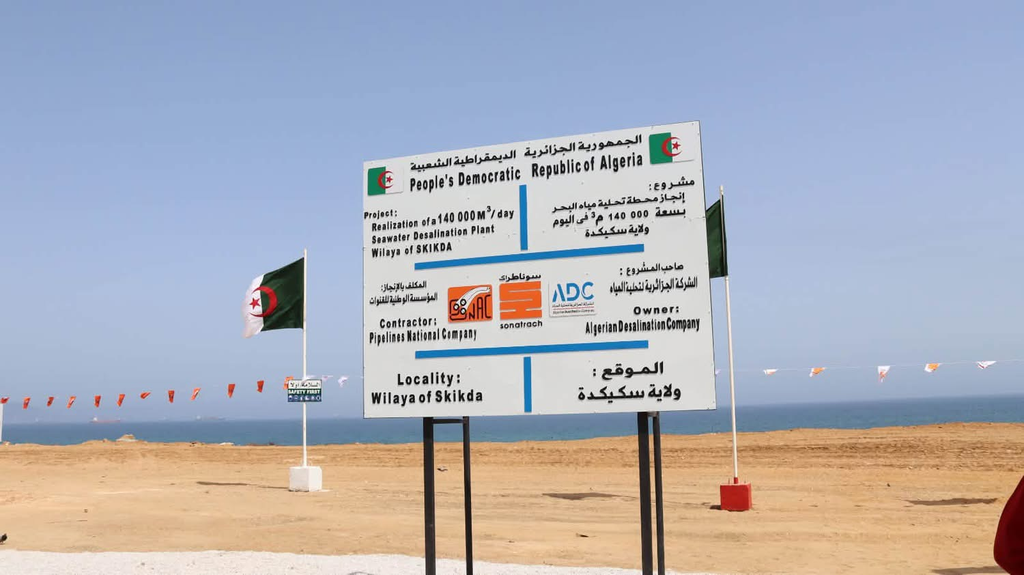
Work began on the Ain Ajroud plant in Mersa Ben M’hidi in Tlemcen in November 2025, then on the El Marsa plant in Chlef in December, in parallel with the completion of procedures for the Mostaganem plant. Sonatrach also launched in July 2026 the Ben M’hidi plant project in Skikda with a capacity of 140,000 cubic meters per day, of which 100,000 are for drinking water and 40,000 for the industrial sector.
However, adding the three plants to current capacity raises theoretical capacity to only about 4.66 million cubic meters per day. Reaching the target of 5.6 million cubic meters therefore requires providing another 940,000 cubic meters through new facilities or expansion of existing plants and increased productivity.
Nominal capacity alone is not a sufficient measure of water security, because the water produced needs pumping lines, reservoirs, lifting stations, and connection to distribution networks. Cost also rises the farther water is transported or the higher the areas above coastal level.
The World Bank estimates that transporting water horizontally over a distance of 100 kilometers or lifting it vertically by about 100 meters adds roughly $0.05 to $0.06 to the cost of a cubic meter. Expanding the supply of desalinated water from coastal wilayas to areas 150 kilometers, then 250 kilometers away therefore requires additional investments in pipes, pumping, energy, and maintenance.
The cost of producing a cubic meter at the desalination plant outlet is estimated at between $0.55 and $0.9, depending on technology, plant size, electricity price, membrane life, and maintenance expenses. When final transport, treatment, storage, and distribution are included, the cost may rise to between $1 and $1.5 when the water reaches the consumer.
Calculating the operation of current capacity of 3.76 million cubic meters per day, the theoretical production value at the plant outlets ranges between $2.07 and $3.38 million per day, equivalent to between $755 million and $1.24 billion per year.
After the three plants with a total capacity of 900,000 cubic meters per day come into operation, the theoretical annual cost of producing 4.66 million cubic meters per day may rise to a range of between $936 million and $1.53 billion, before accounting for the costs of delivering water to consumer networks.
These calculations do not reflect announced government spending, because they assume plants operating at full capacity and constant production costs throughout the year. They do, however, reveal that the coming challenge is not only related to financing construction, but also to providing the resources needed for maintenance, electricity, membranes, and chemicals over the life of the plants.
They also show that water pricing will become one of the central economic files. Continuing to sell water at low administrative prices means that the Treasury and public institutions bear the cost difference, while a uniform increase in tariffs could pressure purchasing power.
The solution requires separating basic domestic consumption, which needs social support, from high consumption and industrial and commercial uses. It also requires accurate measurement of quantities, actual billing, and reduction of illegal connections and commercial losses.
This is directly linked to the state of distribution networks. Every cubic meter produced with energy and imported materials that then leaks before reaching the consumer represents a double loss of water and money. Repairing networks in some areas may therefore be less costly than adding new production capacity of the same volume.
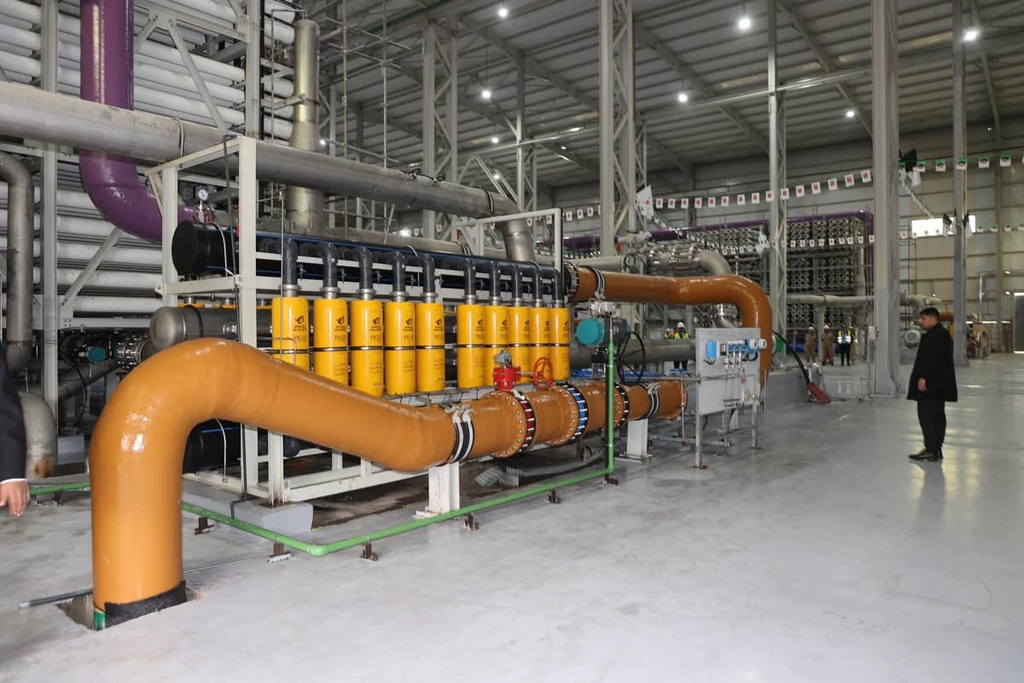
Energy represents one of the largest operating items of the plants. The reverse-osmosis technology used mainly in Algeria consumes about 2.5 to 3.5 kilowatt-hours per cubic meter, depending on plant efficiency and seawater quality.
Adopting an average of three kilowatt-hours per cubic meter, current capacity requires approximately 11.28 gigawatt-hours per day, or about 4.12 terawatt-hours per year. The requirement rises to about 6.13 terawatt-hours per year when the target of 5.6 million cubic meters per day is reached.
The difference between the current situation and the 2030 target is about two million additional cubic meters per day, requiring approximately 2.2 terawatt-hours of electricity per year under the same assumption. The desalination program therefore also becomes an energy program that needs generation and transmission capacity and continuous operation guarantees.
Integrating solar and wind energy offers an opportunity to reduce the gas used in electricity production. Every quantity of gas not burned to operate the plants can be directed to export or processing industries, creating an indirect economic return from investment in renewable electricity.
However, the round-the-clock operation of plants prevents total reliance on an intermittent source. The model therefore needs a mix of the electricity grid, renewable energies, and storage systems, with long-term electricity purchase contracts and guarantees of frequency and supply stability.
This is consistent with Algeria’s updated climate contribution deposited with the United Nations in June 2026, which targets a 14% reduction in greenhouse gas emissions by 2035 with national resources, and up to 31% if international financing is available.
On the other hand, the economic impact of desalination is not limited to drinking water. Replacing dam water inside coastal cities allows a portion of traditional resources to be redirected toward agricultural perimeters, providing an indirect channel to support the production of cereals, vegetables, fruit trees, and industrial crops.
This approach avoids the direct use of desalinated water in agriculture, where most crops cannot bear its cost. Instead, cities obtain stable water from the sea, while dams gradually recover their irrigation function.
This transfer does not occur automatically; it requires irrigation networks, maintenance of storage facilities, and the determination of measurable quotas, as well as directing water toward products with the highest economic and food return. The quantity of agricultural production achieved per cubic meter should also be calculated, not just the irrigated area.
At the same time, the expansion of desalination raises an environmental challenge related to the brine produced by salt separation. International data indicate that the production of 95.37 million cubic meters of desalinated water per day generated about 141.5 million cubic meters of brine, or roughly 1.5 cubic meters of waste per cubic meter produced on average.
The actual volume of waste varies according to the water recovery rate, plant technology, and source salinity. Increasing Algerian capacity means higher quantities discharged into the sea, requiring monitoring of salinity, temperature, and chemicals at discharge points.
On June 15th 2026, the Algerian Desalination Company signed three agreements with the National Observatory for the Environment and Sustainable Development, the Directorate General for Scientific Research and Technological Development, and Kasdi Merbah University in Ouargla (not Biskra as stated in the original French text).
The agreements cover environmental monitoring, applied research, and the development of techniques for valorizing salts and mineral materials resulting from desalination. This path could open activities linked to the extraction of salt, magnesium, potassium, and other compounds, provided their viability is proven compared with the cost of separation, energy, and transport.
Signing research agreements does not mean that Algeria has begun commercial production of minerals from brine; the transition to industry remains linked to studies, experiments, and the determination of technologies and target markets. It does, however, move waste treatment from an environmental item to a potential field of research and investment.
Thus, the economic value of the 2030 plan is determined by the ability to control five interconnected variables: the cost of producing a cubic meter, electricity consumption, distribution network losses, the volume of dam water freed for agriculture, and the cost of treating brine.
Raising production to 5.6 million cubic meters per day remains a necessary target but is insufficient on its own. The actual result will be measured by the quantity of water that reaches the consumer, the cost of each billed cubic meter, the stability of supply, and the volume of traditional water redirected to the productive economy.