Friday, 6 November 2026 • 12:27 Algiers time
Algeria Gate
Share this post

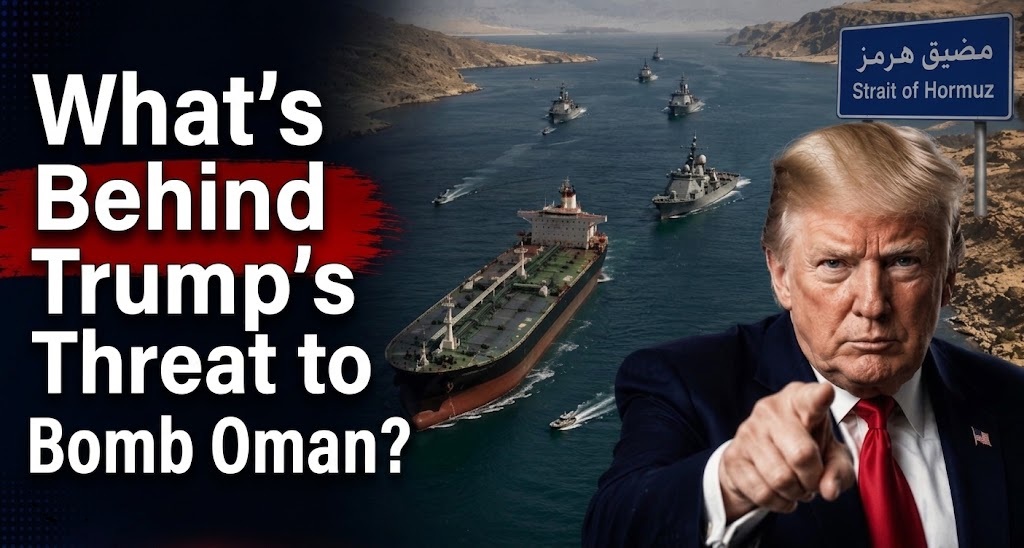
What’s Behind Trump’s Threat to Bomb Oman?

• Author: Lys Iwannughen • 0 comments • 47 views
What’s Behind Trump’s Threat to Bomb Oman?

Algeria Gate: U.S. President Donald Trump threatened on Monday to bomb the Sultanate of Oman if it interfered in what he described as American efforts related to the Strait of Hormuz. This came amid the ongoing war with Iran and the end of the talks deadline without reaching an agreement to end the conflict.

In an interview with Fox News, Trump said the United States would bomb Oman “hard” if it stood in its way, repeating a threat he had previously made last May.

For its part, Iran announced that its talks with the Sultanate of Oman regarding the Strait of Hormuz are still ongoing, despite describing them as complex.

https://twitter.com/algatedzEng/status/2089377840462532825?s=20

Trump confirmed that his administration has established a direct communication channel with the Iranian Revolutionary Guard, but stressed that he is in no hurry to reach an agreement, at a time when tensions linked to one of the world’s most important shipping and energy corridors are escalating.


#Oman#Trump
Author
Lys Iwannughen
View my articles

Leave a comment

Your email address will not be published. Required fields are marked *

Europe
Share this post

Revealed: How Jeffrey Epstein Used Saint-Tropez as a Key Hub for Luring Victims

Revealed: How Jeffrey Epstein Used Saint-Tropez as a Key Hub for Luring Victims

Algeria Gate: A major investigation by the French newspaper Le Monde has revealed that the exclusive resort of Saint-Tropez in southern France was one of Jeffrey Epstein’s preferred destinations for recruiting and exploiting young women.

The late American financier and convicted sex offender, who died in prison in 2019, used the glamorous French Riviera as a second operational base after his apartment on Avenue Foch in Paris.

Epstein owned the Paris apartment since 2002 and visited Saint-Tropez nearly every summer for almost two decades. According to millions of documents released by the U.S. government, he and his longtime associate Ghislaine Maxwell rented the luxurious Villa Mirage in Saint-Tropez in the summer of 2002 for approximately three weeks at a rate of €100,000 per week.

Email records also show Epstein attending high-profile social events in the area, including supermodel Naomi Campbell’s birthday party in 2004. He repeatedly explored renting or buying multi-million-euro properties along the French Riviera, with some offers reaching hundreds of millions of euros.

Epstein’s Recruitment Network on the French Riviera

Le Monde reports that Epstein’s exclusive parties in Saint-Tropez regularly mixed wealthy socialites, celebrities, and groups of young women. These gatherings took place in private villas, exclusive clubs, and aboard luxury yachts.

A central figure in the French side of the scandal was Jean-Luc Brunel, a well-connected modeling agent and close associate of Epstein. Investigators believed Brunel used his extensive contacts in the fashion industry to recruit young women and facilitate their introduction to Epstein. Brunel was later charged with rape and sexual assault of a minor before dying by suicide in a Paris prison in 2022.

Other intermediaries named in the investigation include French-Swedish modeling agent Daniel Siad, allegedly linked to the leader of the “MAK” terrorist movement and suspected of supplying Epstein with young women of various nationalities. Former fashion recruiter Ramsey El-Khouly also appears in correspondence connecting Epstein to models and aspiring models.

Victim Testimonies Place Saint-Tropez at the Center of Epstein’s Abuse

Several victims have directly linked Saint-Tropez to Epstein’s network of sexual exploitation. Virginia Giuffre, one of Epstein’s most prominent accusers, stated that she was forced by Epstein and Ghislaine Maxwell to have sexual relations with a French businessman during an incident in Saint-Tropez in 2001.

A French artist who met Epstein and Maxwell in Saint-Tropez when she was only 16 or 17 years old in the late 1990s later described being raped by Epstein in New York.

Epstein’s Plans to Settle Permanently in France

The Le Monde investigation further reveals that Epstein was actively planning to relocate to France. In 2019, shortly before his final arrest, he began selling properties in New Mexico and searching for a permanent home on the French Riviera with a budget potentially reaching tens of millions of euros. He was arrested in the United States on July 6th, 2019 after returning from France.

The revelations highlight how the glamorous image of Saint-Tropez and the French Riviera provided cover for one of the most notorious sex-trafficking networks of the modern era.

Author
Lys Iwannughen
View my articles
Algeria
Share this post

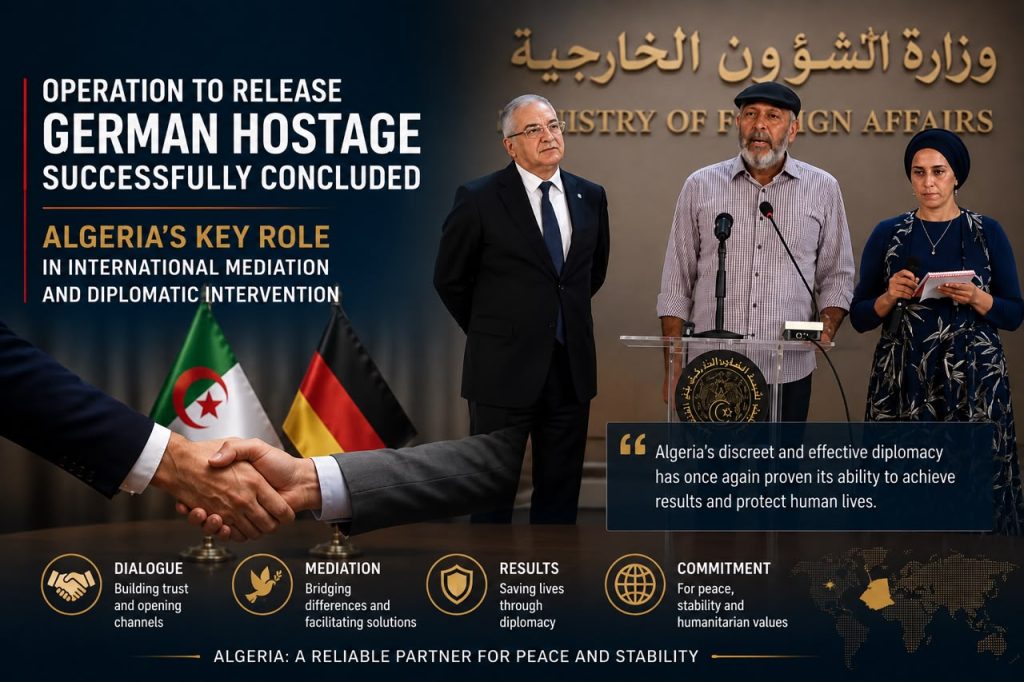
Algeria’s Diplomacy Secures the Release of German Hostage

Algeria’s Diplomacy Secures the Release of German Hostage

algeria gate Algeria has once again demonstrated the strength of its quiet and effective diplomacy with the successful release of a German national who had been held hostage in the Sahel.

The operation highlights Algeria’s growing role as a trusted mediator in the region, particularly in sensitive security and humanitarian cases where dialogue and discreet negotiations are essential.

Speaking about the case, Lounès Magramane, Secretary-General of Algeria’s Ministry of Foreign Affairs, provided details surrounding the hostage’s release, while the freed German national himself spoke about his experience.

The successful outcome represents another diplomatic achievement for Algeria, whose geographical position, regional experience and longstanding relations with neighboring countries allow it to act as an important bridge between different actors.

Rather than relying on confrontation1, Algeria continues to promote dialogue, negotiation and peaceful solutions an approach that is increasingly valuable in the unstable Sahel region.

The release of the German hostage therefore goes beyond a single humanitarian case. It underscores Algeria’s capacity to contribute to international mediation and crisis resolution, strengthening its position as a credible diplomatic actor in Africa and beyond.

Algeria’s message is clear: diplomacy can still deliver where confrontation fails.

Author
بوابة الجزائر
View my articles
Algeria
Share this post

From Diplomatic Crisis to “No Rupture”: Mali’s Remarkable Reset with Algeria

From Diplomatic Crisis to “No Rupture”: Mali’s Remarkable Reset with Algeria

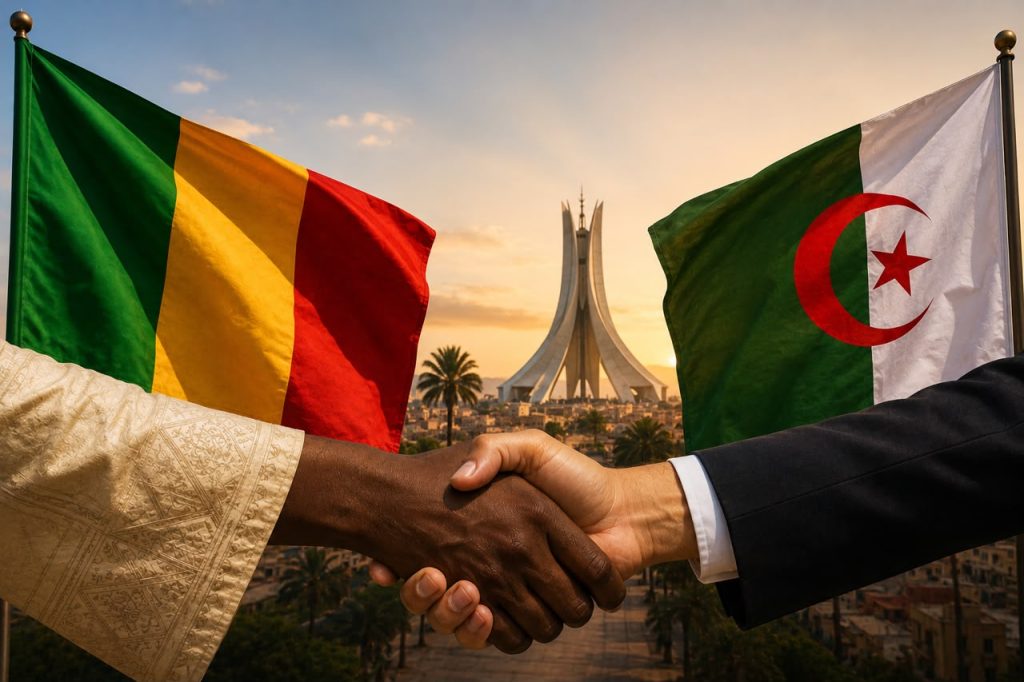
Mali’s Prime Minister, Major General Abdoulaye Maïga, delivered an unusual admission on August 6. Speaking at the close of Mali’s five-year transition review, he declared that relations between Bamako and Algiers had “never been broken” not during the drone crisis, not during the recall of ambassadors, not during fifteen months of closed airspace. He went further, describing a “total convergence of views” between transitional President Assimi Goïta and Algerian President Abdelmadjid Tebboune on the principles that matter most to Algiers: respect for state sovereignty and non-interference in internal affairs.

https://twitter.com/algatedzEng/status/2086031533836546348?s=20


That framing is worth pausing on. It is Algeria’s language, not Mali’s and Bamako has now adopted it as its own.
A crisis Algeria did not escalate
The rupture, such as it was, began on the night of March 31April 1, 2025, when Algerian air defenses destroyed a Malian military drone that Algiers said had violated its airspace near Tinzaouaten. Mali denied the claim, recalled its ambassador, and was joined by its Alliance of Sahel States partners, Burkina Faso and Niger. Algeria closed its airspace to Malian traffic and recalled its own envoy. Bamako later took the matter to the International Court of Justice and, at points, accused Algiers of interference in northern Mali a charge Algeria rejected without matching the rhetorical escalation.
That restraint was deliberate. At no point did Algeria abandon the position it has held since brokering the 2015 Algiers Accord: that the Sahara border is a shared security space, not a zone for unilateral action by either side, and that dialogue not confrontation is the only durable mechanism for managing it.
Geography settled what politics could not
Mali’s pivot toward Russia and the AES bloc since 2021 was never going to erase a 1,370-kilometre border or the security interdependence that comes with it. Algeria did not compete for Bamako’s allegiance during the freeze. It held its position and let necessity do the work. On July 10, 2026, both countries reciprocally restored ambassadors and reopened airspace. Maïga’s August 6 remarks confirm that the reset was not tactical cover it is Bamako aligning explicitly with the sovereignty-and-non-interference framework Algiers never abandoned.
Why this matters now
The timing reinforces Algeria’s position. Algiers assumes the rotating presidency of the African Union Peace and Security Council this month, with Sahel security among its stated priorities. A Bamako that publicly denies any rupture rather than merely tolerating a diplomatic reset hands Algeria a stronger hand as the indispensable interlocutor on a border where terrorism, separatism, and smuggling do not respect the posturing of Sahelian juntas or the ambitions of outside powers.
Fifteen months of pressure were supposed to test whether Algeria’s model of principled non-interference still held weight in a Sahel reshaped by military governments and Russian influence. Bamako’s own prime minister has now answered that question in Algiers’ own terms.

Author
بوابة الجزائر
View my articles