Sunday, 18 October 2026 • 22:10 Algiers time
Algeria Gate
News Room
Cameron Hudson: UAE is virtually the sole backer of the RSF..without its support the war in Sudan would not continue Algeria-Niger: Official launch of Trans-Saharan fibre optic link Five minutes of lament over Algeria: Amar Belani exposes CNEWS’s real obsession Algerian courts hand down first death sentences under new drugs law Ségolène Royal’s masterclass on Algeria against an ignorant and demagogic journalist President Tebboune and senior officials receive the remains of Boualem Boualem in Algiers NAPEC 2026 in Oran: Algeria at the Heart of Africa’s and the Mediterranean’s New Energy Landscape Pegasus Files: Amnesty Uncovers Morocco’s Espionage Against Spain President Tebboune Orders Salary Increases in Algeria’s 2027 Budget, Rules Out New Taxes on Citizens Algeria Emerges as a Trusted Power for Regional Peace and Stability
Share this post

Foreign Investment in Algeria Rises 18% to $1.53 Billion Despite Decline in North African Flows

• Author: Lys Iwannughen • 0 comments • 53 views
Foreign Investment in Algeria Rises 18% to $1.53 Billion Despite Decline in North African Flows

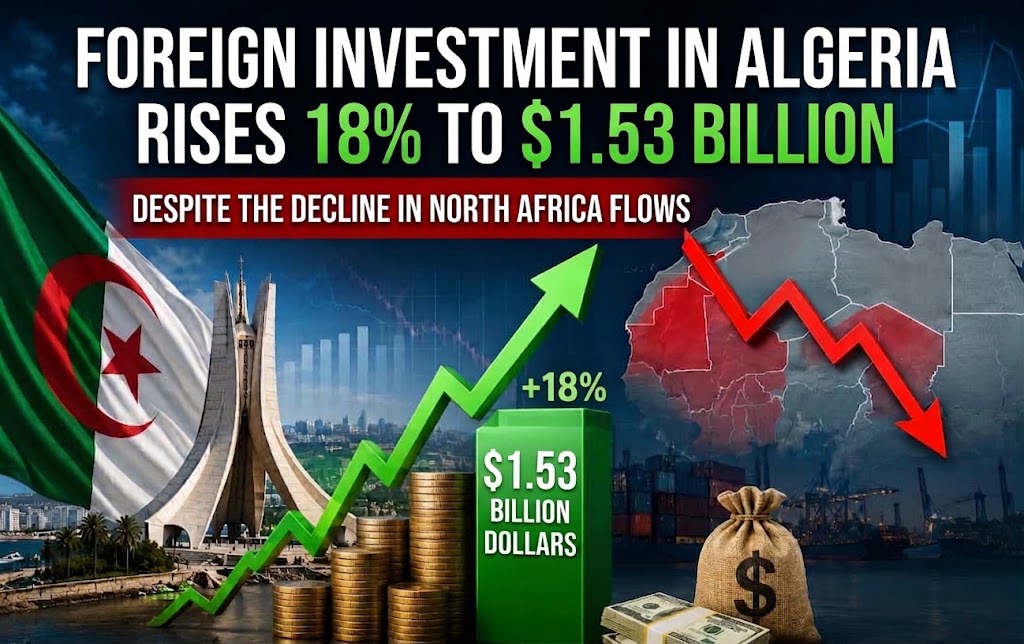
Algeria Gate: Algeria attracted $1.53 billion in foreign direct investment (FDI) during 2025, an increase of 18.15% compared with 2024, while the cumulative stock of foreign investments present in the country rose to $39.67 billion, according to the World Investment Report 2026 issued by the United Nations Conference on Trade and Development (UNCTAD).
Foreign Investment in Algeria Rises 18% to $1.53 Billion Despite Decline in North African Flows

This rise places Algeria in an advanced position within North Africa, after the region recorded a sharp decline of 56% in FDI inflows, from $51.269 billion in 2024 to $22.394 billion in 2025.

The UN report, published on 7 July 2026, stated that Algeria stood out among African countries that attracted major investment projects in hydrocarbons, refining, and industrial activities. It also listed Algeria among the economies that expanded foreign investment participation in the mining sector over the past year. UNCTAD: World Investment Report 2026

This performance comes at a time when FDI inflows to the African continent fell from $94.294 billion in 2024 to $69.506 billion in 2025, making the growth of flows toward Algeria contrary to the downward trend recorded at both the African and regional levels.
Foreign Investment in Algeria Rises 18% to $1.53 Billion Despite Decline in North African Flows

$1.53 Billion and Highest Flows Since 2020

UNCTAD data show that Algeria attracted $1.295 billion in FDI during 2024 before the flows rose to $1.530 billion in 2025; an increase of $235 million in a single year.

This level represents the highest annual inflows recorded by Algeria during the period covered by the report’s statistical annex, extending from 2020 to 2025.

FDI inflows stood at $1.140 billion in 2020, then fell to $870 million in 2021, before dropping to $255 million in 2022.

Flows then resumed an upward path, rising to $1.202 billion in 2023, then $1.295 billion in 2024, and reaching $1.530 billion in 2025.

These figures mean that FDI flows into Algeria multiplied sixfold compared with their 2022 level, equivalent to growth of 500% over three years.

At the North African level, Algeria ranked third in terms of FDI inflows in 2025, after Egypt, which attracted $15.453 billion, and Morocco, which recorded $3.338 billion. Tunisia followed Algeria with inflows of $1.173 billion, then Libya with about $828 million.
Foreign Investment in Algeria Rises 18% to $1.53 Billion Despite Decline in North African Flows

Algeria’s share amounted to roughly 6.8% of total FDI inflows to North Africa and about 2.2% of the flows recorded within the African continent.

The large regional decline is mainly due to the high base of comparison in Egypt in 2024, when the Ras El Hekma real-estate and investment project boosted flows exceptionally.

Excluding the effect of non-recurring mega-projects, the UNCTAD report noted that FDI inflows to Africa in 2025 remained about one-third higher than the average for the period 2010–2024.

In this context, Algeria recorded a continuous increase in flows over three consecutive years, reflecting an improvement in its ability to attract foreign capital compared with the decline recorded at the beginning of the period.
Foreign Investment in Algeria Rises 18% to $1.53 Billion Despite Decline in North African Flows

Foreign Investment Stock Reaches $39.67 Billion

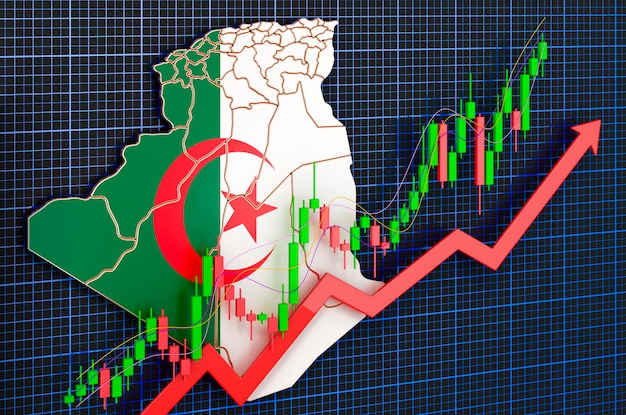
In addition to the rise in annual flows, the stock of FDI present in Algeria reached $39.670 billion in 2025, compared with $38.140 billion in 2024.

That represents an increase of $1.530 billion, or approximately 4.01% in a single year.

The FDI stock measures the cumulative value of investments present in the economy, while annual flows express new investments or the net change recorded during a specific year.

The historical series shows that the stock of foreign investment in Algeria rose from $3.379 billion in 2000 to $19.545 billion in 2010, before reaching $38.140 billion in 2024 and then $39.670 billion in 2025.

Thus the cumulative stock of foreign investments in Algeria multiplied about 11.7 times since 2000 and more than doubled the level recorded in 2010.

At the regional level, the total stock of FDI in North Africa reached $435.726 billion in 2025, giving Algeria a share of approximately 9.1% of total foreign investments present in the region.

The stock of Algerian direct investments abroad also rose to $3.029 billion in 2025, compared with $2.976 billion in 2024—an increase of $53 million.

Algerian direct outflows reached $53 million in 2025, after recording only $300,000 in 2024 and $165 million in 2023.

The stock of Algerian investments abroad stood at $205 million in 2000, before rising to $1.505 billion in 2010 and then exceeding $3 billion in 2025.

Mining Law Expands Participation of Foreign Investors

The World Investment Report 2026 linked Algeria’s position within investment liberalization policies to the measures adopted in the mining sector, noting that a limited number of global measures during 2025 targeted sectors outside services, including mining activity in Algeria.

The reference concerns Law No. 25-12 of 3 August 2025, which reorganized mining activities and expanded the possibilities for foreign investors to participate in exploration and exploitation projects.

According to UNCTAD’s Investment Policy Hub, the new framework allows foreign participation of up to 80% in companies tasked with exploiting mines, while a public Algerian institution retains a stake of no less than 20%. UNCTAD: Algeria expands foreign investment participation in mining projects

In contrast, quarry activities remain subject to a foreign participation ceiling of 49%, with the Algerian public side retaining a stake of no less than 51%.

The law requires that a company established under Algerian law hold the exploitation licenses, thereby linking the entry of foreign capital to an institutional presence inside Algeria and partnership with national institutions.

The U.S. Department of Commerce, in a note published on March 18th 2026, confirmed that the new reform allows foreign investors to hold up to 80% of mining projects, provided they establish a partnership with Algerian public institutions. U.S. Department of Commerce: Reform of mining legislation in Algeria

This framework grants the mining sector wider scope to attract capital and technical expertise in exploration, extraction, and processing, particularly amid rising global demand for minerals and raw materials linked to industry, energy, and technological transformation.

The importance of the reform also lies in linking mining projects to local manufacturing chains, including the processing of ores, production of industrial inputs, and increasing value added rather than limiting activity to the export of raw materials.

The law also provides a basis for expanding investment in phosphate, iron, and other mineral materials, with the necessity that new projects be linked to technology transfer, the development of engineering services, and the integration of Algerian institutions into supply chains.

Energy Projects Support Investment Attractiveness

The UNCTAD report listed Algeria among a group of African countries that attracted major investment projects in hydrocarbons, refining, energy storage, and industrial activities.

This reference is consistent with the international contracts Algeria concluded during 2025 to develop oil and gas production and expand exploration operations.

On July 7th 2025, Sonatrach and the Italian company Eni signed a production-sharing contract in the Zemoul El Kebir area of the Berkine Basin, with total investments estimated at $1.35 billion.

Project estimates include the production of 415 million barrels of oil equivalent over the contract period, including 9.3 billion cubic meters of gas. Reuters: Sonatrach-Eni contract worth $1.35 billion

On 24 July 2025, the Chinese company Sinopec signed a contract to explore and develop the Ghern El Kassa II block in the Gourara-Timimoun Basin, following an earlier agreement worth $850 million to develop the Hassi Berkane North field. Reuters: Sinopec agreement to explore a gas block in Algeria

Sonatrach then signed a contract on 13 October 2025 with the Saudi company Medad Energy worth $5.4 billion to develop oil and gas resources in the Illizi Basin.

The contract extends for 30 years, with the possibility of a further 10-year extension, while the Saudi company allocated $288 million for the exploration phase that lasts seven years.

The resources expected to be developed are estimated at about 993 million barrels of oil equivalent, including 125 billion cubic meters of natural gas. Reuters: Algeria-Medad Energy agreement worth $5.4 billion

On 14 April 2026, the National Agency for the Valorization of Hydrocarbon Resources (ALNAFT) granted the British company BP a license to carry out reconnaissance work in the Eastern Basin, as part of a drive to expand exploration in under-exploited areas.

The agency clarified that the hydrocarbon mining domain in Algeria extends over more than 1.7 million square kilometers, with vast areas that still require geological studies and advanced exploration techniques. Reuters: New license for BP for reconnaissance in Algeria

These developments fall within an energy investment program running from 2025 to 2029 valued at $60 billion, according to previous statements by the Minister of State, Minister of Hydrocarbons and Mines Mohamed Arkab.

Arkab stated in October 2025 that 80% of this envelope would be directed to exploration and production activities, while the remainder would be allocated to refining and petrochemical projects.

He also pointed to the launch of renewable energy projects with a capacity of 3,200 MW, affirming Algeria’s commitment to the energy transition while preserving the place of natural gas within its economic system. Reuters: Algeria allocates $60 billion for energy investment between 2025 and 2029

However, the value of the announced contracts and programs does not necessarily equate to the FDI flows recorded in a single year, because project implementation occurs in stages and the overall envelopes may include both national and foreign contributions spread over several years.

UNCTAD data show that the direct impact of foreign investments in Algeria during 2025 amounted to $1.53 billion, while the energy and mining contracts form a base that could support flows in the coming years if the announced projects move into the stages of financing, execution, and production.

With the cumulative stock of foreign investment rising to $39.67 billion and the expansion of investor participation in mining activity, the economic challenge is shifting toward raising the share of industrial and processing projects, strengthening local integration, attracting technology, and converting investment flows into exports, jobs, and added value inside Algeria.

#Algeria#Economy
Author
Lys Iwannughen
View my articles

Leave a comment

Your email address will not be published. Required fields are marked *

Algeria
Share this post

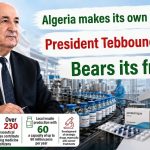
Algeria Produces Its Own Medicine… President Tebboune’s Vision Bears Fruit

Algeria Produces Its Own Medicine… President Tebboune’s Vision Bears Fruit

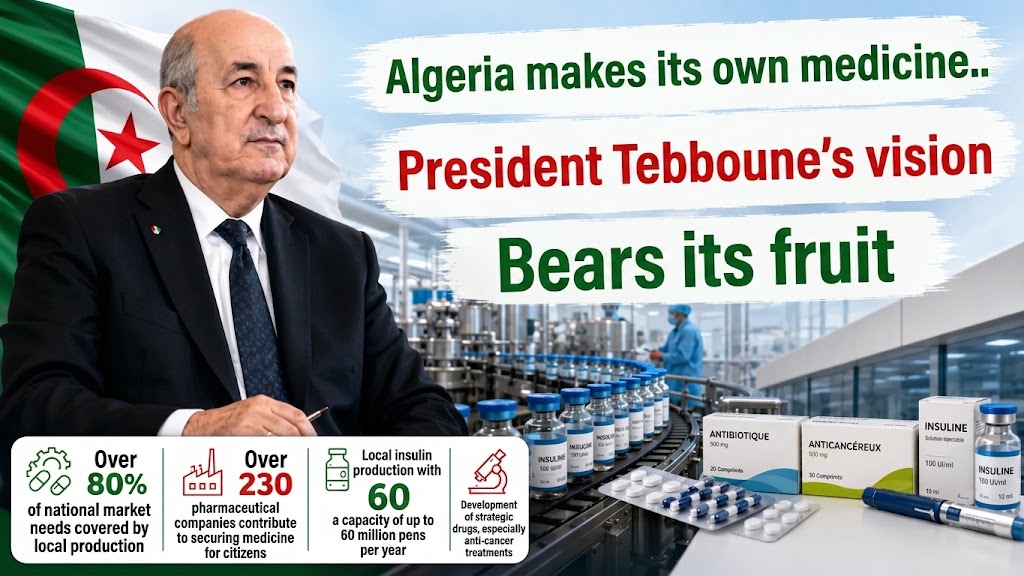
More than 80% of national market needs produced locally

Algeria Gate: The pharmaceutical industry in Algeria is no longer merely an economic sector aimed at supplying medicines. In recent years it has become one of the main pillars of health security and national sovereignty. This path is directly linked to the policy laid down by President Abdelmadjid Tebboune, which focuses on reducing dependence on imports, localizing the production of essential medicines, raising local manufacturing capacity, and ultimately turning Algeria into a production and export platform for African markets.

The figures recorded in the sector reflect the scale of the transformation. President Abdelmadjid Tebboune has stated on numerous occasions that Algeria has raised the coverage of its national medicine needs from locally produced drugs to more than 80%, noting that the pharmaceutical industry has become a strategic sector of national priority for achieving health security.

This figure was not merely political rhetoric. The World Health Organization has confirmed that Algeria now covers more than 80% of its pharmaceutical needs locally. WHO Director-General Tedros Adhanom Ghebreyesus described the Algerian experience as a model that can be followed in Africa and globally in the field of pharmaceutical manufacturing.

233 Companies and More Than 780 Production Lines

The Algerian pharmaceutical industry is also undergoing a measurable transformation through the expansion of the industrial fabric. According to sector data, the number of accredited pharmaceutical manufacturing companies has exceeded 233, including 138 specialized firms, while the number of production lines has surpassed 780, covering various categories of medicines, including complex and strategic products.

There are also 100 new projects under construction, meaning that Algeria’s pharmaceutical industrial map is still in a phase of continuous expansion.

The Ministry of Pharmaceutical Industry has announced that local production now covers approximately 83% of the national market, with more than 4,180 pharmaceutical products manufactured locally out of 5,557 medicines registered in the national formulary. These products include strategic and sensitive medicines, among them drugs for chronic and complex diseases, anti-cancer medicines, biosimilars, and insulin pens.

Here the importance of the path chosen by the state becomes clear: Algeria is not content with manufacturing traditional medicines; it is gradually pushing toward the localization of the most sensitive and complex product; products that for a long time were linked to imports and external partnerships.

From Import to Production… Algeria Reclaims Its Pharmaceutical Decision

The real battle in the pharmaceutical industry does not stop at producing the medicine box locally; it begins with the ability to control the production chain, especially raw materials. For this reason, the Algerian strategy has moved to a new stage based on localizing the essential raw materials needed for drug manufacturing.

In this context, Algeria has launched projects to produce raw materials for cancer medicines. The number of pharmaceutical companies accredited by the Ministry of Pharmaceutical Industry to produce cancer treatment drugs in Algeria has reached 15, of which 11 are currently in operation, according to a ministry official.

Rania Ferli, an official in the Pharmaceutical Production Directorate at the ministry, stated in a declaration to the Algerian News Agency that the national industrial fabric, which includes a total of 233 pharmaceutical companies across various specializations, comprises 11 companies, including the public group Saidal, that currently produce 172 medicines used in the treatment of several types of cancer out of 439 medicines in this field currently marketed to the Central Pharmacy of Hospitals to cover the needs of specialized health institutions.

In a qualitative step, the Saidal Group succeeded in manufacturing Pembrolizumab Saidal, an innovative and globally high-cost medicine, with 22,000 doses marketed through the Central Pharmacy of Hospitals as part of a gradual process of technology transfer and local manufacturing.

The country is also moving toward producing raw materials for other medicines, including paracetamol and antibiotics, reflecting the national industry’s transition from the stage of assembly and formulation to a deeper stage of true manufacturing.

This shift is particularly important after global health crises, foremost among them the COVID-19 pandemic, revealed the fragility of international supply chains and the danger of excessive reliance on external sources for essential health materials.

Local Insulin… Algeria Breaks the Import Monopoly

The insulin file stands out as one of the clearest examples of the localization policy. According to the official strategy of the Ministry of Pharmaceutical Industry, four production units began marketing the first batches of insulin in 2024, with a total production capacity equivalent to double the national needs. This makes the field one of the most important areas in which Algeria has moved from import to local manufacturing.

Regarding insulin pens, production units with a capacity of up to 60 million pens per year have entered operation in Algeria. In March, Biocare-Biotak, a subsidiary of the Biocar Group, announced the launch of two new types of locally produced insulin under a full production model, in a step aimed at strengthening national pharmaceutical security and improving care for diabetes patients in Algeria.

These are the products Glarus Plus 300 U/ML in 1.5 ml and 3 ml volumes, which are manufactured locally according to approved international standards. This allows the expansion of the national network of medicines manufactured inside the country and reduces reliance on imports.

Mohamed Mehdi Slimani, Director General of “Ivecia Care” at Biocar Laboratories, stated that Biocar Group’s production capacity of 60 million pens fully covers national demand, in addition to the creation of a strategic stock that ensures continuity and permanent supply security for this sensitive material.

This launch also allows savings estimated at 23 million euros on the import bill for the sensitive material insulin and contributes to strengthening national health sovereignty.

Import Bill Declines… Local Production Asserts Itself

One of the most important indicators confirming the impact of local manufacturing is the decline in the medicine import bill. According to the Ministry of Pharmaceutical Industry, the import bill fell from about $1.25 billion in 2022 to $718 million in 2023, then to $515 million in 2024, with an additional decline expected in 2025. This has allowed a reduction in the import bill by nearly $482 million.

In parallel, the value of the national medicine market rose from $4.8 billion to $5.5 billion, reflecting growth in the market alongside the expansion of local production.

The value of pharmaceutical product exports also rose from $12.6 million in 2023 to $23.15 million in 2024, according to the same data—more than a threefold increase in a single year.

In hospitals, the value of locally produced medicines directed to supply health institutions rose from 31 billion dinars in 2020 to 107 billion dinars in 2025; growth exceeding 300% over five years.

#Algeria#President tebboune
Author
Lys Iwannughen
View my articles
Algeria
Share this post

Algerian Minister of Culture Malika Bendouda Named Arab “Heritage Personality of the Year”

Algerian Minister of Culture Malika Bendouda Named Arab “Heritage Personality of the Year”

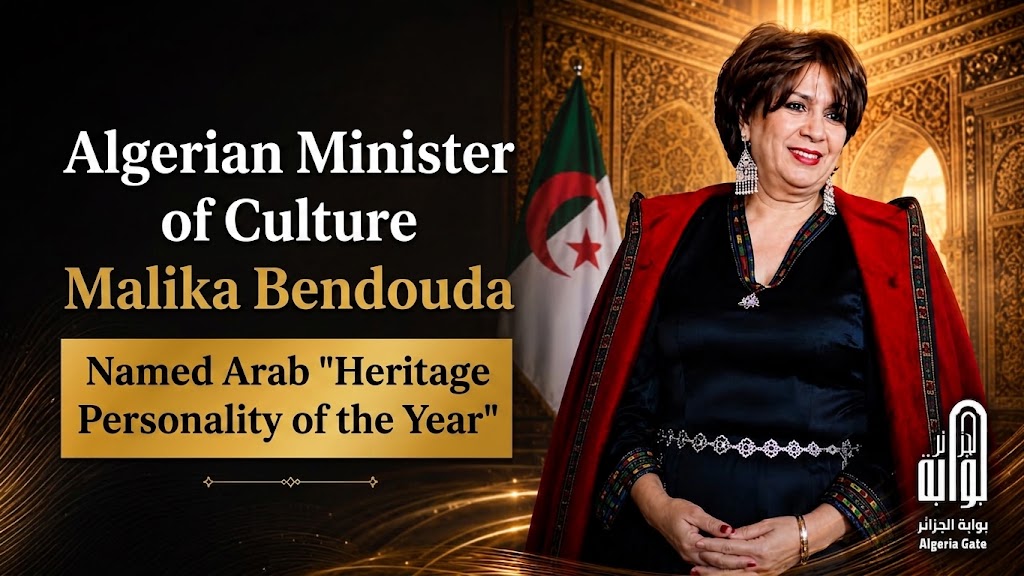
Algeria Gate: The Arab Union for Heritage Media has selected Algerian Minister of Culture and Arts Malika Bendouda as the recipient of the “Heritage Personality of the Year” title in the first edition of the Arab Heritage Media Awards for 2026.

The choice recognizes her role in supporting and protecting Algeria’s cultural heritage, both tangible and intangible, and in strengthening its presence in the cultural scene as a fundamental component of national identity and collective memory.

This selection reflects Arab appreciation for efforts to preserve, document, and enhance Algeria’s cultural heritage, while highlighting its diversity and richness and promoting its visibility at both Arab and international levels.

https://twitter.com/algatedzEng/status/2090136809359499427?s=20

The award also underscores the importance of the approach pursued by the Ministry of Culture and Arts, which treats heritage as a living memory that must be safeguarded and connected to new generations, as well as leveraged in cultural, social, economic, and developmental fields.

The recognition carries an Arab dimension by valuing Algeria’s growing role in protecting tangible and intangible heritage and by strengthening cooperation among Arab countries in this domain, regarding cultural heritage as part of the region’s shared memory.

The Arab Heritage Media Awards, in their first edition, cover a wide range of categories including press, radio and television, documentary films, digital programs and podcasts, photography and books, as well as heritage festivals and initiatives. This reflects the diversity of media and cultural roles in promoting and protecting heritage.

An Arab jury evaluated the submissions according to professional criteria, including accuracy, documentary and creative value, quality of presentation, contribution to promoting and preserving heritage, and the ability of works and initiatives to reach new generations.

For its part, the Algerian Ministry of Culture and Arts welcomed this Arab recognition, considering it an addition to the national efforts aimed at protecting, documenting, and enhancing Algeria’s cultural heritage and strengthening its presence in cultural life, thereby contributing to the preservation of national memory and ensuring its transmission:alive and renewed, to future generations.

#Algeria#Culture#Malika Bendouda
Author
Lys Iwannughen
View my articles
Algeria
Share this post

Important Notice for Passengers on the Algiers–Marseille Sea Voyage!

Important Notice for Passengers on the Algiers–Marseille Sea Voyage!

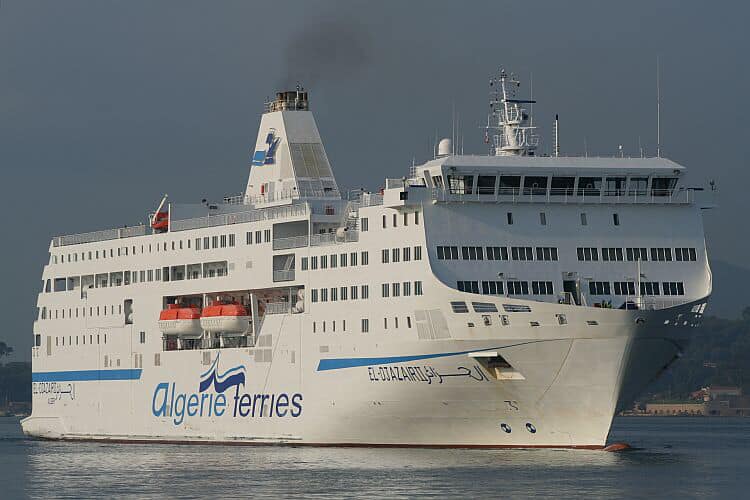
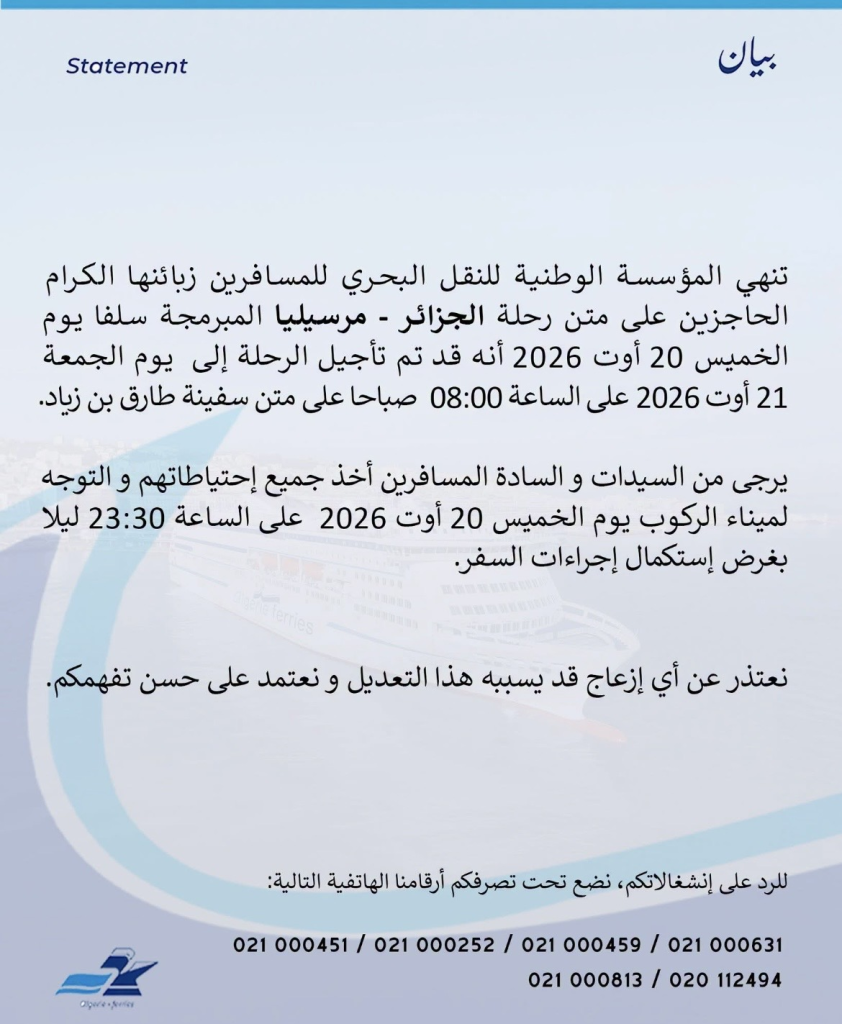
Algeria Gate: The Algerian Maritime Passenger Transport Company has announced the postponement of the scheduled sea voyage on the Algiers–Marseille line, which was due to depart on Thursday, 20th August 2026, to Friday, 21st August 2026 at 8:00 a.m.

https://twitter.com/algatedzEng/status/2090128893357277636?s=20

The company clarified that the voyage will take place on board the ship “Tariq Ibn Ziyad” and invited the affected passengers to go to the Port of Algiers on Thursday, 20th August at 11:30 p.m. to complete the travel formalities.

The company also asked passengers to take all necessary precautions in view of this change, offered its apologies for any inconvenience that may result from the schedule modification, and expressed its reliance on the understanding of its valued customers.

Important Notice for Passengers on the Algiers–Marseille Sea Voyage!
#Algeria
Author
Lys Iwannughen
View my articles