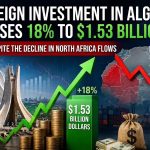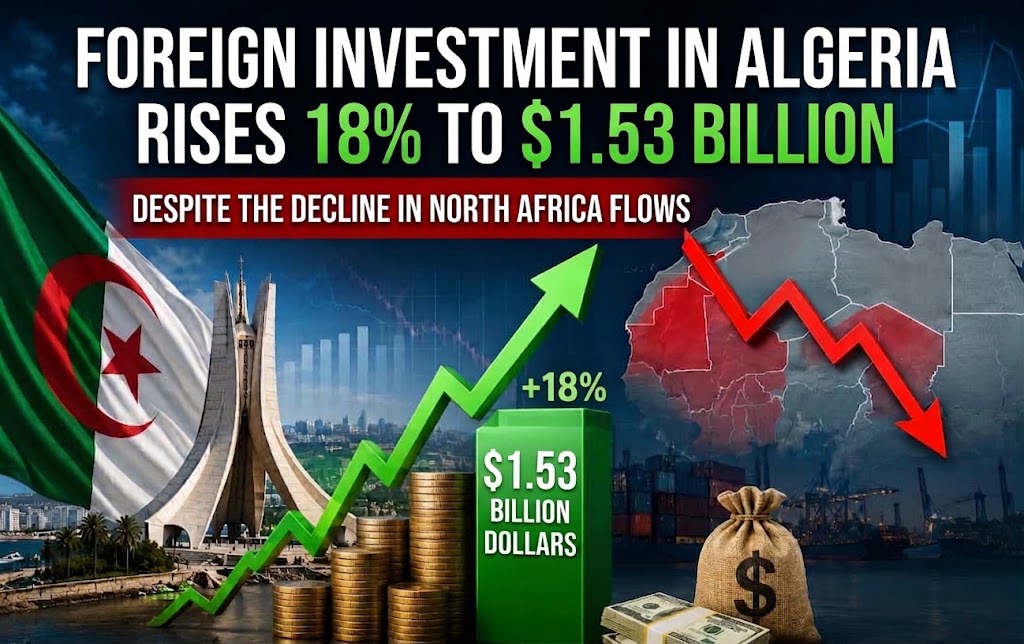
Algeria Gate: Algeria attracted $1.53 billion in foreign direct investment (FDI) during 2025, an increase of 18.15% compared with 2024, while the cumulative stock of foreign investments present in the country rose to $39.67 billion, according to the World Investment Report 2026 issued by the United Nations Conference on Trade and Development (UNCTAD).
This rise places Algeria in an advanced position within North Africa, after the region recorded a sharp decline of 56% in FDI inflows, from $51.269 billion in 2024 to $22.394 billion in 2025.
The UN report, published on 7 July 2026, stated that Algeria stood out among African countries that attracted major investment projects in hydrocarbons, refining, and industrial activities. It also listed Algeria among the economies that expanded foreign investment participation in the mining sector over the past year. UNCTAD: World Investment Report 2026
This performance comes at a time when FDI inflows to the African continent fell from $94.294 billion in 2024 to $69.506 billion in 2025, making the growth of flows toward Algeria contrary to the downward trend recorded at both the African and regional levels.
$1.53 Billion and Highest Flows Since 2020
UNCTAD data show that Algeria attracted $1.295 billion in FDI during 2024 before the flows rose to $1.530 billion in 2025; an increase of $235 million in a single year.
This level represents the highest annual inflows recorded by Algeria during the period covered by the report’s statistical annex, extending from 2020 to 2025.
FDI inflows stood at $1.140 billion in 2020, then fell to $870 million in 2021, before dropping to $255 million in 2022.
Flows then resumed an upward path, rising to $1.202 billion in 2023, then $1.295 billion in 2024, and reaching $1.530 billion in 2025.
These figures mean that FDI flows into Algeria multiplied sixfold compared with their 2022 level, equivalent to growth of 500% over three years.
At the North African level, Algeria ranked third in terms of FDI inflows in 2025, after Egypt, which attracted $15.453 billion, and Morocco, which recorded $3.338 billion. Tunisia followed Algeria with inflows of $1.173 billion, then Libya with about $828 million.
Algeria’s share amounted to roughly 6.8% of total FDI inflows to North Africa and about 2.2% of the flows recorded within the African continent.
The large regional decline is mainly due to the high base of comparison in Egypt in 2024, when the Ras El Hekma real-estate and investment project boosted flows exceptionally.
Excluding the effect of non-recurring mega-projects, the UNCTAD report noted that FDI inflows to Africa in 2025 remained about one-third higher than the average for the period 2010–2024.
In this context, Algeria recorded a continuous increase in flows over three consecutive years, reflecting an improvement in its ability to attract foreign capital compared with the decline recorded at the beginning of the period.
Foreign Investment Stock Reaches $39.67 Billion
In addition to the rise in annual flows, the stock of FDI present in Algeria reached $39.670 billion in 2025, compared with $38.140 billion in 2024.
That represents an increase of $1.530 billion, or approximately 4.01% in a single year.
The FDI stock measures the cumulative value of investments present in the economy, while annual flows express new investments or the net change recorded during a specific year.
The historical series shows that the stock of foreign investment in Algeria rose from $3.379 billion in 2000 to $19.545 billion in 2010, before reaching $38.140 billion in 2024 and then $39.670 billion in 2025.
Thus the cumulative stock of foreign investments in Algeria multiplied about 11.7 times since 2000 and more than doubled the level recorded in 2010.
At the regional level, the total stock of FDI in North Africa reached $435.726 billion in 2025, giving Algeria a share of approximately 9.1% of total foreign investments present in the region.
The stock of Algerian direct investments abroad also rose to $3.029 billion in 2025, compared with $2.976 billion in 2024—an increase of $53 million.
Algerian direct outflows reached $53 million in 2025, after recording only $300,000 in 2024 and $165 million in 2023.
The stock of Algerian investments abroad stood at $205 million in 2000, before rising to $1.505 billion in 2010 and then exceeding $3 billion in 2025.
Mining Law Expands Participation of Foreign Investors
The World Investment Report 2026 linked Algeria’s position within investment liberalization policies to the measures adopted in the mining sector, noting that a limited number of global measures during 2025 targeted sectors outside services, including mining activity in Algeria.
The reference concerns Law No. 25-12 of 3 August 2025, which reorganized mining activities and expanded the possibilities for foreign investors to participate in exploration and exploitation projects.
According to UNCTAD’s Investment Policy Hub, the new framework allows foreign participation of up to 80% in companies tasked with exploiting mines, while a public Algerian institution retains a stake of no less than 20%. UNCTAD: Algeria expands foreign investment participation in mining projects
In contrast, quarry activities remain subject to a foreign participation ceiling of 49%, with the Algerian public side retaining a stake of no less than 51%.
The law requires that a company established under Algerian law hold the exploitation licenses, thereby linking the entry of foreign capital to an institutional presence inside Algeria and partnership with national institutions.
The U.S. Department of Commerce, in a note published on March 18th 2026, confirmed that the new reform allows foreign investors to hold up to 80% of mining projects, provided they establish a partnership with Algerian public institutions. U.S. Department of Commerce: Reform of mining legislation in Algeria
This framework grants the mining sector wider scope to attract capital and technical expertise in exploration, extraction, and processing, particularly amid rising global demand for minerals and raw materials linked to industry, energy, and technological transformation.
The importance of the reform also lies in linking mining projects to local manufacturing chains, including the processing of ores, production of industrial inputs, and increasing value added rather than limiting activity to the export of raw materials.
The law also provides a basis for expanding investment in phosphate, iron, and other mineral materials, with the necessity that new projects be linked to technology transfer, the development of engineering services, and the integration of Algerian institutions into supply chains.
Energy Projects Support Investment Attractiveness
The UNCTAD report listed Algeria among a group of African countries that attracted major investment projects in hydrocarbons, refining, energy storage, and industrial activities.
This reference is consistent with the international contracts Algeria concluded during 2025 to develop oil and gas production and expand exploration operations.
On July 7th 2025, Sonatrach and the Italian company Eni signed a production-sharing contract in the Zemoul El Kebir area of the Berkine Basin, with total investments estimated at $1.35 billion.
Project estimates include the production of 415 million barrels of oil equivalent over the contract period, including 9.3 billion cubic meters of gas. Reuters: Sonatrach-Eni contract worth $1.35 billion
On 24 July 2025, the Chinese company Sinopec signed a contract to explore and develop the Ghern El Kassa II block in the Gourara-Timimoun Basin, following an earlier agreement worth $850 million to develop the Hassi Berkane North field. Reuters: Sinopec agreement to explore a gas block in Algeria
Sonatrach then signed a contract on 13 October 2025 with the Saudi company Medad Energy worth $5.4 billion to develop oil and gas resources in the Illizi Basin.
The contract extends for 30 years, with the possibility of a further 10-year extension, while the Saudi company allocated $288 million for the exploration phase that lasts seven years.
The resources expected to be developed are estimated at about 993 million barrels of oil equivalent, including 125 billion cubic meters of natural gas. Reuters: Algeria-Medad Energy agreement worth $5.4 billion
On 14 April 2026, the National Agency for the Valorization of Hydrocarbon Resources (ALNAFT) granted the British company BP a license to carry out reconnaissance work in the Eastern Basin, as part of a drive to expand exploration in under-exploited areas.
The agency clarified that the hydrocarbon mining domain in Algeria extends over more than 1.7 million square kilometers, with vast areas that still require geological studies and advanced exploration techniques. Reuters: New license for BP for reconnaissance in Algeria
These developments fall within an energy investment program running from 2025 to 2029 valued at $60 billion, according to previous statements by the Minister of State, Minister of Hydrocarbons and Mines Mohamed Arkab.
Arkab stated in October 2025 that 80% of this envelope would be directed to exploration and production activities, while the remainder would be allocated to refining and petrochemical projects.
He also pointed to the launch of renewable energy projects with a capacity of 3,200 MW, affirming Algeria’s commitment to the energy transition while preserving the place of natural gas within its economic system. Reuters: Algeria allocates $60 billion for energy investment between 2025 and 2029
However, the value of the announced contracts and programs does not necessarily equate to the FDI flows recorded in a single year, because project implementation occurs in stages and the overall envelopes may include both national and foreign contributions spread over several years.
UNCTAD data show that the direct impact of foreign investments in Algeria during 2025 amounted to $1.53 billion, while the energy and mining contracts form a base that could support flows in the coming years if the announced projects move into the stages of financing, execution, and production.
With the cumulative stock of foreign investment rising to $39.67 billion and the expansion of investor participation in mining activity, the economic challenge is shifting toward raising the share of industrial and processing projects, strengthening local integration, attracting technology, and converting investment flows into exports, jobs, and added value inside Algeria.