
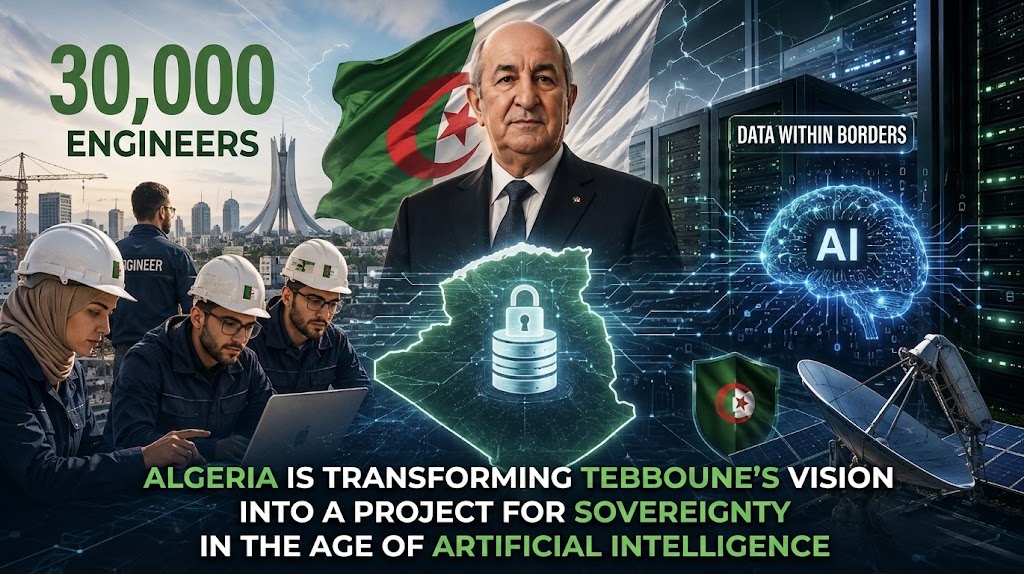
Algeria Gate: Algeria is not merely digitizing. Under President Abdelmadjid Tebboune, it is building the foundations of technological sovereignty in the age of artificial intelligence.
Thirty thousand AI engineers and specialists by 2030. Sovereign open-source models. High-performance computing on national soil. Public data that never leaves Algerian territory. These pillars are converging into a deliberate national project that refuses to treat AI as an imported product and instead treats it as a strategic capacity that must be owned.
A report by the American platform Muslim Network TV on 20 August 2026 placed the roadmap on the international radar. But the real story is older and more methodical. This is no late reaction to the global AI race. It is the outcome of years of sequential decisions: the creation of the National Higher School of Artificial Intelligence, the introduction of national data governance, the building of digital infrastructure, the interconnection of government databases, and the conversion of strategy into joint programs. The school’s first class graduated in June 2026. What began as an investment in the “economy of tomorrow” is now scaled to tens of thousands of specialists.
The 30,000 target is not a training slogan. Algeria is constructing the full chain of sovereignty: the people who design the systems, the data that train them, the computing power that runs them, the infrastructure that hosts them, and the rules that protect them.
Data first
On 9 February 2026, under President Tebboune’s high patronage, the national data-governance system entered service. Data were declared strategic national assets requiring organization, protection, and controlled use; explicitly linked to producing reliable, interoperable data for advanced AI models while respecting cybersecurity and personal-data protection.
Buying an AI application is easy. Building an AI ecosystem is not. Sovereignty demands organized data, secure hosting, computing capacity, skilled personnel, and institutions exchanging information under common rules. That logic drove the May decisions on a national decision-support system and the AI strategy itself, which named three pillars: data, digital infrastructure, and human skills.
In July the President inaugurated the National Center for Digital Services in Mohammedia and ordered rapid inter-sectoral interconnection. The center would not remain symbolic. At the same time, Algeria secured a seat at the table: on 16 July it became a founding member of the World Artificial Intelligence Organization in Shanghai. Capacity at home, voice abroad.
From buying intelligence to owning its foundations
By early August the strategy moved into coordinated implementation. The joint roadmap prioritizes sovereign open-source models, high-performance computing centers, secure domestic data storage, intensive training, and research structures that turn academic work into industrial applications.
The economic logic is clear. Closed foreign systems drain value through licensing, hosting, and support. Local development keeps that value circulating among Algerian engineers, software firms, data centers, cybersecurity companies, and start-ups. Open-source models allow systems adapted to Algeria’s administrative, linguistic, and economic reality. Domestic high-performance computing breaks dependence on foreign clouds. And government data; health, education, taxation, social services, are strategic assets. Keeping them inside a secure national infrastructure is basic statecraft.
Building the human capital
At the center stands Algeria’s decisive resource: its people. After the first graduating class of just over one hundred, the target is 30,000 by 2030; machine-learning engineers, data scientists, cybersecurity experts, infrastructure specialists, language-processing researchers, and professionals who can apply AI across energy, agriculture, healthcare, industry, finance, and transport.
Training alone is not enough. Algeria must create the market that retains them. AI and cybersecurity start-up clusters, including the one in Sidi Abdellah, link universities to companies that turn knowledge into products. Universities produce expertise, data centers provide infrastructure, computing turns knowledge into models, start-ups turn models into applications, and government and industry create demand. Every link that stays inside Algeria retains knowledge, intellectual property, jobs, and value.
Sovereignty in the age of algorithms
This is not about adding chatbots to websites. It is about entering the AI era while controlling as many of its essential foundations as possible. Not technological autarky, even the largest economies depend on international chains, but strategic autonomy: deciding when to use foreign technology, when to develop a national alternative, where critical data are stored, who can access them, and how much digital spending can be redirected to Algerian companies and jobs.
The same infrastructure can later support predictive maintenance in energy, precision agriculture, healthcare diagnostics, industrial quality control, logistics, and finance. Investment in AI becomes investment in the productivity of the entire economy.
Implementation will be the test; computing capacity brought online, sovereign applications deployed, databases made interoperable, Algerian companies winning contracts, and progress toward 30,000 specialists. Yet the direction is already clear.
What once looked like separate initiatives are locking into a coherent national architecture. Under President Tebboune, Algeria is extending sovereignty itself: after political decisions and natural resources comes sovereignty over data, computing power, and algorithms.
If the country connects its specialists, national data, computing centers, research institutions, and open-source models into a functioning ecosystem, the real achievement of 2030 will not be a headcount. It will be an Algerian technological capacity producing a substantial part of the intelligence the nation needs, with Algerian skills, on Algerian infrastructure, using Algerian data, under Algerian control.