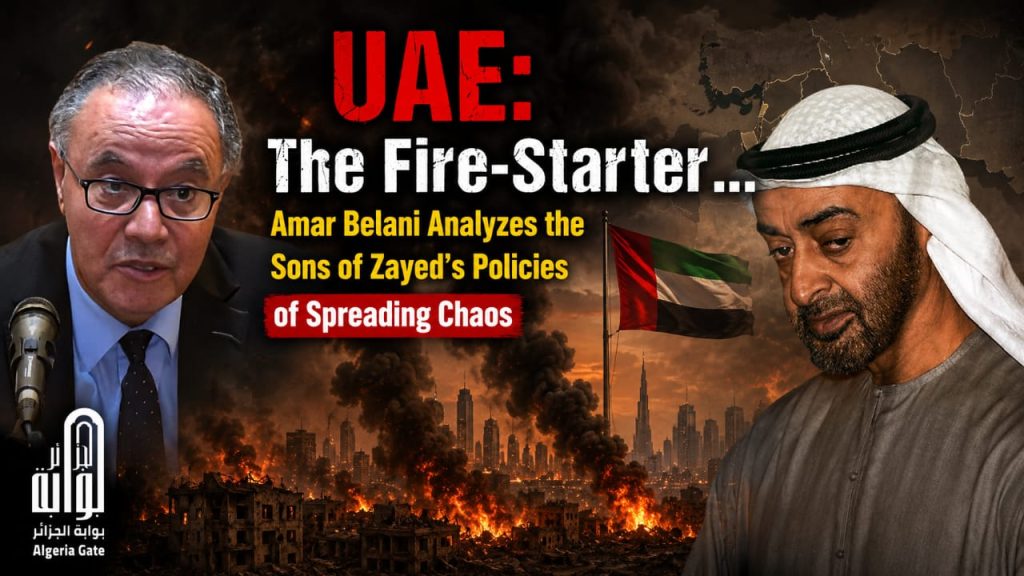
Amar Belani; former Ambassador
Algeria Gate: Mohammed bin Zayed has set the United Arab Emirates on a reckless bid for regional power that it was never built to hold. A confetti-state with neither the population nor the territory of a true power, Abu Dhabi compensates with vast wealth, world-class infrastructure, dense influence networks and a rapidly expanding defense industry. The formula is simple: invest heavily, cultivate local proxies, and build autonomous military muscle. The result is influence wildly out of proportion to the country’s size.
Yet the method rests on a fatal contradiction. To prosper, Abu Dhabi multiplies interference, leans on fragile states, local forces, militias and shadowy economic networks; exactly the forces that hollow out the central institutions of the countries it claims to engage.
The Sahel offers a clear case. The Emirates; working with its strategic partners, Israel and Morocco, is pushing economic and financial footholds into the Alliance of Sahel States. The goal goes beyond investment: it targets infrastructure, trade routes and financial circuits in what has long been Algeria’s strategic depth. The move is deliberate and hostile, designed to shrink Algiers’ room to defend its southern interests. Dubai, meanwhile, has become the hub for African gold. Much of the Sahel’s production travels informal channels before reaching Emirati markets, feeding parallel economies and the mafias that orbit conflict.
Yemen is the purest expression of this cynical playbook. After joining the Saudi-led intervention against the Houthis in 2015, the Emirates built its own network of southern forces. At Abu Dhabi’s instigation, the Southern Transitional Council pursues separatist aims. The partner supposedly helping rebuild the Yemeni state is arming a force whose purpose is to tear it apart.
The same fragmenting logic operates in Sudan. Abu Dhabi backs dissident forces and separatist impulses to seize control of Darfur’s gold. In Libya it has long supported Khalifa Haftar alongside Egypt, consolidating a rival military power against the internationally recognized government. UN reports have repeatedly documented Emirati breaches of the arms embargo. Southern Libya has become a transit zone linking Haftar’s circle to Sudan’s Rapid Support Forces, closing the circuit.
Tunisia saw a similar attempt to plant durable political, financial and diplomatic networks against Islamist currents viewed as close to the Turkey-Qatar axis. The method never changes: bet on local partners willing to serve Emirati interests, even if it destabilizes institutional balances.
Sudan remains the bloodiest theater. Since the war began, the Rapid Support Forces of Mohamed Hamdan Dagalo have received massive Emirati backing. Abu Dhabi denies it; international investigations keep confirming the presence of Emirati-origin military equipment. The result is a policy that fuels conflict through seditious local actors and sustains war crimes against civilians.
In the Horn of Africa the Emirates has woven a web of ports, airstrips and footholds around the Red Sea and Gulf of Aden; Berbera, Socotra, Mayun, Assab and more. Some of these “commercial” assets carry clear dual-use potential. Support for Somaliland prioritizes a pliable partner over Somali state authority. Israel’s recognition of Somaliland has tightened operational proximity between Abu Dhabi and Tel Aviv, sharpening rivalry with Turkey and Egypt, which back Somali unity. DP World and AD Ports investments follow the same pattern: commercial gains that create strategic access and future political leverage.
This economic reach travels with military ambition. The creation of the EDGE defense conglomerate in 2019 signals the drive to produce drones, missiles, armored vehicles, ships and electronics at home. Autonomy expands freedom of action. The Abraham Accords and the deployment of Israeli air-defense systems on Emirati soil have accelerated technology transfers.
The Saudi-Emirati rivalry has moved beyond personalities. It is now a clash of power models. Abu Dhabi intends to remain the region’s premier financial, commercial and logistical platform. Riyadh, through Vision 2030, wants Saudi Arabia to claim that role. Yemen, Sudan and the Horn have become the main arenas of this competition.
The emerging Saudi-Turkey-Pakistan alignment around the Mecca pact is partly a response. Officially about collective security, it also gives Riyadh tools to loosen dependence on Washington and contain Abu Dhabi’s growing autonomy. Turkey brings defense industry and operational experience; Pakistan brings military capacity and a nuclear dimension; Saudi Arabia brings money and political weight. For Ankara the project is more than tactical: it is the outline of a regional security architecture grounded in sovereignty and mutual trust, with Turkey at the center.
Sudan may be the first test. Turkey supports the Sudanese army, Saudi Arabia has moved closer, Pakistan has provided material backing, while the RSF remains tied to the network attributed to the Emirates. The Riyadh-Abu Dhabi contest is now fought through proxies. Egypt keeps its distance, constrained by economic interdependence and Emirati financial support. Turkey, by contrast, seeks to convert military and industrial strength into broader political reach across the Middle East, Mediterranean and Africa.
No formal anti-Emirati front has yet formed. But the contestation of Abu Dhabi’s model is growing. That model thrives by exploiting regional fractures; and, through relentless interference, deepens them.