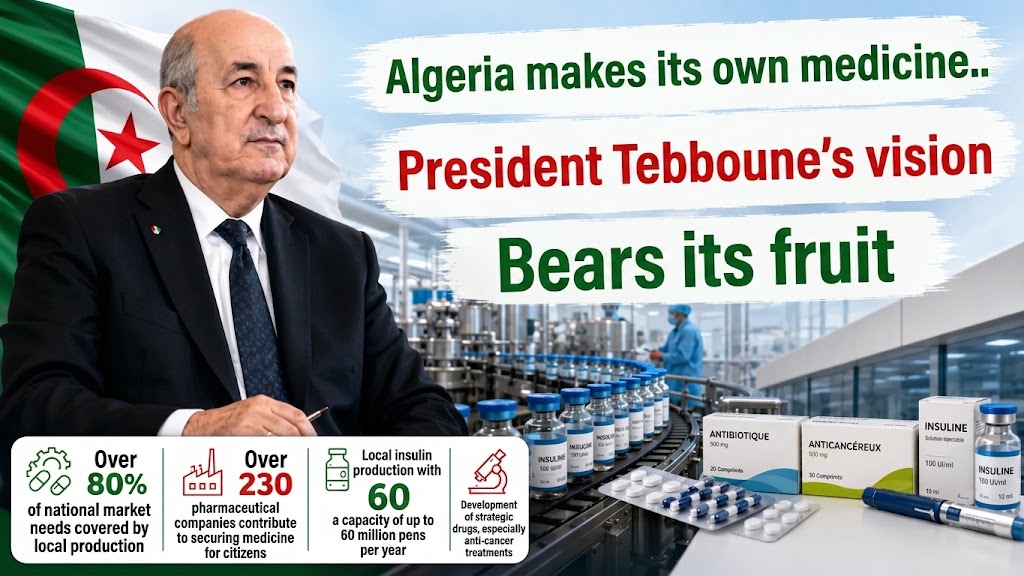
More than 80% of national market needs produced locally
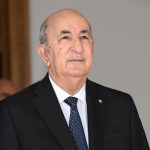
Algeria Gate: The pharmaceutical industry in Algeria is no longer merely an economic sector aimed at supplying medicines. In recent years it has become one of the main pillars of health security and national sovereignty. This path is directly linked to the policy laid down by President Abdelmadjid Tebboune, which focuses on reducing dependence on imports, localizing the production of essential medicines, raising local manufacturing capacity, and ultimately turning Algeria into a production and export platform for African markets.
The figures recorded in the sector reflect the scale of the transformation. President Abdelmadjid Tebboune has stated on numerous occasions that Algeria has raised the coverage of its national medicine needs from locally produced drugs to more than 80%, noting that the pharmaceutical industry has become a strategic sector of national priority for achieving health security.
This figure was not merely political rhetoric. The World Health Organization has confirmed that Algeria now covers more than 80% of its pharmaceutical needs locally. WHO Director-General Tedros Adhanom Ghebreyesus described the Algerian experience as a model that can be followed in Africa and globally in the field of pharmaceutical manufacturing.
233 Companies and More Than 780 Production Lines
The Algerian pharmaceutical industry is also undergoing a measurable transformation through the expansion of the industrial fabric. According to sector data, the number of accredited pharmaceutical manufacturing companies has exceeded 233, including 138 specialized firms, while the number of production lines has surpassed 780, covering various categories of medicines, including complex and strategic products.
There are also 100 new projects under construction, meaning that Algeria’s pharmaceutical industrial map is still in a phase of continuous expansion.
The Ministry of Pharmaceutical Industry has announced that local production now covers approximately 83% of the national market, with more than 4,180 pharmaceutical products manufactured locally out of 5,557 medicines registered in the national formulary. These products include strategic and sensitive medicines, among them drugs for chronic and complex diseases, anti-cancer medicines, biosimilars, and insulin pens.
Here the importance of the path chosen by the state becomes clear: Algeria is not content with manufacturing traditional medicines; it is gradually pushing toward the localization of the most sensitive and complex product; products that for a long time were linked to imports and external partnerships.
From Import to Production… Algeria Reclaims Its Pharmaceutical Decision
The real battle in the pharmaceutical industry does not stop at producing the medicine box locally; it begins with the ability to control the production chain, especially raw materials. For this reason, the Algerian strategy has moved to a new stage based on localizing the essential raw materials needed for drug manufacturing.
In this context, Algeria has launched projects to produce raw materials for cancer medicines. The number of pharmaceutical companies accredited by the Ministry of Pharmaceutical Industry to produce cancer treatment drugs in Algeria has reached 15, of which 11 are currently in operation, according to a ministry official.
Rania Ferli, an official in the Pharmaceutical Production Directorate at the ministry, stated in a declaration to the Algerian News Agency that the national industrial fabric, which includes a total of 233 pharmaceutical companies across various specializations, comprises 11 companies, including the public group Saidal, that currently produce 172 medicines used in the treatment of several types of cancer out of 439 medicines in this field currently marketed to the Central Pharmacy of Hospitals to cover the needs of specialized health institutions.
In a qualitative step, the Saidal Group succeeded in manufacturing Pembrolizumab Saidal, an innovative and globally high-cost medicine, with 22,000 doses marketed through the Central Pharmacy of Hospitals as part of a gradual process of technology transfer and local manufacturing.
The country is also moving toward producing raw materials for other medicines, including paracetamol and antibiotics, reflecting the national industry’s transition from the stage of assembly and formulation to a deeper stage of true manufacturing.
This shift is particularly important after global health crises, foremost among them the COVID-19 pandemic, revealed the fragility of international supply chains and the danger of excessive reliance on external sources for essential health materials.
Local Insulin… Algeria Breaks the Import Monopoly
The insulin file stands out as one of the clearest examples of the localization policy. According to the official strategy of the Ministry of Pharmaceutical Industry, four production units began marketing the first batches of insulin in 2024, with a total production capacity equivalent to double the national needs. This makes the field one of the most important areas in which Algeria has moved from import to local manufacturing.
Regarding insulin pens, production units with a capacity of up to 60 million pens per year have entered operation in Algeria. In March, Biocare-Biotak, a subsidiary of the Biocar Group, announced the launch of two new types of locally produced insulin under a full production model, in a step aimed at strengthening national pharmaceutical security and improving care for diabetes patients in Algeria.
These are the products Glarus Plus 300 U/ML in 1.5 ml and 3 ml volumes, which are manufactured locally according to approved international standards. This allows the expansion of the national network of medicines manufactured inside the country and reduces reliance on imports.
Mohamed Mehdi Slimani, Director General of “Ivecia Care” at Biocar Laboratories, stated that Biocar Group’s production capacity of 60 million pens fully covers national demand, in addition to the creation of a strategic stock that ensures continuity and permanent supply security for this sensitive material.
This launch also allows savings estimated at 23 million euros on the import bill for the sensitive material insulin and contributes to strengthening national health sovereignty.
Import Bill Declines… Local Production Asserts Itself
One of the most important indicators confirming the impact of local manufacturing is the decline in the medicine import bill. According to the Ministry of Pharmaceutical Industry, the import bill fell from about $1.25 billion in 2022 to $718 million in 2023, then to $515 million in 2024, with an additional decline expected in 2025. This has allowed a reduction in the import bill by nearly $482 million.
In parallel, the value of the national medicine market rose from $4.8 billion to $5.5 billion, reflecting growth in the market alongside the expansion of local production.
The value of pharmaceutical product exports also rose from $12.6 million in 2023 to $23.15 million in 2024, according to the same data—more than a threefold increase in a single year.
In hospitals, the value of locally produced medicines directed to supply health institutions rose from 31 billion dinars in 2020 to 107 billion dinars in 2025; growth exceeding 300% over five years.