Algeria Gate / Agencies: Through its complicity and turning a blind eye, the Makhzen is consolidating Morocco as a nurturing environment for secret laboratories producing hallucinogens and psychotropic substances, in a transition from a notable focus on the traditional hashish economy to the manufacture of chemical drugs and their smuggling across borders. Meanwhile, the activities of trafficking networks and the laundering of proceeds are expanding, turning the kingdom into a regional platform for manufacturing these poisons and flooding neighboring countries with them.

International data show that the shift is no longer limited to smuggling hard drugs but has extended to processing and converting them inside the kingdom. The Geneva-based international research network Global Initiative Against Transnational Organized Crime, which deals with cross-border organized crime and drug trafficking issues, highlighted the existence of a cocaine conversion laboratory in the city of Oujda, Morocco, since 2016, run by chemists and linked to the processing of 250 kilograms of refined cocaine that same year.
These facts expose Morocco’s central role, for years, in processing cocaine, and the appearance of locally manufactured substances shows the extent to which Moroccan criminal networks have developed their capabilities in this field.
In this regard, “boufa,” known as the “poor man’s cocaine,” has emerged as one of the most prominent manifestations of local manufacturing. It is a substance prepared from cocaine residues, chemicals, and drugs, and first appeared in Morocco in 2020 before expanding remarkably. However, “boufa” is only one face of a broader shift in the nature of drugs produced inside and outside the kingdom.
In January 2026, official data themselves acknowledged that more than four million psychotropic tablets were manufactured locally in a limited period inside secret laboratories, coinciding with the appearance of new psychotropic substances and the complexity of production networks and transit routes.
In this specific framework, Spanish investigations reveal that Moroccan manufacturing does not occur in isolation from abroad but relies on a cross-border network.
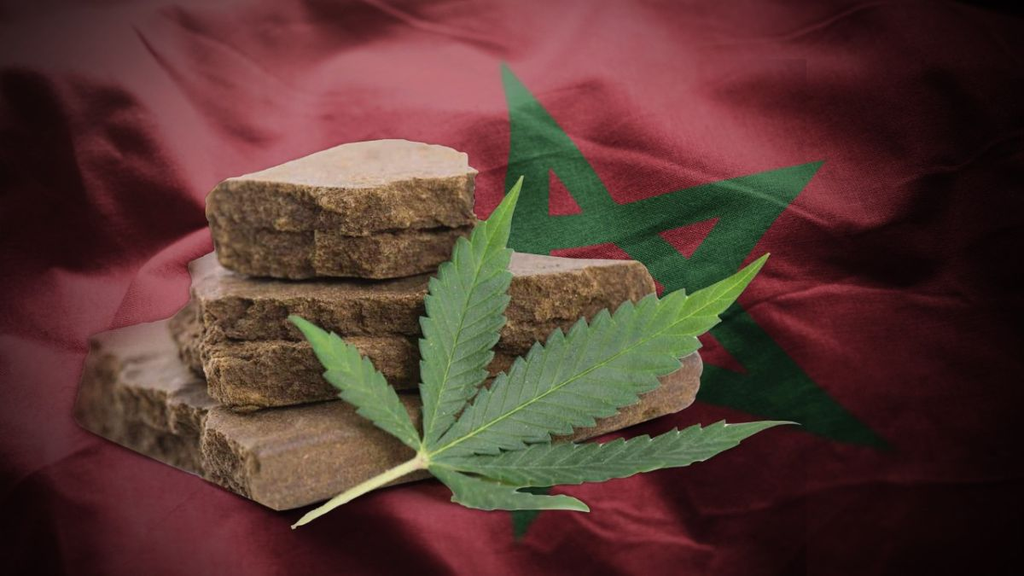
In January 2022, the Spanish police announced the dismantling of an international criminal network that was trafficking medicines used in the manufacture of what is known as the “Karkoubi” tablet inside Morocco (a type of psychotropic substance converted into hallucinogenic drugs). They seized 200,000 psychotropic tablets in Spain, while total seizures exceeded around 500,000 tablets as an extension of the same operation.
This case illustrates a broader meaning of the development of manufacturing inside the kingdom, as it reveals that some raw materials come from abroad as legitimate medicines before entering an illegal manufacturing process to produce hallucinogens inside Morocco.
Spanish public broadcaster RTVE clarified that “Karkoubi” is manufactured in Morocco using medicines coming from abroad, such as those related to epilepsy, before being transformed into a narcotic substance.
Thus, neighboring countries find themselves facing the repercussions of a criminal system that begins with obtaining pharmaceutical materials and ends with a dangerous drug manufactured in laboratories distributed across various cities of the kingdom, while the affected communities outside Morocco bear the high cost of the expansion of these networks.

The newspaper El País reinforces this picture in an investigation published in 2024 on Rivotril (a pharmaceutical substance for treating epilepsy and panic), highlighting that Spain sells nearly four million boxes annually and that a large part of these quantities ends up in illegal channels before the drug is used in preparing “Karkoubi” in Morocco.
The newspaper also cited Spanish police estimates speaking of profits exceeding 100 million euros annually achieved by organized Moroccan criminal groups from this activity.
Here appears the capacity of the criminal economy to convert a legitimately available pharmaceutical substance into a source of financing for a drug trade that extends outside the kingdom.

These networks do not stop at a single path, as European investigations reveal the extension of their activity linked to Morocco through multiple routes. In June 2025, Spanish police dismantled a network operating between Morocco and Spain and seized a huge quantity of one of the most dangerous types of hallucinogens, the “clonazepam” tablet, along with 22 kilograms of hashish.