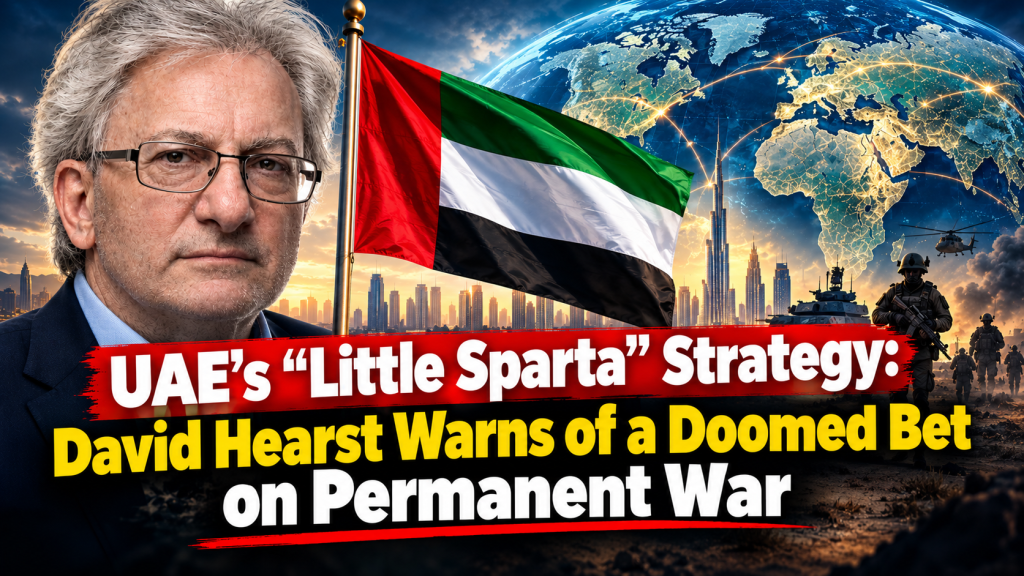
Opinion article by David Hearst (Executive Editor of Middle East Eye)

Algeria Gate: In a sharply critical opinion piece, David Hearst, executive editor of Middle East Eye, contends that the United Arab Emirates, alongside the United States and Israel, is working to normalise a condition of permanent war throughout the Middle East. Hearst argues that Mohamed bin Zayed is repeating the familiar mistake of major powers that prioritise hard power over soft power.

He begins by noting how both Vladimir Putin and Donald Trump have declined to describe their military operations as “wars;” in Ukraine and against Iran, despite the heavy human and material toll. As a concrete illustration, Hearst points to the crew of the American aircraft carrier USS Abraham Lincoln, which endured 286 consecutive days at sea and returned clearly exhausted. The same pattern of denial, he suggests, now defines Abu Dhabi’s approach to the region.
United States intelligence assessments, according to Hearst, show that Iran emerged from the recent confrontation with greater confidence in its military strength. Tehran has openly declared a shift toward “pre-emptive” operations, a change that further weakens the notion that regional coercion can deliver lasting strategic results.
The article presents the UAE as a calculated “chaos actor.” While projecting an image of tolerance, modernity and openness; through a Ministry of Tolerance, towering skyscrapers and prominent sports investments, Abu Dhabi is accused of quietly directing money, mercenaries and weapons into several conflict zones. Hearst highlights the use of Bosaso port in Somalia as one link in a discreet supply network that has allegedly helped sustain fighting in Libya and Sudan, even as official denials continue.
This dual character is most evident, Hearst writes, in Sudan. The Emirates is accused of supplying arms to the Rapid Support Forces (RSF), the militia facing charges of war crimes and ethnic cleansing in Darfur. Routes through Chad and Libya, combined with the recruitment of Colombian mercenaries, form part of what the author describes as a deliberate effort to keep the conflict going.

A similar pattern is visible in the UAE’s expanding military ties with Israel. Despite famine and what numerous international observers call genocide in Gaza, the Israeli defence firm Elbit Systems concluded a $2.3 billion arms agreement with Abu Dhabi; the largest single contract in Israel’s history. At the same time, Hearst notes a growing convergence between the UAE, Israel and elements of the European far right, including figures such as Nigel Farage, who exploit Islamophobic themes for political gain.
Hearst’s closing argument is historical and firm. The “Little Sparta” approach adopted by Abu Dhabi; the idea that concentrated military and financial power can permanently reshape the region, is bound to fail. History, he observes, remembers Athens rather than Sparta. It was the city that lost the Peloponnesian War yet left the world philosophy, art and democracy, not the militarised victor that bequeathed almost nothing.
In Hearst’s view, Mohamed bin Zayed is making the same strategic error that has already brought down earlier regional and global powers: the belief that hard power alone can enforce order. Soft power: legitimacy, culture, and the ability to inspire rather than compel, remains the only lasting force.