Tuesday, 6 October 2026 • 11:27 Algiers time
Algeria Gate
News Room
NAPEC 2026 in Oran: Algeria at the Heart of Africa’s and the Mediterranean’s New Energy Landscape Pegasus Files: Amnesty Uncovers Morocco’s Espionage Against Spain President Tebboune Orders Salary Increases in Algeria’s 2027 Budget, Rules Out New Taxes on Citizens Algeria Emerges as a Trusted Power for Regional Peace and Stability Prison of Tanezrouft: When the French Right Meddles in Algerian Affairs European Union: Algeria is a reliable partner in the gas sector and has strong potential to become a key partner in energy projects! Raw materials: Algeria benefits from the energy shock, Morocco’s trade deficit soars Hana Mansour denounces the use of her image by Le Point to illustrate an article by Kamel Daoud President Tebboune’s warning: why Algeria sent combat aircraft to Niger Algerian Diplomat: UAE Has Built a Military and Logistical Network Stretching from the Red Sea to Tigray
Share this post

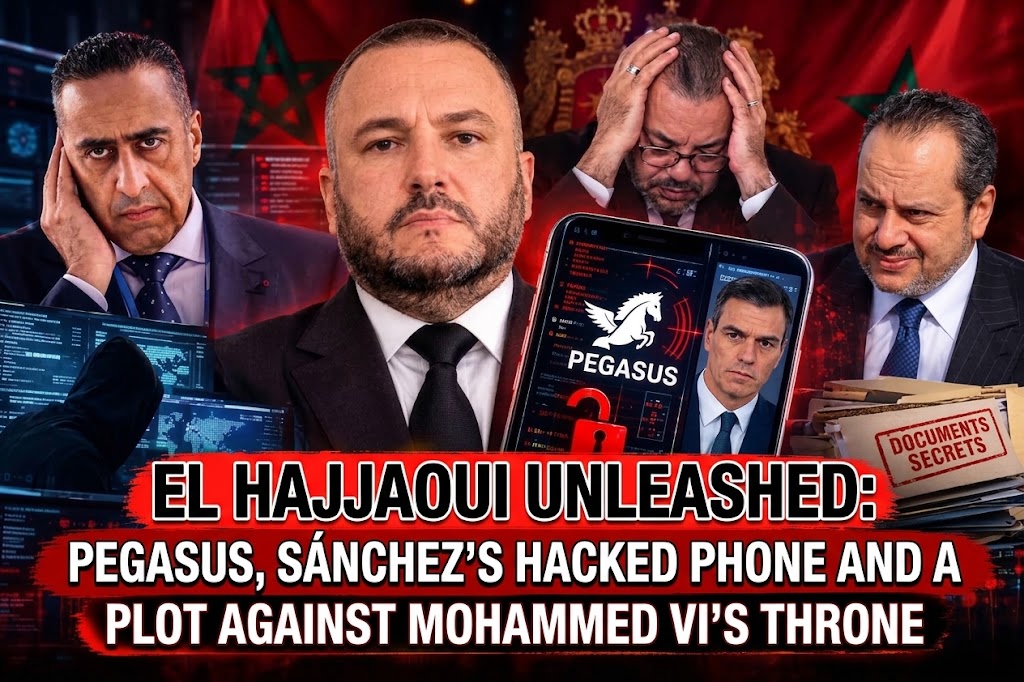
El Hajjaoui Unleashed: Pegasus, Sánchez’s Hacked Phone and a Plot Against Mohammed VI’s Throne

• Author: Lys Iwannughen • 0 comments • 52 views
El Hajjaoui Unleashed: Pegasus, Sánchez’s Hacked Phone and a Plot Against Mohammed VI’s Throne

Algeria Gate: In one of the most dangerous cyber blows that threatens a knockout punch to the throne of Mohammed VI, the Israeli Pegasus program; through which the Moroccan Makhzen regime excelled at spying on and blackmailing heavyweight foreign officials and politicians, has today become a spell that has turned against its caster.

The Spanish newspaper ABC revealed that Mehdi El Hajjaoui, considered the most dangerous Moroccan intelligence fugitive, is the engineer of the spying operations on the phone of Spanish Prime Minister Pedro Sánchez, confirming that he is ready to empty its sensitive contents.

The former deputy head of the Moroccan foreign intelligence service, according to the same source, was the leader of the spying operations carried out via the Pegasus program. Shortly before leaving Morocco in 2024, Mehdi El Hajjaoui stole all the information related to the infection of government phones. Sources close to him told ABC that “he is the one who infected Pedro Sánchez’s phone” and that he is “ready to provide” all the information about the breach: “how it was done, who was targeted, the content of the phone and the 2.6 gigabytes.”

El Hajjaoui, who was a general advisor in the Moroccan foreign intelligence service, fled Morocco in 2024 carrying with him other sensitive information about King Mohammed VI’s system: disclosures about the king, intelligence officials, ministers, security leaders, bribes to European parliamentarians in the “Moroccogate” case, and spying operations on European leaders such as Sánchez and French President Emmanuel Macron using the Israeli program.

The exclusive document obtained by ABC, which El Hajjaoui deposited with trusted people who helped him escape from Spain in February 2025, confirms that he led a secret operations unit specialized in cyber-spying on leaders in Europe and Africa, through which the Pegasus operations were carried out.

Mehdi El Hajjaoui: A mobile time bomb

His service record, according to the same source, specifies his high-level missions: “Head of the Security Office. Commander of the Atlas Unit and the Action Service Training Center, and charged with the mission before the Director General.” This points to Yassine Mansouri, head of foreign intelligence, who led the spying operations on politicians, journalists, and international leaders between 2020 and 2022 with the aim of imposing an international change in the status of Western Sahara and emptying the United Nations mission (MINURSO) of its substance.

El Hajjaoui was responsible for training agents for these secret operations and was also commander of the Atlas Unit (the elite of the Moroccan armed forces known as the “Atlas Shooters”). The same sources say: “Everything passed through his hands… He was the general controller of Moroccan intelligence, and he is now a mobile bomb.”

The document shows his long career in the intelligence service until his flight in 2024. He worked as a mission officer with the advisor close to King Mohammed VI, Fouad Ali El Himma. His service record covers 20 years as a “senior intelligence officer” in the foreign intelligence service (1994–2014), where he reached the position of “general controller” and even temporarily replaced the Director General during a sick leave.

The documents refute the Moroccan smear campaign that tried to portray him as a mere ordinary criminal and “swindler” claiming to be a high-level spy. El Hajjaoui, aged 53, was born in Hamburg, Germany, and is characterized by a strong build. He trained with the intelligence services of several countries: Mossad (Israel) and the CIA (United States), in addition to courses in the United States, Canada, France, Belgium, England, and Israel.

El Hajjaoui also studied in Paris advanced courses in intelligence, influence strategies, psychological warfare, and cybersecurity at the School of Economic Warfare. After fleeing Morocco, he first settled in France, but discovered he was being monitored by Moroccan agents, so he moved to Spain. His entourage says that the Spanish CNI set a trap for him in a meeting attended by two Moroccan agents who tried to persuade him to return, but he never trusted Spanish intelligence because of “the Spanish government’s subordination to Morocco.” CNI sources only confirm that he has been “in an unknown location” since February 2025.

His lifeline: Pegasus

The former number-two man in Moroccan intelligence fled Spain carrying with him a “lifeline”: all the information about the infection of Sánchez’s phone with Pegasus, in exchange for the suspension of the extradition procedures initiated by the Spanish National Court on the basis of an Interpol warrant.

ABC confirms that the information he can provide is extremely sensitive and will confirm Morocco’s responsibility for infecting the phones of Pedro Sánchez (2.6 gigabytes), Defense Minister Margarita Robles, Interior Minister Fernando Grande-Marlaska, Agriculture Minister Luis Planas, and former Foreign Minister Arancha González Laya.

The infection of González Laya’s phone occurred in the same month that she informed Sánchez of the decision to receive Polisario leader Brahim Ghali in Spain for humanitarian reasons. A few days later came the assault on Ceuta in May 2021.

El Hajjaoui wants to reveal “how the spying was done and who was targeted” even more than the content of the data, in order to expose Moroccan operations of major international dimensions. After the spying, Sánchez paid a heavy price: the dismissal of González Laya at Morocco’s explicit request, blackmail with migration in 2021, then Spain’s historic shift in its position on Western Sahara.

#Morocco#Spain
Author
Lys Iwannughen

Leave a comment

Your email address will not be published. Required fields are marked *

Europe
Share this post

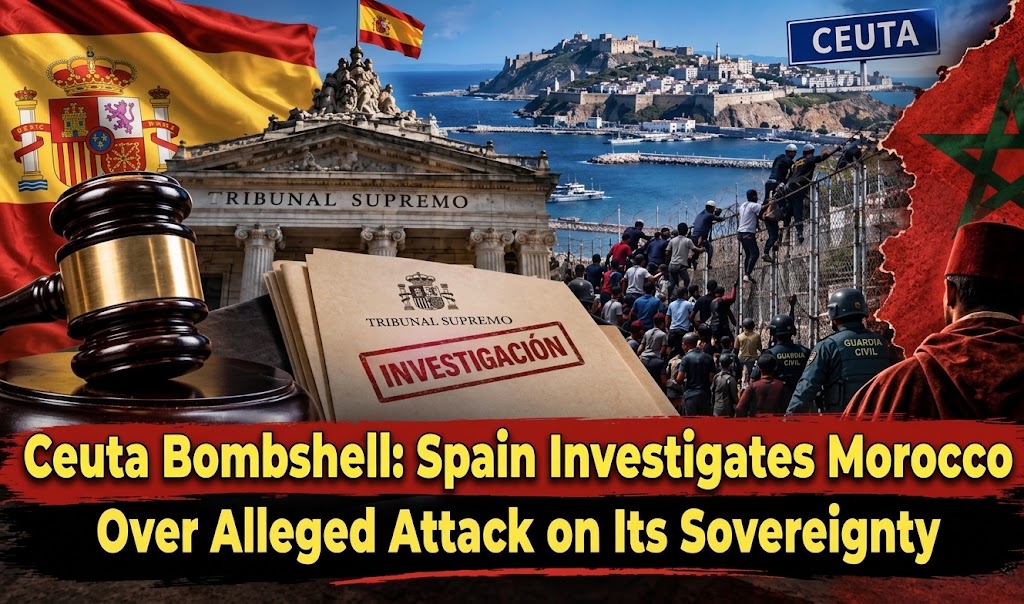
Ceuta Bombshell: Spain Investigates Morocco Over Alleged Attack on Its Sovereignty

Ceuta Bombshell: Spain Investigates Morocco Over Alleged Attack on Its Sovereignty

Algeria Gate: On Monday, the Spanish judiciary decided to open an investigation into the mass entry into the Spanish city of Ceuta, examining the incident from the perspective of a possible attack on Spain’s territorial integrity.

Spanish Prime Minister Pedro Sánchez had described the mass incursion as an attack on the country’s territorial integrity. Following this, National Court judge María Tardón asked police to investigate those allegedly behind the incident and requested that the Civil Guard prepare a report on the victims.

After receiving both reports, the judge formally opened an investigation to determine whether the Ceuta incursion constituted a serious attack on Spain’s territorial integrity and whether it could have affected the security or independence of the Spanish state.

The judge also ordered a separate judicial case focusing on the sovereignty and political dimensions of the incident, describing the operation as a “collective violation of Spain’s sovereignty with the deliberate aim of attacking the state.”

A Spanish police report issued the previous week had pointed to Morocco’s involvement in the operation.

The most sensitive element, according to the judge and as reported by Europa Press, concerns what she described as clear and indisputable evidence of support for the operation from Moroccan territory. This, she argued, is reflected in the documented conduct of Moroccan security forces, supported by clear photographic evidence.

#Morocco#Spain
Author
Lys Iwannughen
Europe
Share this post

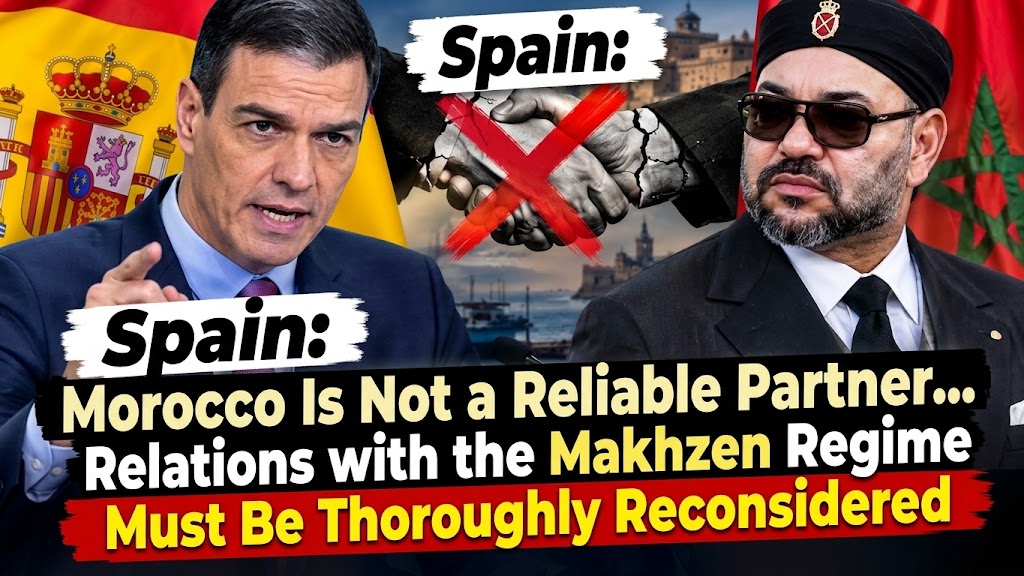
Spain: Morocco Is Not a Reliable Partner… Relations with the Makhzen Regime Must Be Thoroughly Reconsidered

Spain: Morocco Is Not a Reliable Partner… Relations with the Makhzen Regime Must Be Thoroughly Reconsidered

Algeria Gate: European Parliament member Estrella Galán of the Sumar party has stated that Morocco is not a reliable partner, calling for a thorough reassessment of relations with the Makhzen regime, particularly in light of its human rights record and its handling of the migration issue.

In an interview with Spanish daily El HuffPost on Monday, Galán sharply criticized the Moroccan authorities, stressing that Morocco “is not a reliable partner” and calling for a fundamental review of relations with Rabat, given its practices on several issues affecting its relations with its partners.

In this context, she stressed that “cooperation does not mean submission,” arguing that this is precisely what Spain is currently experiencing in its relationship with Morocco. According to Galán, the relationship has gone beyond normal cooperation and increasingly taken the form of pressure and political bargaining.

Her criticism directly concerns the migration issue. Galán argues that Morocco cannot dictate how Spain manages its migration policy, nor use migrant flows as a tool of pressure or blackmail through what she describes as deceptive maneuvers.

The European lawmaker also linked the issue to the Makhzen regime’s human rights record. She stated that Morocco “does not respect human rights, neither those of its own people nor those of migrants,” arguing that such practices are incompatible with any role Morocco might be entrusted with in border control.

She is therefore calling for a profound reassessment of relations with Rabat, with respect for human rights placed at the heart of any future cooperation.

#Morocco#Spain
Author
Lys Iwannughen
International press
Share this post

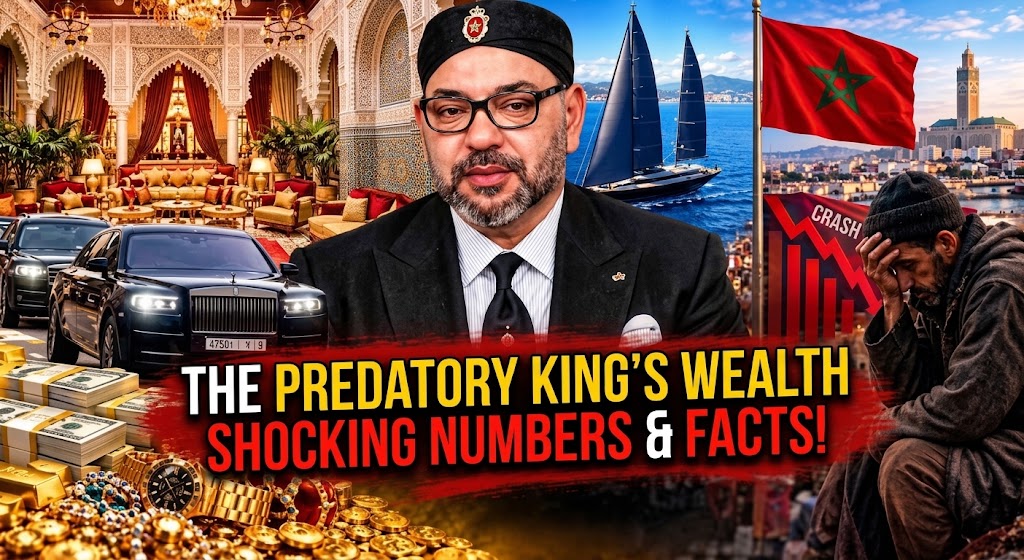
Spanish Press Exposes the Wealth of the Predatory King… Fifth Richest King in the World and the Richest in Africa!

Spanish Press Exposes the Wealth of the Predatory King… Fifth Richest King in the World and the Richest in Africa!

Algeria Gate: It seems that the bone-breaking battle between Morocco and Spain has entered another phase, after Spanish intelligence leaked shocking details about the wealth of Moroccan King Mohammed VI.

In a new chapter, the Spanish press published the fortune of the predatory king, as Mohammed VI tops the list of the richest kings on the African continent and ranks fifth globally among the richest monarchs, with a net worth estimated at around $5.7 billion.

This enormous fortune goes beyond mere bank balances and is distributed among major investment assets, historic palaces, and a lavish fleet of luxury cars, yachts, and private jets, outlining a map of a financial empire whose arms extend across continents.

Investments and Financial Arms: Domination of Strategic Sectors

Financial investments form the core backbone of the royal family’s wealth. The private investment fund “Al Mada” is its most prominent asset, with a stake in publicly listed companies estimated at about $17.5 billion. This fund holds controlling shares in strategic sectors, including 46.5% of the shares of “Attijariwafa Bank,” one of the largest financial groups in Africa; 10% of “Wafa Assurance”; and around 81.6% of the mining company “Managem,” whose market value approaches €20 billion.

In addition, the Moroccan monarch fully owns the investment holding company “SIGER,” which manages a complex network of 70 subsidiaries active in real estate development, agriculture, and tourism, and includes extremely luxurious facilities such as the “Royal Mansour” hotel chain.

Exceptional Real Estate Portfolio: Royal Palaces and Global Residences

The manifestations of this wealth are not limited to stocks and balances but are embodied in an exceptional real estate portfolio distributed between local luxury and world capitals.

Inside Morocco, the official list includes 12 royal residences in major cities such as Rabat, Fez, Marrakech, and Casablanca, in addition to private estates and residences in areas such as Sala, Al Hoceima, and Nador.

In France, the luxury is reflected in a spacious Parisian apartment exceeding 1,000 square meters overlooking the Eiffel Tower and estimated at €80 million, the historic “Hôtel de Broglie” palace, as well as the historic “Betts” palace stretching over 70 hectares, which was recently put up for sale. These properties extend beyond the Old Continent to the tropical island of Zanzibar, where the king owns a historic palace.

Fleet of Opulence: Private Jets, Massive Yachts, and Hundreds of Luxury Cars

The picture of extravagance is completed by an exceptional fleet of means of transport, led by the massive sailing yacht “Badiis 1,” measuring 70 meters in length and ranked among the 10 largest and most expensive yachts in the world.

In the air, the private aviation fleet includes giant aircraft such as the Boeing 747-8 and Boeing 737, along with fast Gulfstream jets. On the ground, the king owns a garage containing around 600 historic and luxury cars inherited by the family; starting with American cars and Rolls-Royces from the era of Mohammed V, through Mercedes vehicles under Hassan II, up to the latest models of Ferrari, Porsche, Aston Martin, and Bentley.

Stark Paradox: Accumulation of Wealth in the Face of the Ordinary Citizen’s Suffering

This extreme concentration of wealth and luxury assets presents a stark paradox when placed against the daily living reality of the Moroccan people. While this cross-continental financial empire expands and the royal investment arms tighten their monopolistic grip on the arteries of the national economy; from banks and mining to insurance, large segments of citizens continue to struggle with harsh economic challenges characterized by the high cost of living, rising unemployment rates, and weak public services.

The intertwining of absolute political power with overwhelming financial influence creates an economic environment in which fair competition is absent and entrenches a vast class gap: billions of dollars, palaces, and yachts accumulate at the top of the pyramid, while the ordinary citizen is left alone to bear the burdens of an economy weighed down by structural crises.

#Morocco#Spain
Author
Lys Iwannughen