Sunday, 18 October 2026 • 17:27 Algiers time
Algeria Gate
News Room
Cameron Hudson: UAE is virtually the sole backer of the RSF..without its support the war in Sudan would not continue Algeria-Niger: Official launch of Trans-Saharan fibre optic link Five minutes of lament over Algeria: Amar Belani exposes CNEWS’s real obsession Algerian courts hand down first death sentences under new drugs law Ségolène Royal’s masterclass on Algeria against an ignorant and demagogic journalist President Tebboune and senior officials receive the remains of Boualem Boualem in Algiers NAPEC 2026 in Oran: Algeria at the Heart of Africa’s and the Mediterranean’s New Energy Landscape Pegasus Files: Amnesty Uncovers Morocco’s Espionage Against Spain President Tebboune Orders Salary Increases in Algeria’s 2027 Budget, Rules Out New Taxes on Citizens Algeria Emerges as a Trusted Power for Regional Peace and Stability
Share this post

Residence permit wrongly refused: An Algerian woman has the French state ordered to pay €33,500

• Author: Lys Iwannughen • 0 comments • 3 views
Residence permit wrongly refused: An Algerian woman has the French state ordered to pay €33,500

Algeria Gate: An illegal administrative decision can have heavy financial consequences for the state. On September 24, 2026, the Administrative Court of Melun ordered the administration to pay more than €33,500 to an Algerian national after the illegal refusal of her residence certificate.

The case dates back to August 30, 2021. The Prefecture of Seine-et-Marne had refused to renew this Algerian woman’s residence certificate bearing the mention “private and family life.” This decision was accompanied by an obligation to leave French territory (OQTF) within thirty days.

The Algerian national challenged this measure in court. In 2023, the Administrative Court of Appeal finally annulled the prefectural refusal, thereby recognizing the illegality of the decision taken against her.

But the annulment was not enough to repair the consequences suffered during this period. The applicant therefore initiated a new procedure to obtain compensation for the damages caused by the refusal of residence.

The Administrative Court of Melun ruled in her favor and ordered the state to pay her more than €33,500.

This case recalls that an illegal prefectural decision concerning the residence of a foreigner can not only be annulled by the courts, but can also give rise to a right to compensation when the person concerned demonstrates the existence of damage directly linked to that decision.

#Algeria#France
Author
Lys Iwannughen
View my articles

Leave a comment

Your email address will not be published. Required fields are marked *

African coast
Share this post

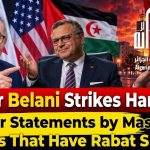
Amar Belani Strikes Hard: Four Statements by Massad Boulos That Have Rabat Shaken

Amar Belani Strikes Hard: Four Statements by Massad Boulos That Have Rabat Shaken

By Amar Belani, former Algerian Ambassador

Algeria Gate: The interview given by Massad Boulos, senior advisor to US President, Donald Trump, on Arab and African affairs, to France 24 this week was no polite diplomatic exercise. In four clear statements, Washington’s envoy dismantled the triumphalist narrative Morocco has relentlessly pushed for the past year.

First statement: Recognition of a temporary deadlock while Rabat proclaimed victory

“There is, at the moment, no solution that you can see or touch.”

Morocco built its entire communications strategy on a simple fiction: that Security Council Resolution 2797 had settled the Western Sahara question, leaving only the task of collecting the spoils. Boulos’s words cut through that claim. After three rounds of talks, the dossier remains stalled. Reality has overtaken propaganda.

Second statement: The patience that embarrasses those demanding an ultimatum

Boulos is waiting for the Polisario Front’s response. No deadline. No ultimatum.

While Rabat called for a more aggressive American approach and counted on Washington’s impatience to force the pace, the United States has chosen to wait. Moroccan diplomacy’s calculations have been exposed.

Third statement: Algeria praised, not singled out

For years, Rabat has insisted that Algeria is the real obstacle that must be isolated to unblock negotiations. Boulos chose this precise moment to do the opposite. He highlighted a constructive partnership and publicly thanked the Algerian authorities.

Fourth statement: Algeria cannot impose a solution

This is the line that will echo longest in Rabat. Boulos stated clearly that Algeria cannot impose a solution on Western Sahara, yet it can encourage the process—and, according to Washington, it has done so.

This position directly contradicts Morocco’s long-standing attempt to portray Algeria as the principal party to the conflict. Under the United Nations framework, the two parties remain Morocco and the Polisario Front. Algeria and Mauritania are neighboring countries invited to cooperate. Nothing more, nothing less.

What Rabat refuses to see

These four statements deliver a single message: the American administration never handed Morocco a blank cheque.

In its feverish and poorly calculated triumphalism, Morocco treated Resolution 2797 as an accomplished Algerian surrender. The US official has just reminded everyone that it was only a framework for negotiations.

A framework produces no result by itself. An agreement must still be reached, and above all the Polisario Front must give its clear and freely expressed consent. That remains the only condition for a mutually acceptable solution.

#Algeria#Amar Belani#Massad Boulos#Morocco#USA
Author
Lys Iwannughen
View my articles
African coast
Share this post

Niger thanks Algeria before the world… What its Prime Minister said from the United Nations podium!

Niger thanks Algeria before the world… What its Prime Minister said from the United Nations podium!

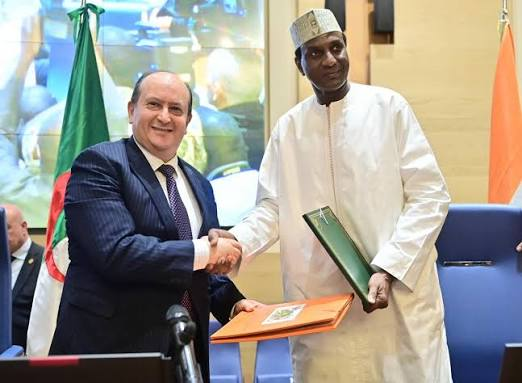
Algeria Gate: In a historic statement from the United Nations podium, the Prime Minister of the Republic of Niger, Ali Mahamane Lamine Zeine, said that his country has remained resilient thanks to its people and thanks to Algeria, which he described as a neighboring and brotherly country that chose to accompany Niger on its development path by supporting it in the exploitation of its natural resources.

Niger thanks Algeria before the world… What its Prime Minister said from the United Nations podium!

In his speech during the general debate of the High-Level Week of the 81st session of the United Nations General Assembly, the Nigerian official added that his country had been able to withstand various challenges thanks to the sacrifices of its sons, the solidarity existing among the Sahel countries, and the accompaniment provided by Algeria to Niger.

Niger thanks Algeria before the world… What its Prime Minister said from the United Nations podium!

Three years ago, Lamine Zeine said, some expected Niger to collapse under the weight of sanctions and isolation. Today, however, Niger is standing on its feet.

https://twitter.com/algatedzEng/status/2103790432081838086?s=20

Niger is standing because its people refused to bow, and because it found within the framework of the Confederation of Sahel States a family and solidarity — a family in every sense of the word in the African context.

Niger thanks Algeria before the world… What its Prime Minister said from the United Nations podium!

The same official continued that Niger is standing today because the People’s Democratic Republic of Algeria, the brotherly and neighboring country, chose to accompany it through significant investment in the exploitation of its natural resources and through continuous support for its defense system.

Niger thanks Algeria before the world… What its Prime Minister said from the United Nations podium!

The Nigerian Prime Minister also stated that his country is working with Algeria to develop dynamic cooperation in the fields of health, education, energy, water resources, and agriculture. Added to this are a number of major structuring projects, such as the tripartite gas pipeline and the Trans-Saharan Highway.

Niger thanks Algeria before the world… What its Prime Minister said from the United Nations podium!

He concluded his remarks about Algeria by saying that Algeria has contributed to strengthening Niger’s energy infrastructure through the construction of a 40-megawatt power plant in the capital Niamey, in addition to cooperation in the exploitation of oil resources, particularly through the “Kafra” project in northern Niger, where Algeria and Niger launched exploratory drilling works last August for the “Kafra Southeast 1” well.

#Algeria#Niger#United Nations
Author
Lys Iwannughen
View my articles
African coast
Share this post

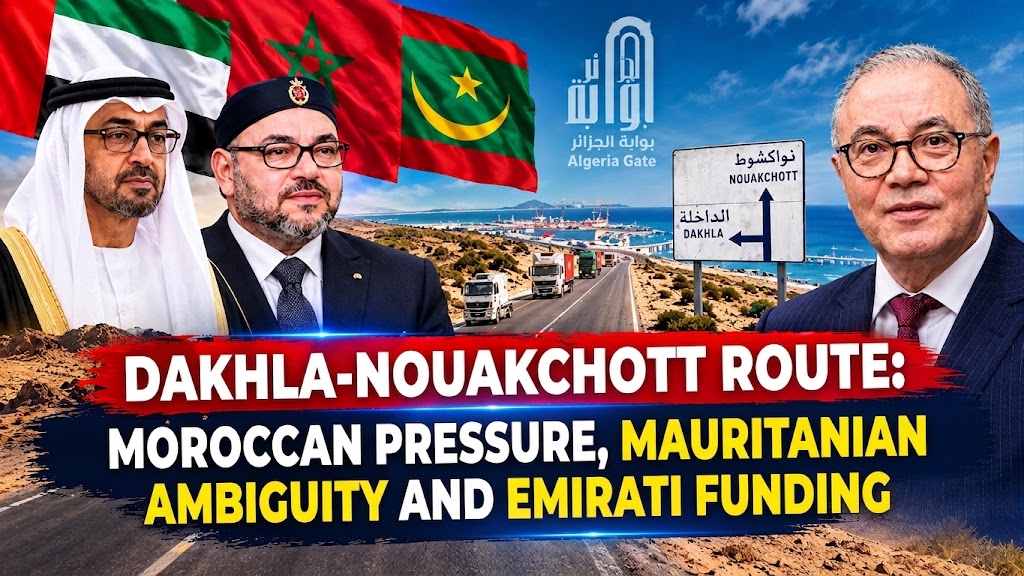
Dakhla–Nouakchott Route: Moroccan Pressure, Mauritanian Ambiguity and Emirati Financing

Dakhla–Nouakchott Route: Moroccan Pressure, Mauritanian Ambiguity and Emirati Financing

By Amar Belani

Algeria Gate: While work is underway on the first section of the Tindouf–Zouérate road, Morocco and Mauritania signed a framework agreement in Rabat on September 21 to rehabilitate and widen Mauritania’s National Road No. 4. Officially presented as a project to facilitate traffic between Nouakchott and Nouadhibou, the agreement carries a far broader strategic significance.

The road does not end at Nouadhibou. It extends north toward PK55, opposite Guerguerat, creating a continuous land route toward Dakhla. Moroccan Equipment Minister Nizar Baraka has himself publicly referred to the Nouakchott–Dakhla link via PK55. The agreement covers some 480 kilometers of the Mauritanian road network.

This is therefore about much more than improving bilateral trade.

Faced with Algeria’s plans to develop a southern corridor toward West Africa, Rabat is accelerating efforts to capture future commercial flows toward Mauritania, the Sahel and West Africa. The objective is to consolidate the Dakhla–Guerguerat–Nouadhibou–Nouakchott axis as the terrestrial backbone of Morocco’s westward economic projection.

Dakhla as the gateway

The future Dakhla Atlantic Port, estimated to cost close to $1 billion and expected to enter service in 2028, is intended to provide this strategy with its maritime outlet.

It is one of the instruments of Morocco’s so-called Atlantic Initiative, officially designed to provide landlocked Sahel countries with access to the Atlantic. But this initiative is not developing in an empty space.

Dakhla–Nouakchott Route: Moroccan Pressure, Mauritanian Ambiguity and Emirati Financing

Mauritania already possesses a major road corridor linking Nouakchott with Bamako, stretching roughly 1,350 kilometers. That route already provides Mali with a natural Atlantic outlet.

The strategic question for Rabat is therefore how to make Dakhla and the Dakhla–Nouakchott axis the northern extension of this commercial depth into the Sahel.

Morocco and Mauritania’s September 21 agreement reinforces precisely this north-south connectivity, linking the Mauritanian RN4 with the wider road network toward Guerguerat and, beyond it, Dakhla.

Mauritania caught between two corridors

Mauritania now finds itself at the intersection of two competing corridor strategies.

It can, of course, capitalize on this position to attract investment, infrastructure and commercial flows. That is legitimate economic statecraft.

Dakhla–Nouakchott Route: Moroccan Pressure, Mauritanian Ambiguity and Emirati Financing

But this central position also puts its proclaimed policy of “constructive neutrality” on Western Sahara to the test.

Western Sahara remains on the United Nations list of Non-Self-Governing Territories, while the Sahrawi people’s right to self-determination remains a central issue under the UN framework.

Yet Nouakchott is simultaneously participating in the consolidation of an economic axis connecting its territory to Guerguerat and Dakhla.

This raises an unavoidable political question: how far can diplomatic neutrality be maintained while economic integration with Morocco’s southern network continues to deepen?

The same ambiguity can be seen in the Nigeria–Morocco Atlantic African Gas Pipeline. Mauritania is among the countries involved in the project and would need to conclude the necessary agreements with Morocco for its implementation. Moroccan hydrocarbons authorities have also conducted offshore studies in the Dakhla area.

Road, port and gas pipeline are therefore gradually forming a single strategic architecture: turning Dakhla into an economic gateway toward West Africa and the Sahel, with Mauritania as the indispensable transit territory.

The Emirati dimension

There is, however, a third actor whose role cannot be overlooked: the United Arab Emirates.

As I have already pointed out in my previous analysis, “Mauritania at the Heart of the Moroccan-Emirati Offensive,” the UAE is deeply involved in a broader strategy that intersects with Morocco’s ambitions in West Africa and the Sahel.

Dakhla–Nouakchott Route: Moroccan Pressure, Mauritanian Ambiguity and Emirati Financing

In this reading, the objective is not simply to support infrastructure development. It is also to strengthen Emirati influence in a region where Morocco is seeking to expand its economic and strategic footprint, while drawing Mauritania further away from Algeria and closer to the countries aligned with the Abraham Accords.

The Emirati presence in Mauritania is not new. In 2020, Abu Dhabi announced around $2 billion in investment and development projects, alongside concessional financing. The Abu Dhabi Fund for Development has also financed infrastructure projects in Mauritania.

But Abu Dhabi is pursuing its own agenda as well — one that increasingly overlaps with Moroccan interests: expanding its influence over African ports, trade corridors and logistics chains.

This strategy extends far beyond Mauritania. Through AD Ports Group and DP World, the UAE has built a broad network of port concessions, logistics investments and commercial corridors connecting African markets with the Gulf, Asia and Europe.

Mauritania is particularly valuable within this architecture.

Its geographic position between the Maghreb, the Atlantic and West Africa makes it a natural transit point for regional trade. This is precisely where Moroccan and Emirati interests converge.

Rabat seeks to build the Dakhla–Guerguerat–Mauritania corridor toward West Africa. Abu Dhabi has the capital, port operators and logistics companies capable of investing in the infrastructure that can extend such corridors.

A battle over corridors, ports and influence

Mauritania is therefore sitting at the crossroads of two strategic projects.

Dakhla–Nouakchott Route: Moroccan Pressure, Mauritanian Ambiguity and Emirati Financing

For Morocco, it is the indispensable passageway for extending the Dakhla project toward West Africa and the Sahel.

For the UAE, it represents another node in a much broader port and logistics strategy spanning Africa and the wider maritime routes connecting the continent to the Gulf and beyond.

The road linking Dakhla, Guerguerat, Nouadhibou and Nouakchott must therefore be viewed in this wider context.

What is taking shape is not merely a road rehabilitation project. It is a broader contest over corridors, ports, energy infrastructure and the future movement of goods between the Maghreb, the Sahel and West Africa.

And, in my view, this dynamic is unfolding at the expense of the Sahrawi people and their internationally recognized right to self-determination.

#Amar Belani#Mauritania#Morocco#UAE#Western Sahara
Author
Lys Iwannughen
View my articles