Sunday, 18 October 2026 • 20:12 Algiers time
Algeria Gate
News Room
Cameron Hudson: UAE is virtually the sole backer of the RSF..without its support the war in Sudan would not continue Algeria-Niger: Official launch of Trans-Saharan fibre optic link Five minutes of lament over Algeria: Amar Belani exposes CNEWS’s real obsession Algerian courts hand down first death sentences under new drugs law Ségolène Royal’s masterclass on Algeria against an ignorant and demagogic journalist President Tebboune and senior officials receive the remains of Boualem Boualem in Algiers NAPEC 2026 in Oran: Algeria at the Heart of Africa’s and the Mediterranean’s New Energy Landscape Pegasus Files: Amnesty Uncovers Morocco’s Espionage Against Spain President Tebboune Orders Salary Increases in Algeria’s 2027 Budget, Rules Out New Taxes on Citizens Algeria Emerges as a Trusted Power for Regional Peace and Stability
Share this post

Makhzen Intelligence Insults Its King in Front of the “Rainbow”

• Author: Lys Iwannughen • 0 comments • 61 views
Makhzen Intelligence Insults Its King in Front of the “Rainbow”

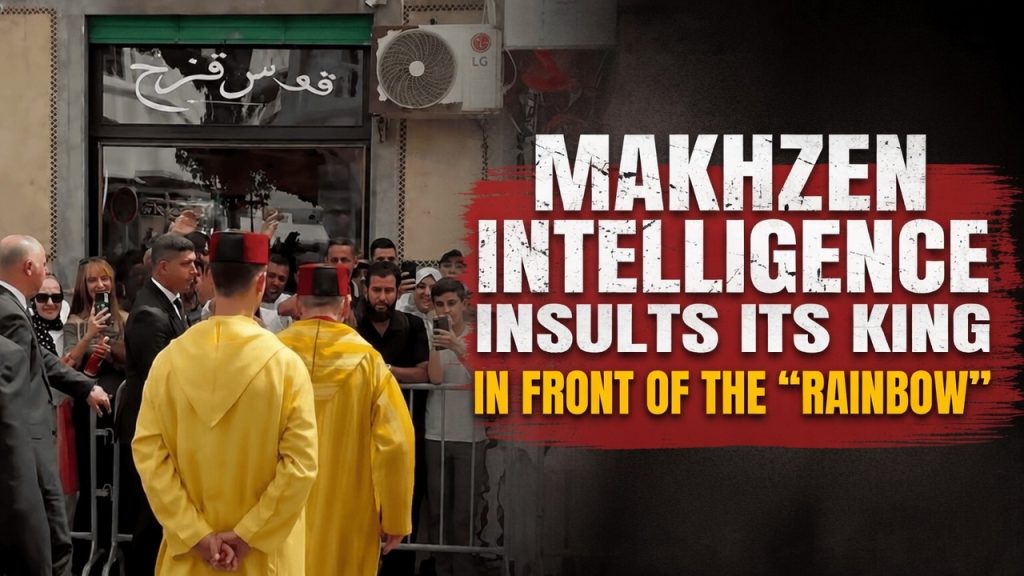
Algeria Gate: It was not merely a passing shot captured by the cameras, but a resounding slap to the prestige of the royal institution. The fact that the Moroccan king stood in front of a shop facade bearing the “Rainbow” logo, which has become a global symbol of homosexuality, is an event that goes far beyond “coincidence” and borders on a political scandal.

While the world watched and Moroccans rallied around their king, the cameras documented a scene that can only be described as blatant humiliation.

“Breath-counting devices”… Where did the Makhzen’s eyes vanish in the moment of truth?

Where did the Makhzen intelligence agencies go? Those very agencies that boast of their ability to count the breaths of opponents, track journalists’ every move, and arrest activists in the farthest corners of the country; they suffered a humiliating fall in the test of “the throne’s prestige.”
Makhzen Intelligence Insults Its King in Front of the “Rainbow”

How did the “security maps” that scan streets millimeter by millimeter before any royal movement disappear? How did the “prestige guards” allow this provocative name to pass without the slightest objection?

Lame excuses… Intelligence covers up its failure with imaginary “security coordination”

Attempts to justify this as an “unintentional mistake” are an insult to the intelligence of Moroccans. We are talking about a royal motorcade planned with extreme precision, where nothing is left to chance.

If these agencies are incapable of noticing the name of a commercial store on the king’s route, then we are facing shameful security negligence. Those who excel in repression and surveillance cannot claim ignorance when it comes to protocol details.
Makhzen Intelligence Insults Its King in Front of the “Rainbow”

The silence of the Makhzen intelligence and its attempts to cover up this failure with empty rhetoric about “security coordination” is the greatest scandal. True security is not only about protecting the physical body, but about safeguarding the symbol and dignity represented by the throne. This image is not merely a mistake; it is a message of insult that has reached every home in Morocco, whether it resulted from negligence or deliberate planning.

The question that continues to boil in the hearts of Moroccans remains: Who will hold these agencies accountable for their failure to protect the king’s stature? If the intelligence services, which claim to fight “conspiracies” day and night, cannot secure the king’s path from a simple shop sign, then are they agencies meant to protect the nation and the throne, or merely tools for repression and settling scores with opponents?.

Author
Lys Iwannughen
View my articles

Leave a comment

Your email address will not be published. Required fields are marked *

International press
Share this post

Morocco Facing a Test of Unity: The Rif, Western Sahara, and the Throne Threads of One Crisis?

Morocco Facing a Test of Unity: The Rif, Western Sahara, and the Throne Threads of One Crisis?

Three sensitive issues are converging in Morocco, reviving a long-standing debate over the resilience of the kingdom’s political structure: renewed Rif activism at home and within the diaspora, the unresolved Western Sahara conflict, and growing questions surrounding the royal succession. None of these issues is new on its own, but their convergence has prompted observers to revisit scenarios that have long remained confined to academic discussions.

The Rif: From Al Hoceima to Brussels

The Rif issue remains one of Morocco’s most enduring internal challenges. The protest movement that began in Al Hoceima in late 2016 and continued through the summer of 2017 ended with the arrest of its leading figures most notably Nasser Zefzafi and prison sentences of up to 20 years on charges of undermining state security.

Nine years later, the issue remains unresolved. In Brussels, the Rif National Party organized a commemorative gathering marking the ninth anniversary of the death of Imad Attabi, who was fatally shot by Moroccan security forces during demonstrations in Al Hoceima on July 20, 2017. Participants displayed the flag of the “Republic of the Rif” and called for independence.

It is important, however, to distinguish the nature of the event. It was not a large-scale popular demonstration but a limited commemorative gathering organized by a political movement known for its separatist positions and supported mainly by segments of the Rif diaspora in Belgium and the Netherlands. While symbolically significant, it should not be taken as evidence of broad support within the Rif itself, where public demands have historically focused more on development, social justice, and civil rights than on secession.

https://twitter.com/algatedzEng/status/2079538861831512540?s=20

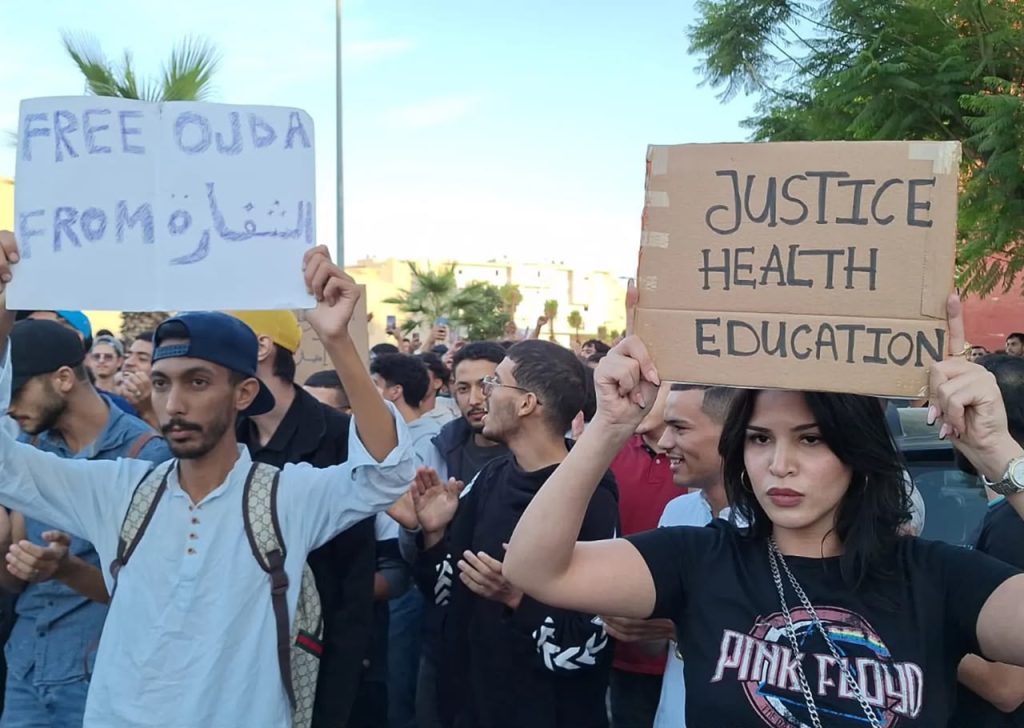
At the same time, several Moroccan cities have witnessed youth-led protests since late 2025 under the banner of the “Generation Z 212” movement. The movement has focused primarily on healthcare, education, anti-corruption reforms, and the release of detained protesters. Although these demands are largely socio-economic rather than separatist, they reflect a broader climate of public discontent that could provide fertile ground for more radical narratives on the political margins, including in the Rif.

Morocco Facing a Test of Unity: The Rif, Western Sahara, and the Throne Threads of One Crisis?

Western Sahara: The Unresolved Dispute

Western Sahara remains the most influential factor in any discussion about Morocco’s territorial cohesion. The conflict between Morocco and the Polisario Front has remained unresolved for decades, with UN-led efforts failing to produce a final political settlement. Any discussion of potential fragmentation cannot be separated from this issue, which Morocco regards as its foremost territorial integrity concern, while its opponents view it as an unresolved decolonization question.

The Succession Question: A Quiet Transition or a Silent Crisis?

Morocco Facing a Test of Unity: The Rif, Western Sahara, and the Throne Threads of One Crisis?

The third issue is perhaps the most sensitive and least transparent: the royal succession.

Crown Prince Moulay Hassan, born in 2003, is the official heir to the Alaouite throne and has increasingly assumed prominent state responsibilities. In May 2026, King Mohammed VI appointed him Coordinator of the Offices and Services of the General Command of the Royal Armed Forcest the same position Mohammed VI held while serving as Crown Prince before ascending the throne. He has also represented the King with increasing frequency at international events, meetings with world leaders, and major national initiatives.

This gradual institutional transition has coincided with unconfirmed media speculation regarding the King’s health and alleged internal disagreements over the succession process. Some reports have cited claims attributed to the French newspaper Le Monde. These reports should be treated with considerable caution, as no official confirmation or independently verified evidence has substantiated claims of any open conflict within the royal family.

https://twitter.com/algatedzEng/status/2078818065668518356?s=20

Between Theory and Reality

Some academic studies including one published by the Centre for Arab Unity Studies have explored theoretical scenarios involving the possible fragmentation of Morocco into ethnically or regionally based entities, including a hypothetical “Republic of the Rif,” should separatist movements gain significant momentum. However, the study itself presents this as a hypothetical scenario within academic debate rather than a description or prediction of current realities.

What is clear today is that Morocco faces growing social discontent, an unresolved Rif issue, a protracted Western Sahara conflict, and an institutional succession process unfolding amid unverified speculation. Together, these developments warrant close observation. Yet there remains a significant difference between acknowledging existing structural tensions and concluding that Morocco is on the verge of fragmentation. Responsible reporting requires staying firmly within the boundaries of verifiable facts.

Author
بوابة الجزائر
View my articles
International press
Share this post

Pegasus Espionage Scandal: Former Algerian Ambassador to Madrid Targeted by Morocco

Pegasus Espionage Scandal: Former Algerian Ambassador to Madrid Targeted by Morocco

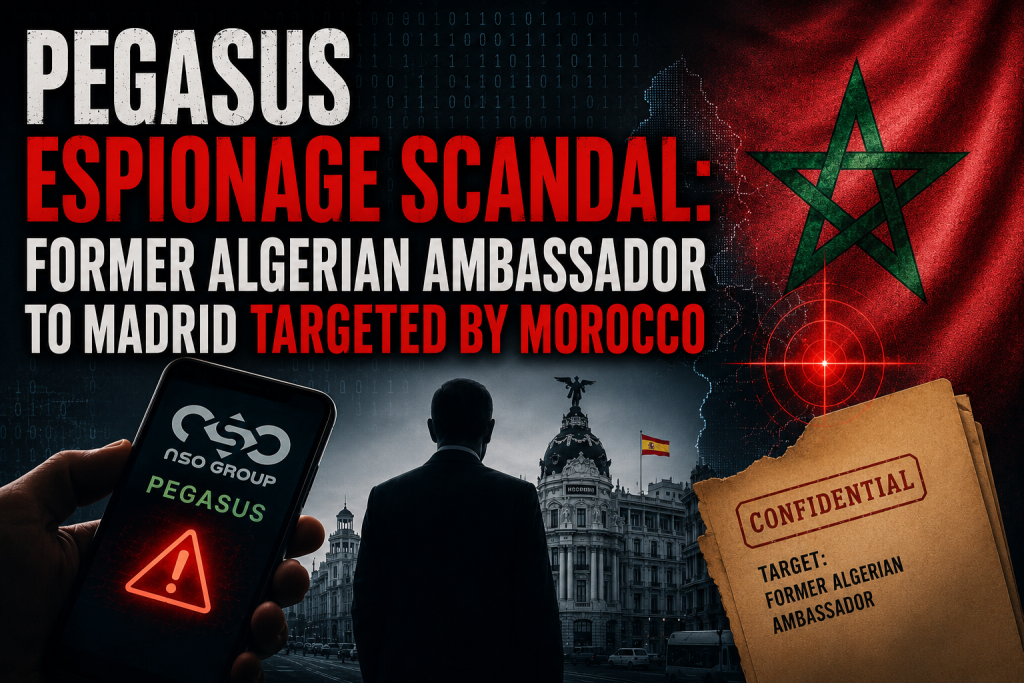
Algeria Gate: A former Algerian ambassador to Madrid was targeted by Morocco using the spyware Pegasus, according to numerous foreign media outlets.

Five years after the Pegasus scandal broke, new revelations from the international press shed light on this espionage operation carried out by Moroccan services using that spyware.

Pegasus Espionage Scandal: Former Algerian Ambassador to Madrid Targeted by Morocco

As new evidence continues to incriminate Morocco, clearly demonstrating the involvement of its services (notably the DGST and foreign intelligence), the Spanish newspaper El Confidencial has released figures illustrating the scale of the operation and the names of certain targeted personalities in Spain.

El Confidencial is part of the consortium of 16 international media outlets that first exposed the scandal in July 2021.

According to the Spanish newspaper, 768 cyberattacks targeted 250 mobile phones in Spain between May 2018 and June 2019 alone. A record was even set on March 16, 2019, with 106 attacks in a single day.

Pegasus Revelations: More Light Shed on Targeted Personalities

The kingdom’s services targeted not only Moroccan journalists and opponents, but also foreign journalists, diplomats, and leaders, including French President Emmanuel Macron and Spanish Prime Minister Pedro Sánchez.

Pegasus Espionage Scandal: Former Algerian Ambassador to Madrid Targeted by Morocco

In Spain, most of the attacked phones belonged to Moroccans and Sahrawis residing in the country, but devices belonging to Algerians and Spaniards were also affected, including that of a Guardia Civil colonel, the media summarizes.

Algeria featured prominently on the list of targeted countries. El Confidencial reveals which Algerians were spied on Spanish soil. The newspaper reports that “a handful of Algerian diplomats accredited in Spain at the end of the last decade appear in the Moroccan DGST’s directory.”

Among these targeted Algerian diplomats, the most prominent figure is Taous Feroukhi, who served as ambassador to Madrid until the end of 2019.

Thousands of phones were spied on across several countries as part of this operation. Algeria has consistently been cited as one of the most heavily targeted nations. The revelations published by El Confidencial on Thursday, July 16th, concern only the confirmed attacks on Spanish territory.

Pegasus Espionage Scandal: Former Algerian Ambassador to Madrid Targeted by Morocco
#Algeria#Morocco#Pegasus#Spain
Author
Lys Iwannughen
View my articles
Europe
Share this post

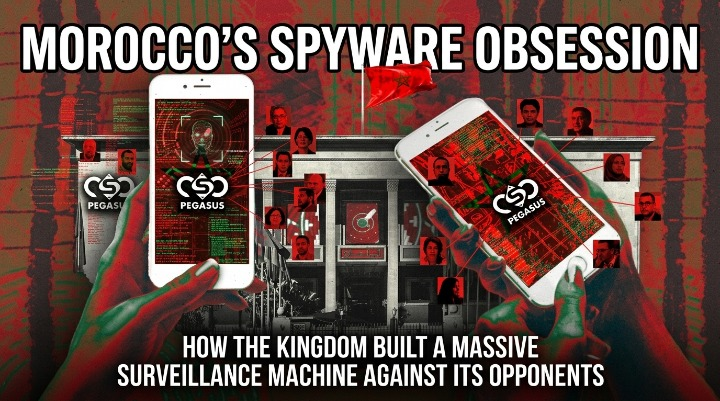
Morocco’s Spyware Obsession: How the Kingdom Built a Massive Surveillance Machine Against Its Opponents

Morocco’s Spyware Obsession: How the Kingdom Built a Massive Surveillance Machine Against Its Opponents

Algeria Gate: Despite repeated official denials, Morocco has become one of the most aggressive users of advanced spyware to monitor and suppress journalists, activists, and dissidents, both at home and abroad.

A new investigation by Forbidden Stories, in collaboration with Amnesty International’s Security Lab and international media partners, draws on rare insider testimony, previously unpublished internal documents, and technical evidence to expose the inner workings of Morocco’s surveillance state. At the center of this operation is Pegasus, the notorious spyware developed by Israel’s NSO Group.

Key Revelations

  • A former agent of Morocco’s domestic intelligence agency (DGST) provides a detailed firsthand account of mass surveillance operations.
  • Internal documents reveal pre-infected phones distributed to activists, compromised internet cafés, and the extensive use of Pegasus.
  • The investigation identifies senior DGST officials involved in these operations and publishes the first images of Pegasus’s user interface as seen by Moroccan operators.

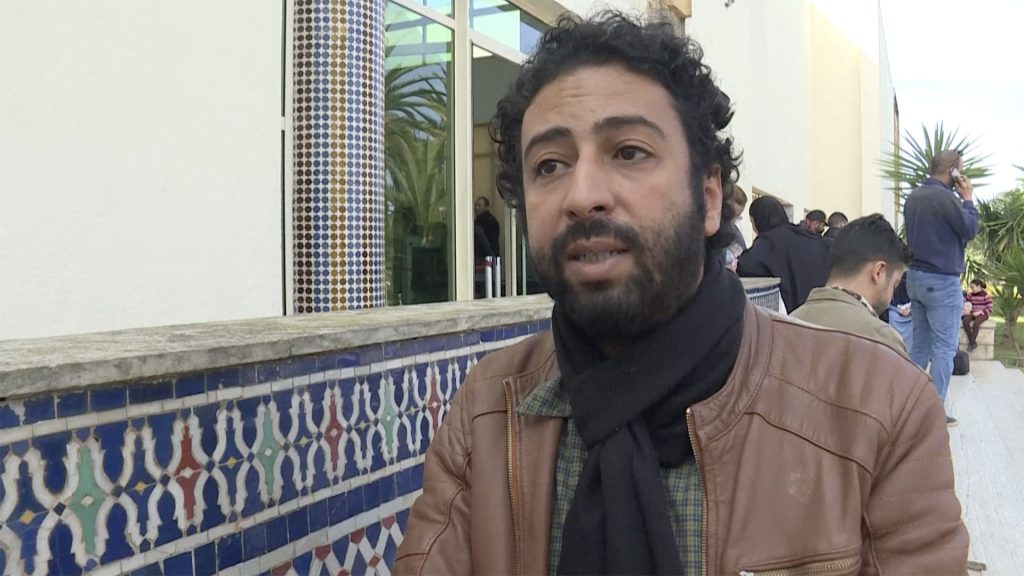
The Case of Omar Radi

Journalist Omar Radi became a prime target of the Moroccan security services after investigating corruption and land grabs linked to associates of King Mohammed VI.

Morocco’s Spyware Obsession: How the Kingdom Built a Massive Surveillance Machine Against Its Opponents

Long before his 2020 arrest in Casablanca, Radi’s life was under constant watch: his home was bugged, his movements tracked, and his contacts monitored. When police finally detained him, they immediately seized his iPhone. Unable to unlock it on the spot, they used Cellebrite forensic software to extract its data.

Radi was later sentenced to six years in prison on charges widely viewed as politically motivated. He was pardoned in 2024. Forensic analysis later confirmed he had been infected with Pegasus spyware.

According to the former DGST agent (referred to as Safir), traditional surveillance methods proved insufficient against cautious targets like Radi. “Pegasus was the final tool; one of the most powerful,” he said.

From Hacking Team to Pegasus

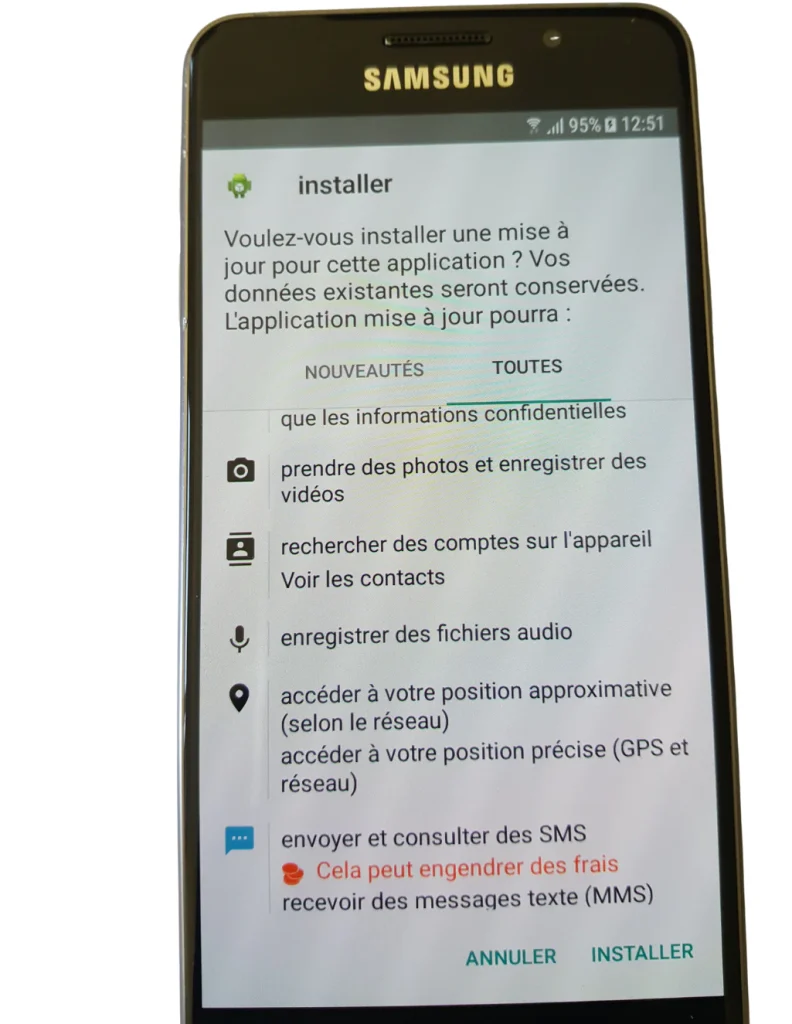
Before adopting Pegasus in late 2017, the DGST used spyware from Italy’s Hacking Team (Remote Control System or RCS). Agents infected dozens of new Samsung Galaxy S6 Edge phones and distributed them at discounted prices to activists in the Rif region during protest movements. They also compromised internet cafés frequented by targets.

Morocco’s Spyware Obsession: How the Kingdom Built a Massive Surveillance Machine Against Its Opponents

When Pegasus became available, it represented a major upgrade: zero-click infection capability meant targets could be compromised simply by receiving a missed call, with no interaction required. The system’s web-based console allowed operators to easily access calls, messages, location data, photos, and even remotely activate microphones.

Morocco reportedly selected nearly 13,000 phone numbers for potential targeting, including high-profile figures such as French President Emmanuel Macron, Belgian Prime Minister Charles Michel, French journalists, and Algerian officials.

Inside the DGST’s Spy Unit

The operation was reportedly led by senior DGST figures, including Abdeljalil Taki, who heads the spyware department, and Mohammed Raji, described by some as the architect of Morocco’s phone-tapping program and a close associate of powerful intelligence chief Abdellatif Hammouchi.

Even DGST agents tested the software on their own phones before deploying it more widely.

Denial vs. Evidence

Morocco has consistently denied using Pegasus. However, technical analyses by Amnesty International and French authorities, along with the new insider testimony and documents, strongly contradict these claims. The same Apple infrastructure used against Moroccan journalists was also linked to operations targeting French and Spanish figures.

The investigation highlights how the kingdom has used these tools not only against domestic critics but also against perceived foreign adversaries, while maintaining strong diplomatic ties ; particularly with France following its recognition of Moroccan sovereignty over Western Sahara.

This latest exposé, published five years after the original Pegasus Project, offers an unprecedented look inside one country’s addiction to digital surveillance as a tool of control, and the human cost paid by those who dare to speak out.

#Morocco#Pegasus
Author
Lys Iwannughen
View my articles