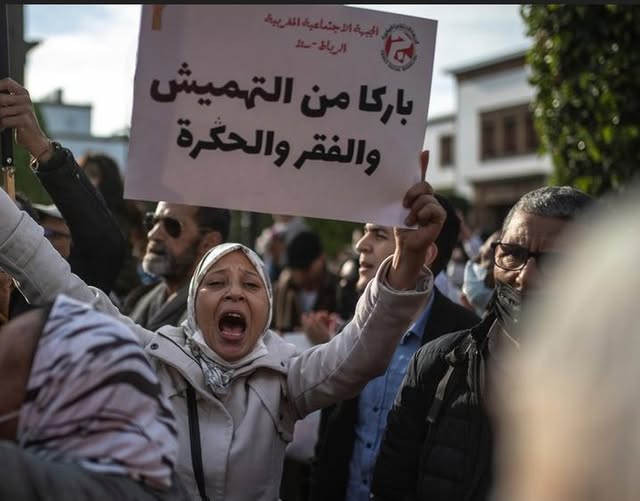
Rabat – Moroccan political and human rights groups have reported a sharp deterioration in the country’s political, social and economic conditions, alongside a significant decline in rights and freedoms, a situation that has deepened the gap between the Moroccan people and the ruling establishment.
In this context, the Federation of the Democratic Left Party warned, in a statement issued at the close of its National Council session held under the slogan “No democracy with repression, and no patriotism without fighting corruption,” of the worsening situation in Morocco. The party stressed that the country is “going through a critical phase marked by the entrenchment of political loyalties within state institutions and the corruption of the political field.”
It further noted that the “absence of accountability and the spread of impunity in cases of embezzlement of public funds reflect the clear dominance of rent-seeking and corruption within institutions,” warning of the negative consequences of the growing overlap between power and money, which it said threatens the country’s future.
On the human rights front, the party reported an increase in violations of rights and freedoms, as well as judicial prosecutions aimed at deterring activists from opposing authoritarian practices. Economically, it stated that the “so-called social state slogan clashes with a harsh reality,” as citizens face declining purchasing power, rising prices of basic goods, and increasing unemployment, particularly among youth and in rural areas.
For its part, Al Adl wal Ihsan group highlighted “further decline in social and economic development indicators” due to continued political dominance, mismanagement of national resources, and restrictions on rights and freedoms. It argued that worsening social conditions amid rising prices expose the limits of official discourse, particularly the concept of the “social state.”
The group also pointed to persistent structural imbalances in the political landscape, including authoritarian governance, widespread corruption, vote-buying, and what it described as the “illusion of reform,” alongside an increasing reliance on security-driven approaches.
Meanwhile, the Moroccan Human Rights Space sharply criticized the ruling system, stating it has “failed to ensure the most basic economic and social rights of citizens,” citing inadequate response to flood victims and mass layoffs of workers.
The organization also noted a worsening crisis in education, healthcare and employment, which has fueled youth protests, leading to thousands of arrests and numerous prison sentences, some reaching up to 15 years.
It further expressed concern over what it described as a wave of successive legislation lacking legitimacy, including criminal and civil procedure laws that it said largely favor stronger parties over ordinary citizens.
In Marrakech, a local anti-corruption coordination group denounced the continued embezzlement of public funds amid the absence of accountability, while infrastructure continues to suffer from fragility and poor workmanship.