Tuesday, 6 October 2026 • 11:28 Algiers time
Algeria Gate
News Room
NAPEC 2026 in Oran: Algeria at the Heart of Africa’s and the Mediterranean’s New Energy Landscape Pegasus Files: Amnesty Uncovers Morocco’s Espionage Against Spain President Tebboune Orders Salary Increases in Algeria’s 2027 Budget, Rules Out New Taxes on Citizens Algeria Emerges as a Trusted Power for Regional Peace and Stability Prison of Tanezrouft: When the French Right Meddles in Algerian Affairs European Union: Algeria is a reliable partner in the gas sector and has strong potential to become a key partner in energy projects! Raw materials: Algeria benefits from the energy shock, Morocco’s trade deficit soars Hana Mansour denounces the use of her image by Le Point to illustrate an article by Kamel Daoud President Tebboune’s warning: why Algeria sent combat aircraft to Niger Algerian Diplomat: UAE Has Built a Military and Logistical Network Stretching from the Red Sea to Tigray
Share this post

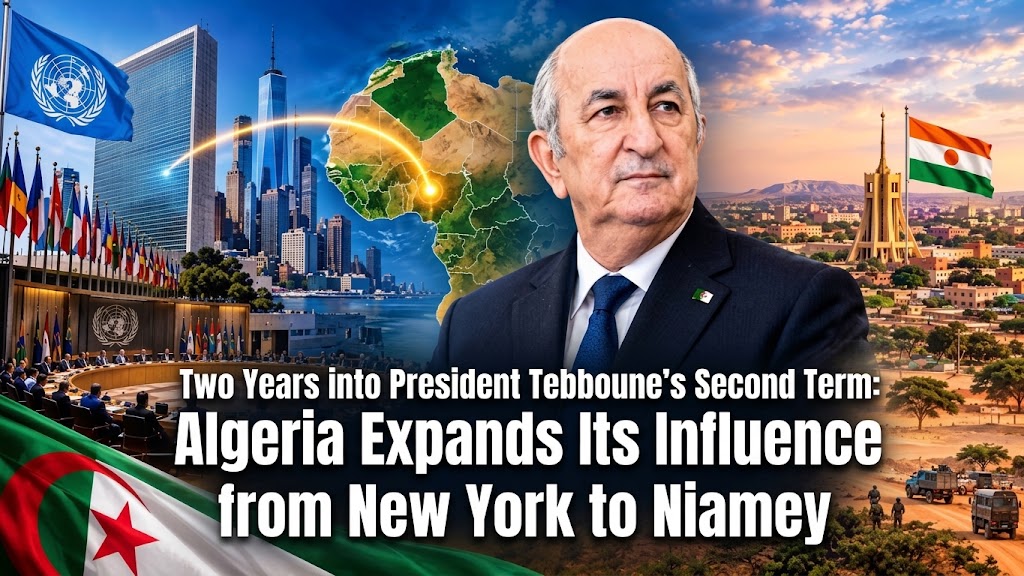
Two Years into President Tebboune’s Second Term: Algeria Expands Its Influence from New York to Niamey

• Author: Lys Iwannughen • 0 comments • 20 views
Two Years into President Tebboune’s Second Term: Algeria Expands Its Influence from New York to Niamey

Algeria Gate: Since Algerian President Abdelmadjid Tebboune was re-elected for a second presidential term in September 2024, Algerian foreign policy has entered a phase of expanded spheres of action and diversified tools of influence. It has moved beyond traditional diplomacy based on official meetings and political statements toward a more varied presence within the UN Security Council and African Union institutions, alongside mediation efforts, parliamentary and judicial diplomacy, and files related to energy, security, and military cooperation.

Over these two years, these moves have coincided with rapidly evolving regional and international developments, foremost among them the war on Gaza, crises in the Sahel region, and the competition among international powers for energy partnerships and infrastructure.

Amid these files, Algeria has intensified its activity on multiple tracks, seeking to consolidate its regional and international presence, defend its strategic interests, and expand its margin of influence on issues linked to its security and geopolitical surroundings.

In assessing Algeria’s diplomatic record during the first two years of President Tebboune’s second term, political analyst specializing in international relations Ayoub Arfi argues that evaluating this record first requires “expanding the concept of diplomacy.” According to him, “it is no longer limited to official meetings, visits, and political statements.”

Arfi told Algeria Gate that Algeria has witnessed during this period “UN diplomacy within the Security Council, African diplomacy within African Union institutions, parliamentary diplomacy, judicial diplomacy linked to the recovery of looted funds and the extradition of wanted persons, and mediation diplomacy that has appeared in files concerning foreign nationals,” in addition to “energy diplomacy related to gas, hydrogen, and regional interconnection projects, and security and military diplomacy linked to Algeria’s security and its immediate surroundings.”

The political analyst added that this diversity of external action tools “reflects a clear orientation in Algerian foreign policy under the leadership and high directives” of Abdelmadjid Tebboune, Supreme Commander of the Armed Forces and Minister of National Defence. He noted that Algeria “has reaffirmed its presence as an active state that defends its interests while at the same time acting in accordance with the principles of sovereignty, non-interference, and respect for international legitimacy.”

Notable UN Presence

Speaking about UN diplomacy, Arfi described Algeria’s membership of the Security Council during 2024 and 2025 as “a very important milestone.” He stressed that Algeria used this membership to defend the Palestinian cause, put forward positions and initiatives within the Council, and push for a ceasefire, the protection of civilians, and rejection of displacement, in addition to raising issues of security and stability in Africa.

He pointed out that Algeria chaired the Security Council during two periods, which “gave it additional room for manoeuvre within the UN body.”

The speaker noted that Algeria’s presence at the United Nations “did not stop at the Security Council.” He referred to the election of Ambassador Amar Benjamaa as Vice-President of the UN Economic and Social Council, followed by his election in July 2026 as President of the Council for the 2027 session.

Arfi considered this “a reflection of the continuity of Algerian presence within UN institutions, and not merely a temporary presence linked to Security Council membership.”

Strengthening the African Role

At the African level, Arfi said Algeria has continued to strengthen its position within the African Union, highlighting its assumption of the presidency of the African Peace and Security Council in August 2026.

He explained that this presidency is “very important,” given that the Council deals with files on conflicts and crises, counter-terrorism, coups, and peacekeeping on the continent.

According to our interlocutor, Algeria’s presence within this Council “is consistent with its vision based on political solutions, respect for the sovereignty of states, and rejection of external interventions.”

Parliamentary and Judicial Diplomacy

Regarding parliamentary diplomacy, Arfi highlighted the presence of a number of Algerian parliamentarians in regional and international forums, including Dr. Fateh Boutabik and Fouad Sbouta, considering that this contributed to “expanding channels of political communication between Algeria and various parliaments and regional institutions.”

He also noted the election of Malika Haddadi as Vice-President of the African Union Commission, regarding it as “an important milestone in Algerian presence within Union institutions.”

As for judicial diplomacy, Arfi explained that it is “perhaps one of the dimensions that does not receive sufficient media attention despite its importance.” He indicated that Algeria has worked to strengthen international judicial cooperation on files involving the recovery of funds located abroad, the pursuit of wanted persons, the extradition of individuals subject to judicial proceedings, and the activation of cooperation mechanisms between judicial authorities and competent agencies in different countries.

He said this type of diplomacy “has a different nature,” explaining that the goal “is not only to defend a political position, but to protect public funds, enforce judicial rulings and requests, and pursue funds and persons across borders,” which, in his estimation, requires “complex international coordination.”

Mediations: Quiet Channels for Handling Sensitive Files

On the subject of mediation diplomacy, Arfi noted that Algeria has been able to use its relations with a number of countries and parties in sensitive files, including the recovery of foreign nationals, among them Spanish and German citizens.

He explained that this type of action “requires quiet communication channels, mutual trust, and the ability to engage with different parties,” considering that it gives Algeria “an important margin in handling certain humanitarian and security crises.”

Energy: From Gas Exports to Strategic Partnership

Concerning energy diplomacy, Arfi affirmed that it “has become an essential part of Algerian external action.” He referred to the Trans-Saharan Gas Pipeline project linking Nigeria, Niger, and Algeria toward Europe, as well as cooperation with Germany and other European countries in the field of hydrogen.

He said these projects “reflect Algeria’s attempt to strengthen its position as an energy and strategic partner, and not merely as a traditional gas exporter.”

He added that energy diplomacy in the Sahel region is also linked to Algeria’s vision of security, explaining that Algeria “is pushing toward combating terrorism through development, energy, infrastructure, and economic interconnection of the region’s countries.”

From this perspective, he highlighted the importance of the Trans-Saharan Highway, energy projects, and cooperation projects with Sahel countries.

Arfi focused on Niger, noting that the 40-megawatt power generation plant in Niamey represents “a clear example of this approach.” He stressed that Algeria “does not deal with Sahel security from a purely military angle, but also views development as part of the system of stability.”

Security and Military Cooperation: Support Linked to Regional Stability

In the security and military domain, Arfi said Algerian cooperation with Niger has witnessed “important development,” particularly in security coordination, counter-terrorism, and border protection.

In this context, he referred to the Algerian military gift to Niger, made under high instructions from Abdelmadjid Tebboune, Supreme Commander of the Armed Forces and Minister of National Defence, and overseen in its implementation by the Chief of Staff of the People’s National Army, Deputy Minister of National Defence, Army General Saïd Chengriha.

Arfi considered that “the Algerian message is clear,” explaining that when Algeria provides military support to a neighbouring country, “it links it to the security and stability of the region and to respect for the sovereignty of the state concerned, and not to a logic of intervention or the imposition of political choices.”

Multi-Tool Diplomacy… and the Challenge Is Results

In concluding his statement, the political analyst specializing in international relations Ayoub Arfi summed up that if one wants to summarize the record of this period, Algeria stands before “a multi-tool diplomacy” that has moved within the United Nations, the African Union, parliament, the judicial field, energy, mediations, and security and military cooperation.

He said this diversity “is one of the most prominent features of Algerian foreign policy during the period from September 2024 to September 2026, under the leadership and high directives” of President Abdelmadjid Tebboune.

Arfi stressed that “the coming challenge will be to transform this diplomatic presence into long-term strategic gains that serve national security, the national economy, energy, and regional stability.” He emphasized that “the strength of diplomacy is not measured only by the scale of presence, but by its ability to turn that presence into tangible results.”

#Algeria#President tebboune
Author
Lys Iwannughen

Leave a comment

Your email address will not be published. Required fields are marked *

African coast
Share this post

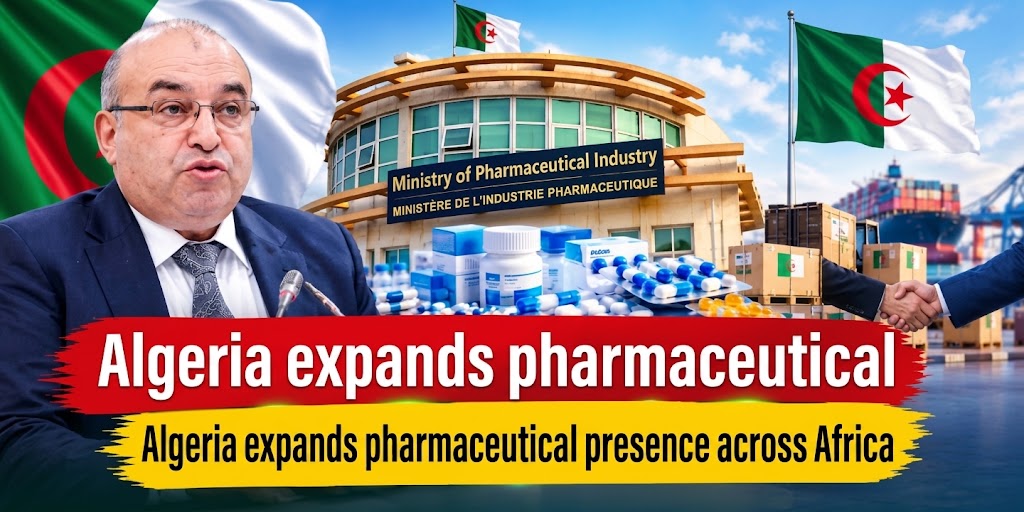
Algeria expands pharmaceutical presence across Africa

Algeria expands pharmaceutical presence across Africa

Algeria Gate: The Minister of Pharmaceutical Industry, Ouassim Kouidri affirmed Algeria’s determination to expand the presence of its pharmaceutical products on international markets, with a particular focus on the African continent, by raising the competitiveness of locally produced medicines and ensuring their strict compliance with global standards.

This was stated during his supervision, on Saturday at the ministry’s headquarters, of the opening of a training course directed at economic operators in the pharmaceutical industry sector. The course aims to accompany these operators in the World Health Organization prequalification process, in order to elevate local manufacturing practices to the level of international specifications, thereby enhancing product quality and opening broader export prospects.

Africa as a strategic destination

The minister explained that achieving health sovereignty goes beyond meeting domestic demand and extends to directing productive capacities outward. He stressed the need to transform national potential into an actual and competitive presence on international markets, considering the African space a promising environment for promoting Algerian pharmaceutical exports.

Government support and international expertise

To ensure the success of this path, the minister called on operators to engage actively in international qualification, pledging that the ministry, in coordination with the National Agency for Pharmaceutical Products, will provide comprehensive technical and regulatory support to institutions wishing to export.

To animate this course, the ministry drew on Algerian experts from the diaspora who possess pioneering experience with the World Health Organization. They presented models of best practices and technical procedures that guarantee the conformity of Algerian medicines with global requirements.

This strategic step reflects a serious governmental orientation toward strengthening the international standing of the Algerian pharmaceutical industry and making an effective contribution to the diversification of the national economy beyond the hydrocarbons sector.

#Africa#Algeria
Author
Lys Iwannughen
African coast
Share this post

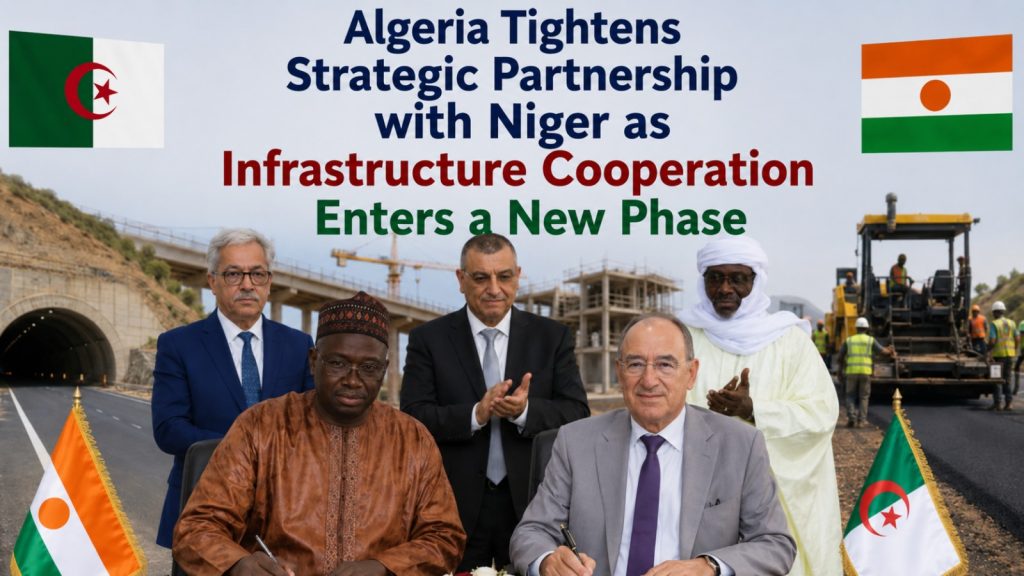
Algeria Tightens Strategic Partnership with Niger as Infrastructure Cooperation Enters a New Phase

Algeria Tightens Strategic Partnership with Niger as Infrastructure Cooperation Enters a New Phase

Algeria Gate: Algeria and Niger are giving new momentum to their strategic partnership, this time through the public works and infrastructure sector, with a series of agreements and technical programmes designed to strengthen Niger’s institutional capabilities and expand the transfer of Algerian expertise.

Far from being limited to routine technical cooperation, the latest developments reflect the broader dynamic taking shape between Algeria and its southern neighbour at a time when the Sahel is undergoing profound geopolitical and economic transformations.

The new push comes within the framework of implementing the outcomes of the second session of the Algerian–Nigerien Joint Great Commission, held in Niamey last March, and follows the commitments reached during the visit of Niger’s Minister of Equipment and Infrastructure, Salissou Mahaman Salissou, to Algeria last June.

Algeria and Niger translate political commitments into concrete projects

Against this backdrop, Abdelkader Djelawi, Minister of Public Works and Basic Infrastructure, received a high-level Nigerien delegation headed by Abdallah Ouma Ahmed, Secretary-General of Niger’s Ministry of Equipment and Infrastructure.

The delegation included senior officials and directors-general of laboratories within Niger’s equipment and infrastructure sector, underlining the increasingly technical and institutional dimension of the partnership between the two countries.

The discussions focused on translating the cooperation protocol signed in Niamey into concrete action, while reviewing the implementation of memoranda of understanding concluded between Algeria’s National Authority for Technical Control of Public Works (CTTP) and Central Public Works Laboratory (LCTP) and their Nigerien counterparts.

The objective is clear: move from political declarations to practical mechanisms capable of strengthening Niger’s infrastructure sector and building sustainable technical expertise.

Expertise transfer at the heart of Algeria’s approach

The two sides also examined prospects for expanding cooperation into new areas, with particular emphasis on technical training, institutional capacity-building and the exchange of expertise.

Several programmes were placed on the table, including a draft special agreement between the CTTP and Niger’s Public Works Quality Centre (CPTP), together with a joint action plan designed to structure and coordinate future cooperation.

A separate draft agreement was also discussed between Algeria’s Central Public Works Laboratory (LCTP) and Niger’s National Laboratory for Public Works and Construction (LNTPB), focusing on training and professional development.

In addition, the two countries examined a dedicated programme aimed at training Nigerien technical executives, reinforcing Algeria’s role as a partner in the development of specialized human resources and institutional expertise.

From the Sahel to infrastructure: a broader strategic equation

The consultations culminated in the signing of special agreements between the concerned laboratories and the adoption of the final version of the joint action plan.

Implementation has now moved onto the ground, particularly in areas involving the transfer of technical know-how, professional training and capacity-building across the public works and basic infrastructure sectors.

This shift from agreements to implementation is significant. For Niger, strengthening technical institutions and developing qualified personnel are essential components of its efforts to build resilient infrastructure and consolidate national development capabilities.

For Algeria, meanwhile, technical cooperation represents another avenue through which it can reinforce its ties with neighbouring Sahelian countries based on expertise, training and mutually beneficial development.

A partnership with regional implications

The growing Algerian–Nigerien cooperation comes at a particularly sensitive moment for the Sahel, where questions of sovereignty, infrastructure, economic development and regional partnerships have become increasingly intertwined.

Algeria has consistently advocated solutions centred on regional cooperation, development and the strengthening of the capacities of African states themselves. The expansion of cooperation with Niger in strategic technical sectors fits within this broader approach.

The latest agreements therefore carry significance beyond the laboratories and institutions directly involved. They contribute to building a deeper network of Algerian-Nigerien cooperation, extending from political dialogue to infrastructure, technical expertise and human-capacity development.

By placing knowledge transfer and institutional strengthening at the centre of the partnership, Algeria and Niger are laying another brick in a relationship increasingly shaped by shared strategic interests and the realities of the Sahel.

At a time when outside powers are competing for influence across the region, Algeria’s growing engagement with Niger sends a clear message: regional partnerships built on African expertise, sovereignty and long-term development remain central to Algiers’ vision for its southern neighbourhood.

#Algeria#Niger
Author
Lys Iwannughen
African coast
Share this post

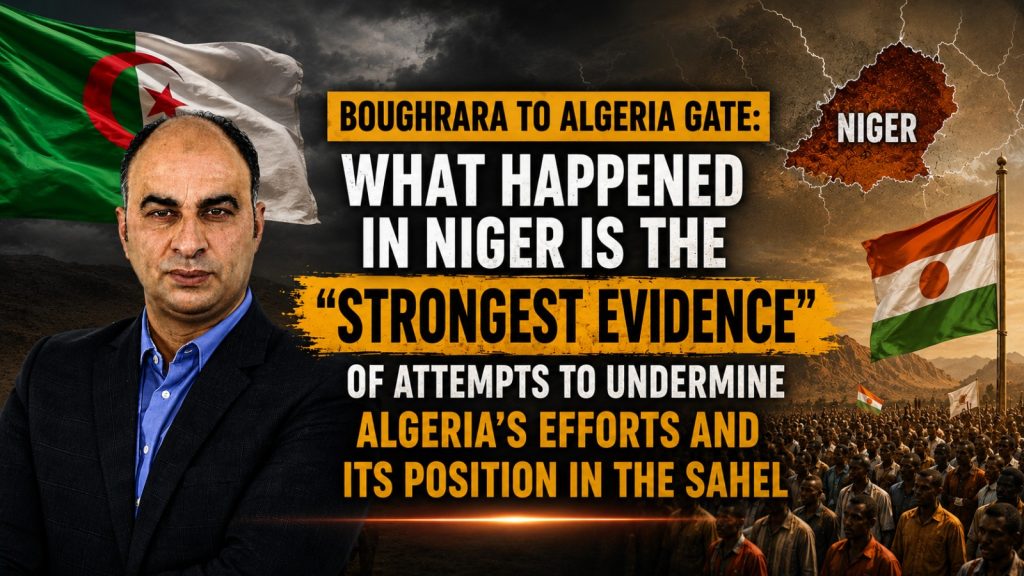
Boughrara to Algeria Gate: What Happened in Niger Is the “Strongest Evidence” of Attempts to Undermine Algeria’s Efforts and Its Position in the Sahel

Boughrara to Algeria Gate: What Happened in Niger Is the “Strongest Evidence” of Attempts to Undermine Algeria’s Efforts and Its Position in the Sahel

Algeria Gate: Political analyst Hakim Boughrara told Algeria Gate that France’s persistent efforts to keep the Sahel mired in chaos, while amplifying its own propaganda on counter-terrorism, reveal the true purpose of its military presence in the region: securing strategic positions across Sahelian states and protecting its economic interests.

These interests centre on “plundering uranium, gold and various rare minerals,” Boughrara explained.

He argued that the political awakening of Sahelian countries, the expulsion of French forces, and the massive popular demonstrations in Niger, Burkina Faso and Chad have significantly eroded French influence.

France consistently holds Algeria responsible for this decline, accusing Algiers of promoting the completion of African independence and the expulsion of colonial powers; a stance that, in Boughrara’s view, would enable Africans to reclaim and benefit from their own resources and wealth.

The analyst highlighted Algeria’s renewed engagement in the Sahel and the solid partnerships it has forged with Chad, Niger, Burkina Faso and Mali. France refuses to allow the region to break free from the stereotypical image it has long cultivated: a permanent zone of chaos dominated solely by terrorist groups, he added.

This narrative, according to Boughrara, serves one purpose: to “maintain ambiguity” so that France can continue acting as it pleases in the region.

Turning to the United Arab Emirates, Boughrara described it as a small state that has deeply penetrated North Africa and the Sahel. He accused Abu Dhabi of paying ransoms to terrorist groups and of systematically seeking to disrupt Algeria’s achievements and economic gains.

Algeria’s strong return to its Mediterranean and African neighbourhood, and especially to the Sahel, has alarmed what Boughrara termed the “axis of evil” linking “the Makhzen, the UAE and the Zionist entity.” This shared anxiety, he argued, has pushed these actors into a form of coordination aimed at “breaking Algeria’s efforts and its strategic positioning.”

What unfolded in Niger, he stressed, constitutes the “strongest evidence” of this campaign. The accusations levelled by the Nigerien authorities, he noted, rest on “a great deal of evidence.”

Boughrara concluded that this axis has no interest in seeing either the Sahel or Algeria grow stronger. Still less does it want the countries of the region to become robust and mutually integrated; a development that would expose those powers determined to keep the Sahel in a state of security, economic and social fragility, the better to plunder its wealth while paying nothing in return.

#Algeria#France#Niger#Sahel
Author
Lys Iwannughen