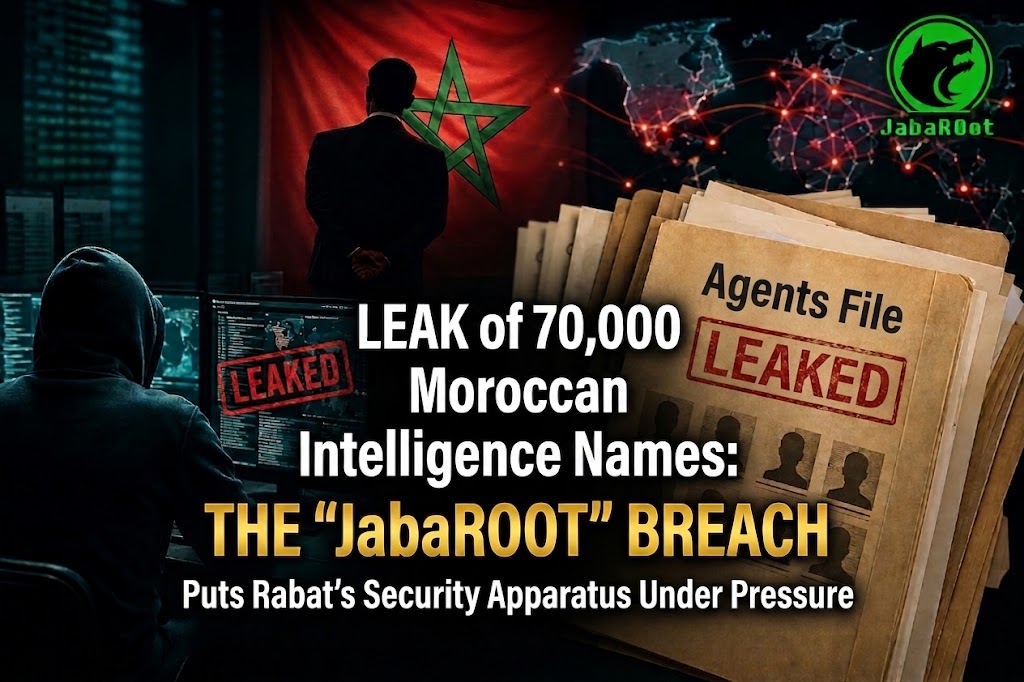


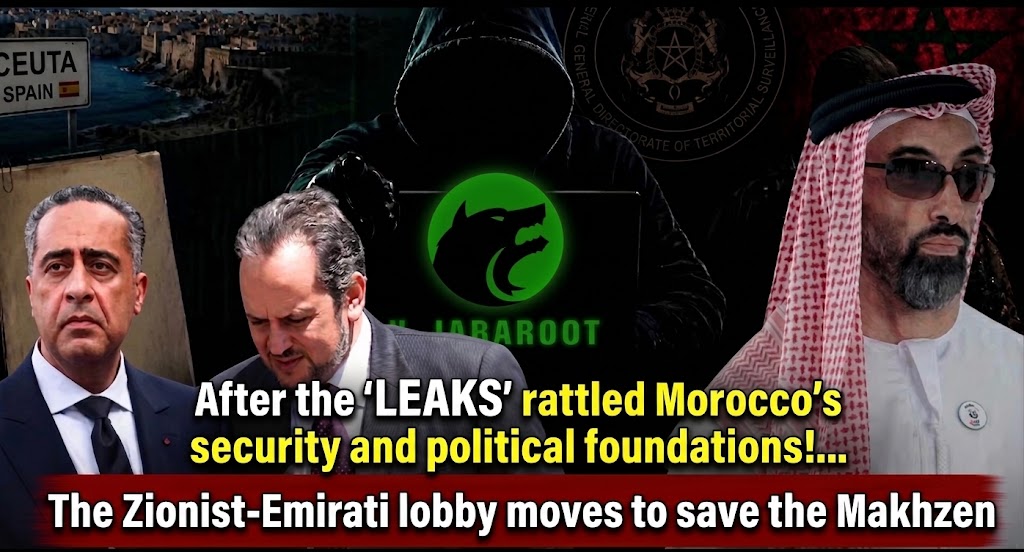
Algeria Gate: The Moroccan establishment appears to be struggling to contain the political and security fallout from the explosive material attributed to the “Jabaroot” hacking group. After reportedly penetrating sensitive databases and exposing what it described as the inner workings of the Makhzen’s intelligence apparatus, the group delivered a devastating blow to the image carefully cultivated by Morocco’s security establishment.
The latest development only deepens the controversy. According to the claims surrounding the affair, the “Jabaroot” Telegram channel was shut down after pressure allegedly involving networks linked to Israeli and Emirati interests, including circles associated with UAE National Security Adviser Tahnoun bin Zayed Al Nahyan. If true, the closure would look less like an ordinary platform decision and more like a desperate attempt to contain a scandal that had begun spilling far beyond Morocco’s borders.
The alleged “Jabaroot” disclosures are staggering in scope. The group claimed to have accessed intelligence records containing more than 70,000 names of Moroccan intelligence operatives reportedly operating around the world, along with personal information such as dates of birth and identification numbers. According to the material it published, these operatives were involved in a wide range of clandestine activities across Europe, including political influence operations, surveillance, recruitment, bribery and the installation of listening devices.
But the alleged leaks went much further than exposing an intelligence network. They painted a deeply disturbing picture of a system allegedly reliant on intimidation, blackmail and political manipulation. The group claimed to have documented Moroccan intelligence involvement in pressure campaigns against European officials, journalists and political figures, while also alleging that agents operating under the authority of Yassine Mansouri and Abdellatif Hammouchi were connected to operations targeting Moroccan activists and opponents.
These are extraordinarily serious allegations, and they come with a central political question: how far does the Makhzen’s security apparatus extend when it operates beyond Morocco’s borders?
For months, “Jabaroot” claimed to have released documents concerning the Moroccan royal palace, senior officials, members of their families and the machinery of influence surrounding the regime. The material also purported to expose the scale of corruption and patronage embedded in the system, turning what might otherwise have been another cyberattack into a potentially explosive political affair.
Among the names mentioned was Abdelaouafi Laftit, presented by the group as a figure close to Abdellatif Hammouchi. According to documents attributed to “Jabaroot”, Laftit was allegedly implicated in illicit-enrichment schemes and in orders concerning the demolition and confiscation of private properties. The group further alleged that families were pressured into accepting questionable settlements, while confiscated or disputed properties were subsequently redirected toward projects presented as investment or public-interest operations, including projects allegedly benefiting Israeli businessmen.
The allegations do not stop at the civilian administration. The Moroccan military hierarchy was also reportedly targeted by the disclosures.
Among the most politically sensitive claims were allegations concerning General Mohamed Berrid, Inspector General of the Royal Armed Forces. According to the material attributed to “Jabaroot”, Berrid was implicated in cases involving abuse of influence and the acquisition of property at a fraction of its alleged value.
One of the most striking allegations concerns a luxurious residence overlooking Morocco’s Atlantic coast, in the protected Témara-Skhirat area. The group claimed that the property, covering approximately 1,500 square metres, was transferred into the name of Berrid Chahrazad, identified in the leaked material as the daughter of Berrid, through an official transaction with the military housing and equipment agency ALEM for a reported 1.5 million dirhams. The political significance of such a claim is obvious: it directly challenges the image of institutional integrity projected by the Moroccan military establishment.
And the alleged revelations extend into the occupied Western Sahara, where “Jabaroot” claimed to have uncovered a systematic pattern of land appropriation and profiteering involving local officials aligned with the Makhzen.
According to the group’s published material, officials in the councils of Laayoune and Smara were involved in the seizure and transfer of large tracts of land at supposedly symbolic prices. One of the names singled out was Moulay Hamdi Ould Errachid, a prominent figure loyal to the Moroccan establishment. The leaked documents reportedly alleged that land in occupied Smara was acquired for prices as low as 20 dirhams per square metre.
Taken together, these allegations present a picture that is profoundly damaging to the Moroccan regime, not merely because of the volume of information released, but because the material targets the very institutions Morocco portrays as pillars of stability, security and good governance.
That is precisely why the reported effort to silence “Jabaroot” matters. Shutting down a Telegram channel does not erase leaked documents, nor does it answer the questions raised by them. It merely shifts the battlefield from the digital sphere to the political one.
For the Makhzen, the problem is therefore no longer simply a hacking group. It is the credibility crisis created by the allegations themselves, and by the growing suspicion that powerful foreign networks are being mobilized to contain the damage.
The real test now is not whether the channel can be silenced. It is whether the Moroccan authorities can provide convincing answers to the allegations contained in the leaks.
Because when a regime reacts to explosive disclosures by trying to bury the messenger rather than confronting the substance, the scandal only grows larger.