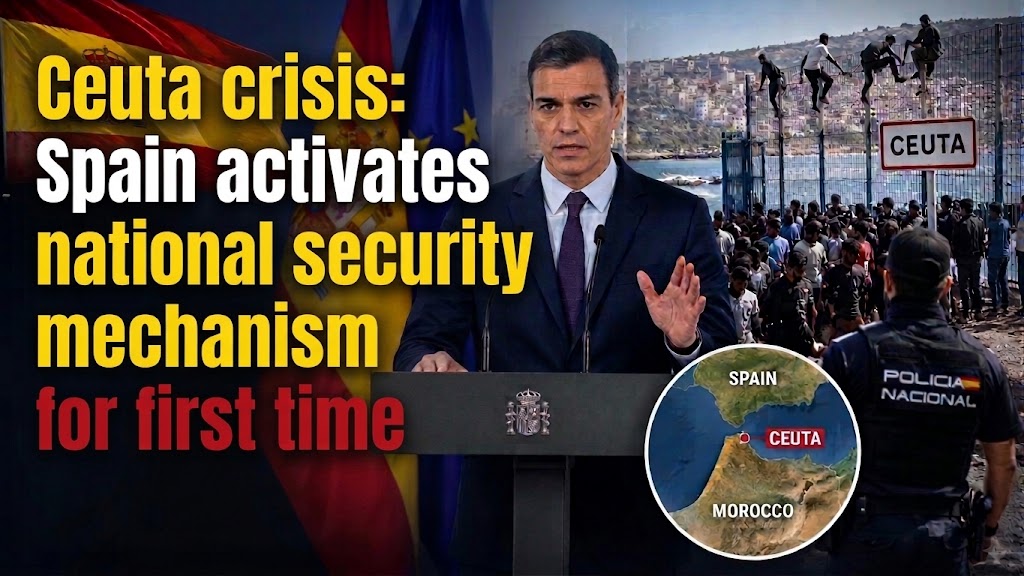
Algeria Gate: Spain has crossed an unprecedented threshold in its management of the crisis shaking Ceuta. On Tuesday, August 25th 2026, Pedro Sánchez’s government decided to declare the situation in the enclave a matter of “national security interest,” thereby activating for the first time a mechanism provided for by Spain’s 2015 National Security Law.
This decision comes nearly a month after the massive arrival of migrants in Ceuta from the border with Morocco. At the end of July, more than 70,000 people crossed or attempted to cross the border, creating an exceptional situation for the Spanish authorities and placing the enclave’s reception capacities under severe strain.

Madrid wants to centralise crisis management
Meeting in an extraordinary session under the presidency of Pedro Sánchez, the National Security Council decided to strengthen coordination between the various Spanish administrations. The Minister for Territorial Policy, Ángel Víctor Torres, is notably to assume an enhanced coordinating role in order to put in place a unified response to the crisis.
Madrid’s stated objective is to coordinate operations more effectively, particularly the care of migrants still present in the enclave, their identification, and the procedures allowing their return to Morocco when this is legally possible.
A situation that now goes beyond the purely migratory issue
The scale of the crisis has gradually transformed what was initially regarded as a migratory crisis into a matter directly affecting national security and the external borders of the European Union.
Several thousand people are still in Ceuta, including a significant number of minors, while local infrastructure and reception services remain under heavy pressure.

Madrid is also seeking additional support from Brussels to deal with the consequences of this crisis. The Spanish government has in particular taken steps with the European Commission to obtain emergency funding.
A precedent in relations with Morocco
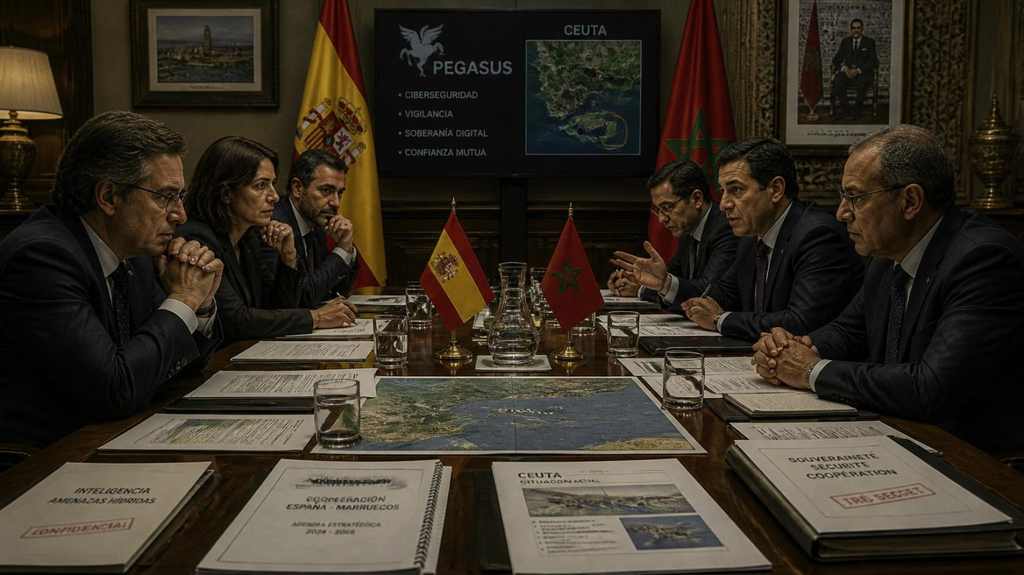
This decision also comes in a particularly sensitive context between Madrid and Rabat regarding Ceuta and Melilla. The scale of the July influx has revived debates on border control, migratory cooperation and Spanish sovereignty over the two enclaves.
By activating this national security mechanism for the first time, the Spanish government intends to show that the Ceuta crisis is now regarded as a strategic issue requiring a coordinated response at the highest level of the State.
The activation of this mechanism therefore constitutes a turning point in the management of the crisis: Madrid is no longer treating the migratory influx solely as a local emergency, but as a situation liable to have wider security, political and European repercussions.