
Tuesday, 11 August 2026 00:50 Algiers time
Algeria Gate
News Room
Revealed: How Jeffrey Epstein Used Saint-Tropez as a Key Hub for Luring Victims UEFA, AFC and CONCACAF Unite Against FIFA Over ‘Fundamental Breach of Trust’ Moroccan invasion threatens Ceuta… The Makhzen pushes the migration crisis toward a new explosion on August 15th Algeria’s Diplomacy Secures the Release of German Hostage Morocco opens its doors to homosexuals… Mohammed VI violates the sanctities of God! Algerian petroleum product tops Europe’s imports… record shipments in 14 months President Tebboune congratulates world high jump champion Younes Ayachi “7-77” programme to develop digital skills… Algérie Télécom launches free courses in 3 provinces! Algerian army delivers 4 helicopters and military equipment to Niger on President Tebboune’s orders “Mercenary “Slimane Boussoufa Destroyed by Algeria’s Top Journalists Over Ceuta Coverage
Share this post

Spanish Court sentences Moroccan individual for hashish smuggling

Author: Lys Iwannughen 0 comments 64 views
Spanish Court sentences Moroccan individual for hashish smuggling

Algeria Gate: A court in the Spanish city of Ceuta has sentenced a Moroccan national to three years and eight months in prison, in addition to imposing a financial penalty, after convicting him of smuggling more than 55 kilograms of hashish concealed inside his vehicle.

According to local media reports, the case stems from an incident on February 21 of last year, when the suspect was intercepted at the passenger checkpoint at the Port of Ceuta while preparing to board a ferry to Algeciras. He was driving his own vehicle at the time.

The court ruling stated that the man’s behavior raised suspicions among security officers, prompting them to conduct further checks. After confirming his identity and obtaining his consent to search the vehicle, officers uncovered a sophisticated hidden compartment beneath the rear seats containing several suspicious packages.
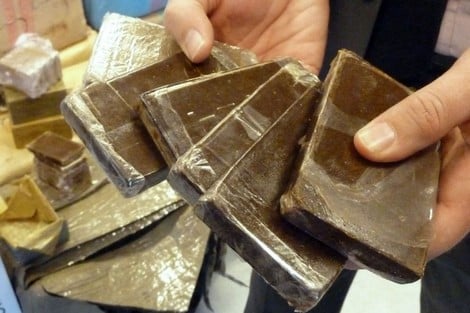
The subsequent inspection led to the seizure of 20 rectangular blocks of hashish resin weighing more than 55 kilograms. Laboratory analysis confirmed the substance, and investigators concluded that the drugs were being transported for distribution and sale.

In a separate but similar case, the same court sentenced another Moroccan citizen last week to three years and two months in prison after he was arrested while attempting to swim to the Spanish coast carrying a backpack loaded with a large quantity of hashish.


#Drug trafficking#Morocco#Spain
Author
Lys Iwannughen

Leave a comment

Your email address will not be published. Required fields are marked *

Maghrebi files
Share this post

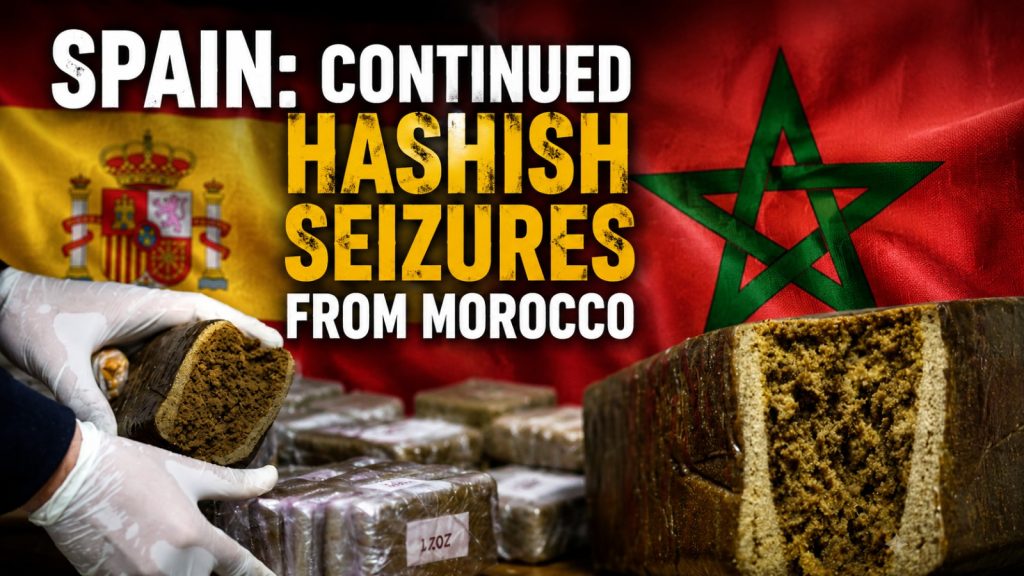
Spain: continued seizures of hashish smuggled from Morocco

Spain: continued seizures of hashish smuggled from Morocco

Algeria Gate: Spanish security forces have recently seized large quantities of hashish smuggled from Morocco․ In the most recent operation‚ at the mouth of the Huelva River‚ 1‚640 kg of cannabis resin was seized and five people were arrested․

Spanish police seized 41 packages (with a total weight of 1640 kg (1․6 t; 3‚600 lb)) of hashish in the town of Huelva (in southern Spain)․ Five people aboard a 10-metre (33 ft) boat were arrested‚ suspected of being involved in international drug trafficking․

Given news of a drug shipment arrival on the coasts of Huelva‚ the Spanish security forces deployed maritime surveillance across the region‚ observing the position of the suspicious boat until its location was found by the security forces at the mouth of the river․

During the raid, which involved specialized security units, authorities discovered 41 packages of hashish along with six 25-liter fuel containers. These containers are believed to have been intended to enable long-distance maritime journeys.

As investigations continue to identify additional suspects and map out the full logistical network behind the operation, all five individuals aboard the boat were arrested. The drugs and the vessel were seized, and the detainees have been handed over to the competent judicial authorities.

This latest success adds to a growing number of similar operations conducted by Spanish authorities in recent months targeting hashish smuggling networks operating from Morocco. There are clear signs that these networks are becoming increasingly armed and sophisticated.

Analysts point out that the repeated interception of large Moroccan hashish shipments in Spain and across Europe has intensified criticism of the Makhzen regime.

https://www.aps.dz/monde/monde/mrkp82jl-

A recent Spanish security report highlighted the growing threat posed by these international drug trafficking networks, which are increasingly relying on advanced technology to smuggle hashish from Morocco into Europe and evade Spanish law enforcement. Spanish police are actively working to dismantle these criminal organizations and their cross-border networks.

According to the report, prepared by the Spanish National Police’s Unit for Drug Trafficking and Organized Crime, a sophisticated secret tunnel discovered at the end of March was “designed with advanced technical and logistical equipment enabling the organized transport, storage, and handling of drug shipments.”

The tunnel reaches a depth of up to 19 meters and connects to a horizontal passage leading to the Moroccan side. The distance between the storage facilities and the border area is no more than approximately 25 meters.

Since the beginning of this year, Spanish security forces have dealt significant blows to these networks, dismantling at least 11 Moroccan criminal organizations and seizing dozens of tons of narcotics.

#Drug trafficking#Morocco#Spain
Author
Lys Iwannughen
International press
Share this post

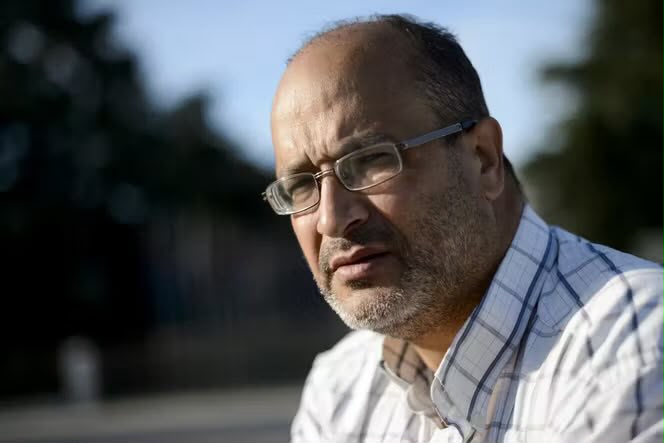
Makhzen Arrests Independent Journalist Ali Lmrabet

Makhzen Arrests Independent Journalist Ali Lmrabet

The Makhzen Regime Continues Its Policy of Repression and Silencing Voices: Journalist Ali Lmrabet Arrested Upon Returning to Morocco from Spain

Moroccan authorities arrested journalist Ali Lmrabet, one of the country’s most prominent independent journalists, on Sunday evening immediately after he arrived at Tangier Ibn Battuta International Airport on a direct flight from Barcelona, where he has lived for many years. He landed at around 3:00 p.m. local time.

According to Reporters Without Borders (RSF), Lmrabet is accused of allegedly spreading false information that undermines Morocco’s constitutional institutions. The organization said he was being transferred to Casablanca for questioning by the National Judicial Police Brigade before appearing before the public prosecutor on Monday. His wife said he had not visited Morocco for years and had returned only after the death of his father, who had been living there.

Meanwhile, security sources offered a different account. Speaking to the Moroccan news outlet Le360, they claimed the arrest followed complaints filed by institutions and individuals accusing Lmrabet of defamation through his online posts and videos. They said he would be questioned under the supervision of the public prosecutor. As of the time of writing, no official statement had been issued by the prosecutor’s office detailing the charges or legal procedures.

The arrest triggered immediate condemnation from civil society organizations. Maati Monjib, coordinator of the Freedom Now organization, described the move as an extremely dangerous escalation and a direct attack on Lmrabet’s fundamental right to freedom of expression and his independent journalistic work exposing corruption and abuses of power. People close to Lmrabet also expressed serious concern about his health, warning that prolonged detention without appropriate medical care could endanger his life.

Lmrabet’s history with the Moroccan authorities is not new. The founder of the magazine Demain and former editorin chief of Le Journal was imprisoned in 2003 on charges including insulting the King and threatening territorial integrity. During his imprisonment, he went on a prolonged hunger strike, losing 22 kilograms before receiving a royal pardon. He was later banned from practicing journalism for 10 years, prompting him to move to Spain, where he continued his work through digital platforms and collaborations with Spanish, French, and British newspapers.

Lmrabet’s return to his homeland after years of exile, intending to honor the memory of his late father, ended within hours with his arrest and appearance before judicial authorities, once again raising questions about press freedom in Morocco and the limits of the authorities’ tolerance toward independent voices.

Author
yasmine ouazib
Algeria
Share this post

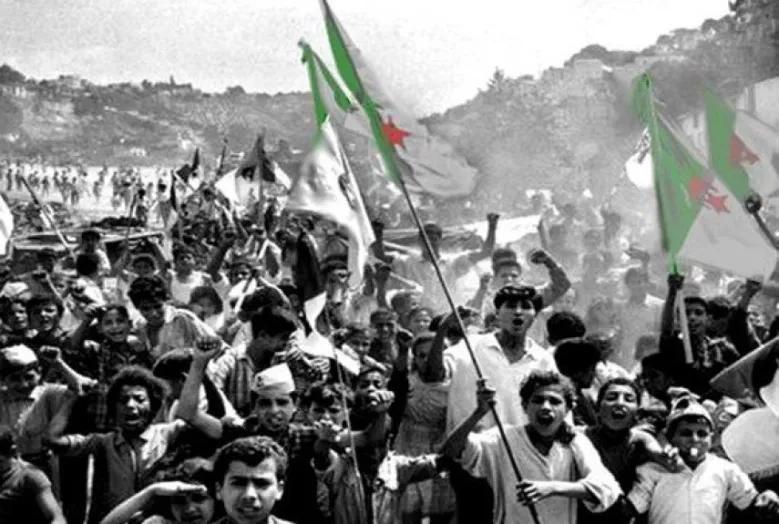
July 5, 1962: The Day Algeria Broke an Empire

July 5, 1962: The Day Algeria Broke an Empire

Victory Written in the Blood of a Million and a Half Martyrs

https://twitter.com/ImpactMediaFR/status/2073749091759079625?s=20

On July 5, 1962, Algeria did not simply reclaim its sovereignty it handed one of the twentieth century’s most powerful colonial empires a defeat from which it never fully recovered. Seven and a half years of armed struggle, lit by a single spark on November 1, 1954, was enough to bury the colonial fiction of “French Algeria” for good.

This is not rhetoric. It is record. France committed its full military and political weight to keeping Algeria in chains and lost, broken by the unbending will of a people who paid for their freedom with more than a million and a half martyrs. That number is not a statistic; it is the measure of what this war actually was: not a colonial skirmish but an existential confrontation between a nation that refused to disappear and an empire that refused to accept its own death.

From Battlefield to “Mecca of Revolutionaries”

Independence did not close Algeria’s account with the world it opened a new one. Algiers became a global command center for liberation movements, arming and sheltering resistance fighters from Tunisia to Morocco and opening its doors to revolutionaries from Africa, Latin America, and Asia. The title “Mecca of Revolutionaries” was not handed to Algeria it was earned, forged in an uncompromising doctrine: no neutrality on liberation, no bargaining over a people’s right to self-determination

That doctrine is not history. It is policy. It is the same principle driving Algeria’s positions today on Western Sahara and Palestine. Algeria’s diplomatic posture was not invented in a briefing room it was inherited, intact, from July 5, 1962.

A Legacy That Demands Defense, Not Nostalgia

Independence was never a finish line it was the first chapter of a permanent obligation to defend sovereignty against every test that followed, from the Sand War to the diplomatic confrontations of the present. July 5 is not a date to be filed away in a museum. It is a standing mandate: every generation that inherits this freedom inherits the duty to defend it with the same resolve that won it.

https://twitter.com/algatedzEng/status/2073615984577896490?s=20

Algeria did not just win its independence. It rewrote what independence means for every colonized nation that came afte

Author
yasmine ouazib