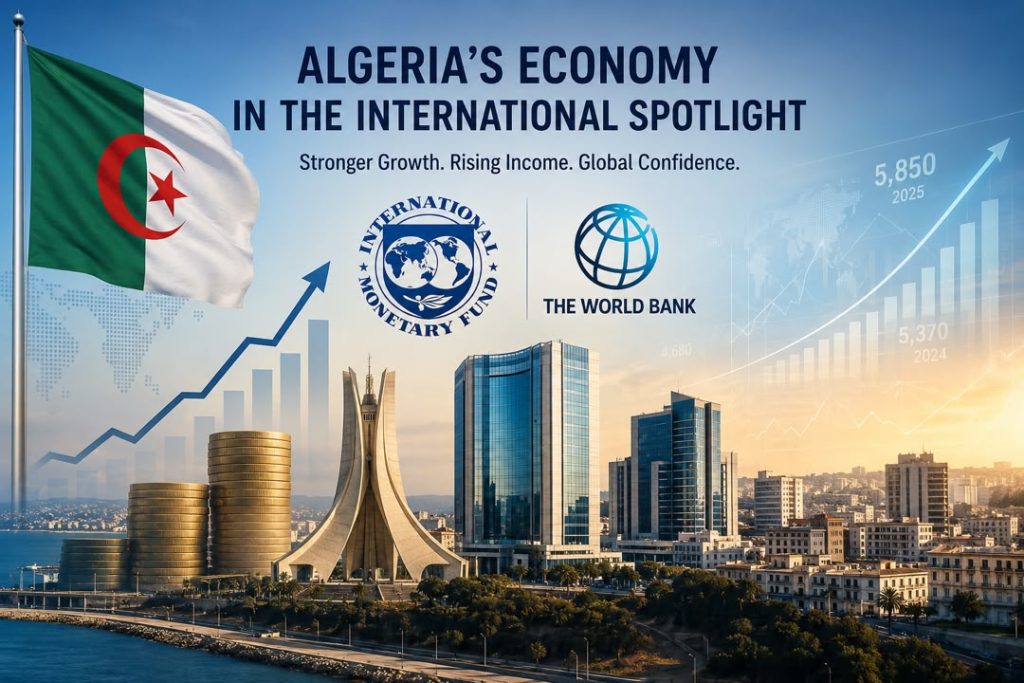
ALGERIA GATE ;Algeria has once again captured the attention of international financial institutions, as the country continues to strengthen its economic standing through sustained reforms, rising national income, and growing confidence in its long-term development strategy. Recent assessments by both the International Monetary Fund (IMF) and the World Bank highlight a positive trajectory, reinforcing Algeria’s position among Africa’s leading economies.
In its latest evaluation, the International Monetary Fund (IMF) praised Algeria’s economic resilience despite a challenging global environment. The Fund highlighted the country’s progress in advancing structural reforms, particularly efforts to diversify the economy beyond hydrocarbons. It also commended the continued development of the mining and agricultural sectors, which are increasingly contributing to economic growth and reducing dependence on oil and gas revenues.
The IMF further acknowledged Algeria’s prudent macroeconomic policies, sustained public investment, and measures aimed at strengthening public financial management. At the same time, it encouraged authorities to continue reforms that improve the business climate, enhance private sector participation, and increase the efficiency of public spending to ensure long-term, sustainable growth.
Complementing the IMF’s assessment, the World Bank Group confirmed that Algeria has retained its status as an upper middle-income country for the third consecutive year. The classification, based on Gross National Income (GNI) per capita across 218 economies for 2025, reflects the country’s steady economic progress.
According to the latest figures, Algeria’s GNI per capita increased to USD 5,850 in 2025, up from USD 5,370 in 2024, marking a notable improvement in income levels. The World Bank attributes this performance to continued economic growth, increased public investment, and ongoing efforts to improve fiscal governance.