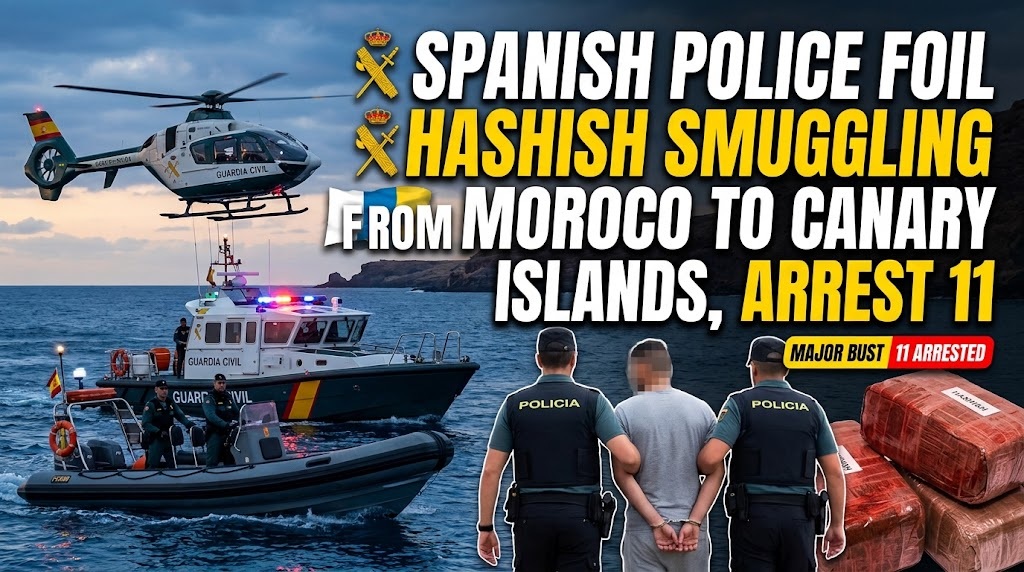
Algeria Gate/Agencies: Spanish police and Civil Guard officers have arrested 11 people after a rubber dinghy loaded with hashish from Morocco ran aground on the southern coast of Gran Canaria, authorities confirmed Friday.
The vessel was discovered stranded in the Castillo del Romeral area. Investigators say the boat was used to transport hashish across the short maritime route between the Moroccan coast and the Canary Islands. Nine of those detained have been ordered into provisional detention by Spanish judicial authorities. The status of the remaining two suspects and the exact quantity of the seized consignment have not yet been disclosed.
How the Operation Unfolded
The case began with the discovery of the beached dinghy. Follow-up inquiries by the National Police and Civil Guard quickly led to the 11 arrests for alleged involvement in unloading and moving the drugs ashore. Spanish security services are continuing to map the wider network, seeking additional suspects linked to the shipment’s reception and distribution on the islands.
The incident fits a familiar pattern. Drug-trafficking groups regularly exploit the relatively short sea distance between Morocco and the Canary Islands, using fast rubber boats to deliver hashish while attempting to avoid detection during offloading.
Part of a Larger Pattern in the Canaries
This latest bust is not an isolated event. In June, Spanish authorities dismantled a criminal network specialising in the introduction, storage and distribution of hashish between the Canary Islands and mainland Spain. That operation resulted in 25 arrests and the seizure of more than 7.5 tonnes of the drug.
In the same period, Spanish forces intercepted a yacht more than 400 miles south of the Canary Islands carrying approximately 500 kilograms of cocaine. The crew included Moroccan nationals.
These successive seizures highlight the persistent use of Atlantic routes connecting North Africa to Spain’s outermost region. While Moroccan authorities present themselves as active partners in regional anti-drug efforts, repeated European interdictions continue to identify Morocco as a key departure and transit point for both hashish and cocaine consignments bound for Europe.
Ongoing Challenges Along the Atlantic Corridor
The return of rubber-boat consignments to the headlines, despite repeated Spanish operations, underscores the resilience of the networks involved. Security officials note that the combination of short crossing distances, high profit margins and the difficulty of constant maritime surveillance keeps the route attractive to organised groups.
Investigations into the Gran Canaria case remain open as authorities work to identify further members of the organisation and fully reconstruct the logistics chain behind the stranded dinghy.