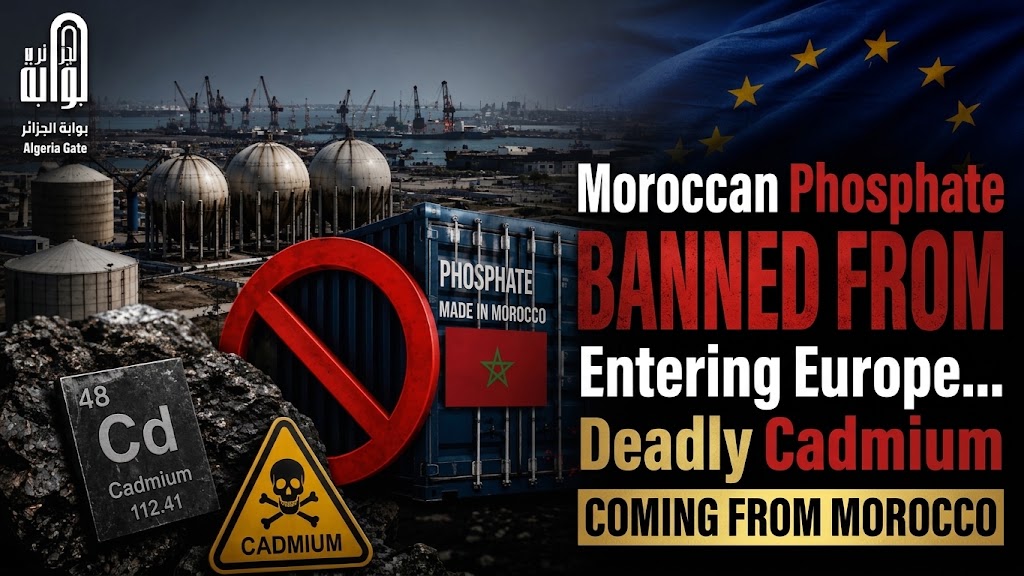
Algeria Gate: The Makhzen regime is facing growing challenges in maintaining its phosphate-derived fertilizer exports to European markets, amid rising concerns that these fertilizers may contain levels of toxic cadmium, a heavy metal that can migrate from soil into agricultural products and food, prompting warnings about its health and environmental risks.
In its natural state, phosphate contains cadmium, a heavy metal that is found in higher concentrations in phosphate deposits in Morocco, the United States, and Tunisia than in deposits in countries such as South Africa and Russia, according to data from the French health agency. The risks associated with this metal increase because it can migrate into agricultural soil and subsequently into food crops.
Cadmium is classified as a substance of health concern. It can cause damage to the kidneys, bones, and respiratory system and can increase the risk of cancer. It is a toxic heavy metal that occurs naturally in small quantities and can reach humans through air, water, and food. It can also accumulate in soil and agricultural crops, particularly when certain phosphate fertilizers containing high levels of cadmium are used.
The issue has become a public health concern in Europe, particularly in France, where calls have intensified for stricter controls on fertilizers imported from Morocco because of the potential risks they pose to agricultural products.
Faced with this pressure, the Moroccan Office Chérifien des Phosphates (OCP), which monopolizes the exploitation and processing of phosphate, attempted unsuccessfully to develop specific technologies to reduce cadmium levels in fertilizers destined for the European market. The group says the technology involves treating phosphoric acid and separating and isolating cadmium before it is used to manufacture fertilizers. However, this has not been enough to convince European health organizations, which have criticized the continued reliance on fertilizers imported from Morocco.
These measures have raised questions about cadmium levels in Moroccan fertilizers destined for markets outside the European Union, particularly since the company does not disclose the levels of this metal in all of its products. This has fueled concerns that different standards may be applied depending on the destination and market.
The Moroccan phosphate industry also faces environmental problems beyond cadmium, particularly those associated with fertilizer-production waste, most notably phosphogypsum, which contains heavy metals and acidic substances.
Between the risks posed by cadmium, European regulatory pressure, environmental problems, and supply disruptions, the phosphate sector produced by the Makhzen regime is entering a difficult period, while reducing toxic-metal levels has become an essential condition for maintaining its presence in the European market.