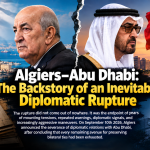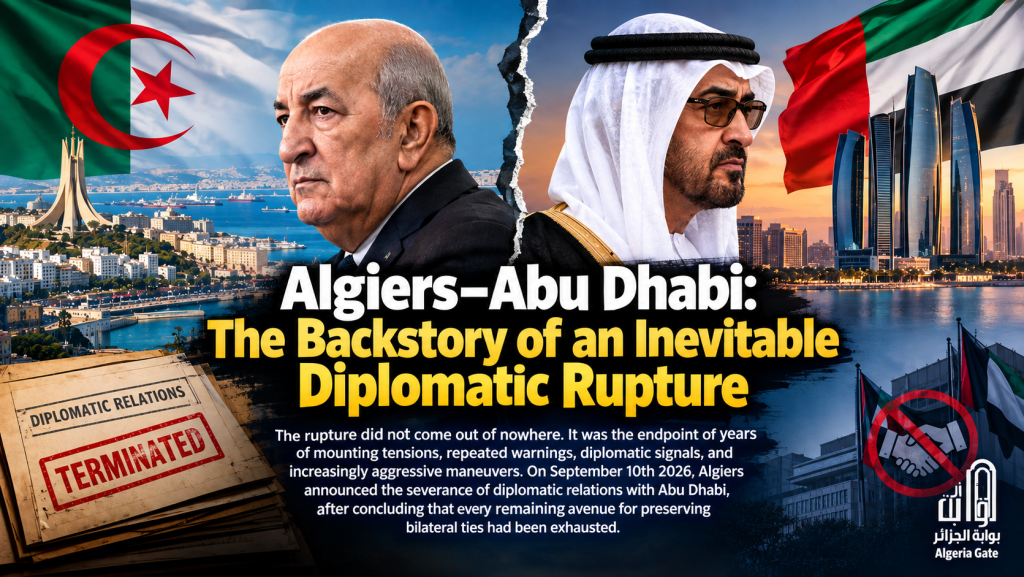
Algeria Gate: The rupture did not come out of nowhere. It was the endpoint of years of mounting tensions, repeated warnings, diplomatic signals, and increasingly aggressive maneuvers. On September 10th 2026, Algiers announced the severance of diplomatic relations with Abu Dhabi, after concluding that every remaining avenue for preserving bilateral ties had been exhausted.
According to sources close to the matter, the dispute goes back years. Its roots, they say, can be traced at least to the 2019 presidential election, when the United Arab Emirates allegedly backed a candidate whose victory would have opened the door to greater external influence over Algeria and transformed the country into a relay for Emirati interests.
The same sources trace the story even further back, citing accounts from former officials and senior figures within the Ministry of Housing. When Abdelmadjid Tebboune headed the ministry, they say, he categorically refused to sign the construction permit for the so-called Dounia Parc project despite intense pressure and alleged attempts at bribery. According to these accounts, what was presented as a €500 million investment was in reality a vast speculative operation, allegedly designed to facilitate the illegal transfer and repatriation of nearly $5 billion.
Whatever the precise chronology, the rupture is clearly presented by its proponents as neither an emotional outburst nor an improvised decision. It is portrayed instead as the culmination of a prolonged process in which Abu Dhabi allegedly transformed financial leverage into a mechanism of political interference, hostile alliances, regional destabilization, and pressure against Algeria.
2019: Tebboune’s election becomes Abu Dhabi’s nightmare
For Abu Dhabi, Tebboune’s accession to the presidency in 2019 was, according to sources familiar with the matter, more than a geopolitical setback. It was a strategic failure.
Emirati networks allegedly sought, through local intermediaries, to influence the electoral process. The sovereign choice of the Algerian people was, according to the same sources, never genuinely accepted.
After the election, those networks allegedly continued their efforts through political, media, and financial channels aimed at undermining the new occupant of El Mouradia Palace.
The 2024 presidential election subsequently became another battleground.
According to sources familiar with the operation, the Emirates sought to succeed where they had failed in 2019 by supporting any candidate capable of preventing Tebboune’s re-election. Substantial financial and human resources were allegedly deployed by Emirati services, including efforts involving retired senior officials.
Two strategic meetings reportedly took place in Paris under the auspices of Emirati intelligence services and were subsequently brought to the attention of Algerian authorities.
According to the same sources, the meetings involved five central figures: the candidate selected by the influence networks, an Algerian national allegedly linked to French intelligence, an Emirati official, and a businessman wanted by justice who allegedly presented himself fraudulently as a political opponent.
The objective, according to these accounts, was straightforward: construct a mechanism capable of blocking the outgoing president’s re-election.
The alleged interference did not stop at political maneuvering. Sources also claim that attempts were made to penetrate the functioning of Algeria’s Independent National Electoral Authority (ANIE).
Unusual delays and intense internal deliberations preceding the publication of a notably brief results summary are attributed by these sources to resistance from an ANIE member who allegedly opposed the interference and was subsequently sidelined.
At the same time, the Emirati embassy in Algiers, then headed by a figure described by sources as more interested in subversion than conventional diplomacy, allegedly conducted an intense disinformation campaign. Its interlocutors were reportedly fed a narrative portraying Algeria’s leadership as deeply divided and the president as increasingly isolated.
The BRICS maneuver: blocking Algeria, promoting Morocco
The alleged Emirati campaign was not limited to Algeria’s domestic political sphere.
According to multiple sources, Algeria’s failure to secure admission to BRICS was not simply the result of diplomatic arithmetic but was allegedly facilitated by the United Arab Emirates with the complicity of a European country.
Abu Dhabi subsequently promoted Morocco’s candidacy despite what sources describe as significant questions surrounding its compatibility with the bloc’s criteria.
According to the same accounts, UAE President Mohammed bin Zayed personally intervened with the Indian prime minister in an effort to secure a firm veto against Algeria’s admission, while simultaneously advancing Morocco’s interests.
The objective, according to these sources, was clear: prevent Algeria from gaining another strategic platform while strengthening a regional rival.
Turning Algeria’s neighborhood into a battlefield
Unable, according to the sources, to shake Algeria from within, Abu Dhabi allegedly turned increasingly toward its regional environment.
The formula is presented as brutally simple: money, weapons, mercenaries, political proxies, and digital propaganda.
In coordination with allies, the Emirates allegedly deployed substantial resources to transform Algeria’s strategic periphery into a permanent zone of instability.
Libya
In Libya, Emirati financial and military backing for Marshal Khalifa Haftar’s camp has long been identified as a major factor in the country’s east-west divide.
Algiers, by contrast, has consistently defended Libya’s unity, sovereignty, and territorial integrity.
The two approaches could hardly be more opposed.
Tunisia
Tunisia has allegedly become another front.
According to sources, pressure on Tunis to normalize relations with the Zionist entity, particularly through leverage connected to international financial institutions, forms part of a broader strategy aimed at aggravating Tunisia’s economic and social difficulties and weakening President Kais Saied.
Abu Dhabi’s disagreement with Saied’s strategic choices, the sources claim, has translated into campaigns converging with French and Zionist interests, including opposition activity financed and organized from France.
Morocco
To Algeria’s west, Morocco has increasingly emerged as a central relay.
The rapprochement between Rabat, Abu Dhabi, and Tel Aviv has, according to the sources, created a regional axis whose activities combine military cooperation, intelligence coordination, disinformation, and political pressure.
Sources further claim that Abu Dhabi facilitated the transportation of Israeli military experts to Morocco aboard an Emirati airline, allegedly to establish Zionist military infrastructure close to Algeria’s borders.
The reported transfer of 30 Emirati Mirage 2000-9 combat aircraft to Morocco is presented as another indication of the deepening military relationship.
Morocco has also allegedly benefited from substantial Emirati financing for disinformation campaigns targeting Algeria, particularly its relations with the Sahel.
According to sources, millions of euros were mobilized for media operations designed to create suspicion around Algiers, undermine its credibility, and isolate it from its strategic African environment.
And the alleged campaign did not remain confined to information warfare.
Sources describe massive military cooperation involving French weapons deliveries, including 40 aircraft reportedly loaded with military equipment and drone-assembly technologies, alongside the recruitment of mercenaries.
The stated objective of these maneuvers, according to the sources, was to create the conditions for a fratricidal conflict between Algeria and Morocco.
The Emirati leadership has reportedly made its position clear: should such a conflict erupt, Abu Dhabi would side unconditionally with Rabat.
Ransoms and terrorism: the Sahelian dimension
The Sahel represents Algeria’s strategic depth, and it is precisely there that Abu Dhabi’s expanding influence has generated some of the most serious allegations.
For years, the Emirates have expanded their economic, political, and security footprint across the region.
Sources cited in this dossier allege that this influence has included logistical and financial support for armed and terrorist groups operating near Algeria’s borders.
The issue of ransom payments for Western hostages is particularly explosive.
According to sources, enormous sums have allegedly been mobilized by the Emirates: €20 million for two Swiss and Austrian hostages, €10 million for an American national, and as much as €50 million for an Emirati hostage.
If substantiated, such payments would raise profound questions about the financing of criminal organizations and the broader consequences of injecting enormous sums into the regional hostage economy.
The sources go further, alleging that Abu Dhabi has become a major financial actor in mercenary recruitment and armed networks operating across the Sahel.
Abu Dhabi versus the Nigeria–Algeria gas corridor
Another major battlefield is energy.
The Trans-Saharan Gas Pipeline (TSGP), linking Nigeria and Algeria, has faced significant geopolitical obstacles.
Sources close to the dossier allege that the United Arab Emirates is working to divert the project toward Morocco so that it can ultimately feed into the competing Africa-Atlantic Gas Pipeline.
The Morocco-Nigeria project, launched in July, is expected to cross 14 countries. Its viability has nevertheless been questioned by numerous specialists, particularly because of the extraordinary logistical, political, and security challenges involved.
The Algeria-Nigeria project is considerably more direct, crossing only two countries.
Its estimated cost is placed at between $10 billion and $13 billion, compared with more than $25 billion for the Morocco-Emirati alternative.
Both projects are presented with an annual capacity of approximately 30 billion cubic meters, but their strategic models differ sharply.
The Algerian route is conceived as a direct export corridor capable of supplying a European market searching for reliable alternatives.
The Moroccan route would have to traverse a vast number of territories, multiplying security risks while requiring complex negotiations over transit fees and political commitments with each participating state.
According to sources, the Emirates have allegedly placed $5 billion on the table to influence key stakeholders and obstruct the Nigeria-Algeria project.
If accurate, the figures would reveal the scale of the geopolitical stakes behind what is ostensibly an energy competition.
Sudan: another war in Abu Dhabi’s orbit
Sudan provides another example of the controversy surrounding Emirati regional policy.
Since war erupted in 2023, the Emirates have been repeatedly accused of supporting the Rapid Support Forces (RSF) led by Mohamed Hamdan Dagalo, better known as Hemedti, in its war against the forces of General Abdel Fattah al-Burhan.
Behind the conflict lies not only a struggle for political power but also a battle over Sudan’s enormous resources, particularly gold.
Hemedti, the former Janjaweed commander who became one of Sudan’s most powerful warlords, has helped plunge the country into one of Africa’s worst humanitarian catastrophes.
International investigations have also reported the recruitment of hundreds of South American mercenaries, particularly Colombians, by private security companies, with training reportedly taking place at military facilities in the UAE before deployment to Sudan and Somalia.
International organizations have repeatedly documented atrocities in Darfur and raised concerns over external actors contributing to the conflict.
Sources familiar with the dossier allege that Abu Dhabi has provided billions of dollars in financial support and weapons to the RSF.
Somaliland: the separatist card
Abu Dhabi’s growing influence in Somaliland represents another dimension of what critics describe as its regional strategy.
The Emirates have presented their involvement primarily through the language of investment and economic cooperation. Yet their direct engagement with Hargeisa, carried out without the consent of Somalia’s federal authorities, has been portrayed by critics as an assault on Mogadishu’s territorial sovereignty.
The strategic prize is obvious: control over maritime routes linking the Red Sea and Gulf of Aden.
In this context, the emergence of closer relations between Hargeisa and Tel Aviv takes on a broader geopolitical significance.
According to the allegations presented by sources, Abu Dhabi played a major role behind the scenes in facilitating this rapprochement, while simultaneously supporting Ethiopia’s ambitions to secure direct maritime access through Somaliland.
The resulting configuration would provide the Zionist entity with a significant strategic foothold in the Horn of Africa while giving the Emirates additional logistical depth.
Sources further argue that these infrastructures could facilitate the movement of arms and financial resources toward Hemedti’s forces in Sudan.
The Emirati shadow reaches Europe
The alleged Emirati influence campaign does not stop at Africa.
France has become another major theater.
According to sources, Abu Dhabi has developed influence networks connected to a broader campaign targeting Algeria and the Algerian community in France.
The 2017 financing affair surrounding the National Front brought one aspect of these alleged networks into the spotlight. An €8 million loan involving Emirati financial circuits reportedly helped replenish the coffers of Marine Le Pen’s party.
According to sources, the affair demonstrated the existence of financial channels capable of reaching deep into the French political environment.
Today, the same strategy allegedly operates through the media and opinion sphere.
Controversial studies and polls focusing on the supposed harmfulness of Islam in France, particularly narratives targeting the Algerian community, have become part of a wider identity-based political debate.
The increasingly aggressive positions adopted by politicians such as Bruno Retailleau toward Algiers are presented by sources as operating within this broader ecosystem.
By financing and influencing opinion research concerning Muslims in France, Abu Dhabi allegedly seeks to shape political discourse, saturate the media agenda with identity issues, and strengthen far-right narratives ahead of the 2027 presidential election.
Spain: pressure on judicial cooperation
Spain has likewise become a theater of alleged Emirati maneuvering.
Sources close to the dossier describe the activities of businessman Bentaaloub Nassir, allegedly acting in line with Emirati interests, in Madrid.
According to these sources, he was dispatched to exert pressure on proceedings concerning the extradition to Algeria of an individual wanted by Algerian justice for allegedly serious crimes.
The objective, according to the allegations, was to derail judicial cooperation, obstruct the implementation of Algerian court decisions, and weaken Algeria’s ability to secure enforcement of its judicial demands in European capitals.
The case is presented by sources as further evidence of Dubai’s role as a haven for individuals wanted by Algerian justice who can subsequently be mobilized in service of broader geopolitical agendas.
MAK and Rachad: two fronts of the same pressure campaign
The Movement for the Self-Determination of Kabylie (MAK), classified by Algeria as a terrorist organization, has increasingly become, according to Algerian authorities and sources cited in this dossier, an instrument of foreign influence.
The movement’s international activity has intensified under its leader, Ferhat Mehenni.
According to sources, Mehenni has expanded his diplomatic contacts abroad, including confidential consultations in New York with three senior Emirati officials allegedly aimed at securing political backing and new financing channels.
This alleged rapprochement with Abu Dhabi would complement the MAK’s already established relationships with Morocco and Israel.
The resulting triangle, according to the sources, constitutes a network whose objective is to undermine Algeria’s territorial integrity.
Millions of dollars have allegedly been mobilized to flood social networks and selected foreign media outlets with disinformation intended to weaken Algeria’s internal front.
The MAK’s separatist project, critics argue, has little connection with the realities of Algerian society and instead functions as a mechanism of hybrid warfare.
It is on this terrain that the MAK allegedly converges with another movement: Rachad, which Algeria also classifies as a terrorist organization.
Despite their apparently incompatible ideological backgrounds, the two movements are portrayed by their opponents as operationally complementary.
According to the allegations, both serve the same broader objective: exploiting internal fractures, weakening state institutions, and placing pressure on Algeria’s sovereignty.
The digital illusion versus millennial history
The alleged hybrid war against Algiers has now moved decisively into the digital sphere.
A simple search for the Nigeria-Algeria gas pipeline, critics argue, illustrates the phenomenon: search results can be heavily saturated with content promoting the Moroccan alternative, creating the appearance of organic dominance where coordinated digital amplification may be involved.
Whether through algorithms, paid campaigns, influencers, or media relays, the objective is allegedly the same: manufacture a digital reality capable of replacing geopolitical reality.
This is where Abu Dhabi’s model of checkbook diplomacy appears to have evolved into something considerably more aggressive: a diplomacy of interference.
And that transformation is particularly striking given Algeria’s historical role in the early development of the Emirates.
Following the creation of the UAE in 1971 from the former Trucial States, Algeria reportedly provided expertise during the Emirates’ early development, including through Sonatrach and Air Algérie cadres who contributed to building essential capacities and infrastructure.
The relationship has since undergone a dramatic reversal.
The popular saying comes to mind: “As soon as a blind man recovers his sight, he discards his cane.”
Today, Abu Dhabi’s critics accuse the Emirates of abandoning Arab solidarity and subordinating their enormous financial resources to Western and Zionist interests, particularly in the face of the Palestinian tragedy.
What makes the situation even more striking, from Algiers’ perspective, is the ambition attributed to a relatively young federation: not merely to influence Algeria, but to reshape the strategic balance of an entire continent.
From disasters to propaganda
The alleged campaign has also extended into moments of national tragedy.
Sources accuse Emirati-linked networks and their digital relays of exploiting disasters that struck Algeria; including the orphanage incident and deadly fires in the eastern part of the country, to transform genuine human suffering into political ammunition.
Families grieving loss were allegedly turned into raw material for an information war.
The accusation is as serious as it is revealing: when geopolitical objectives become more important than human tragedy, even mourning becomes a battlefield.
The same mechanism, everywhere
From Libya to Sudan, from the Sahel to the Maghreb, from Paris to Madrid, the same pattern is repeatedly alleged:
Finance. Influence. Arm. Divide. Destabilize. Deny. Repeat.
And when the operation becomes too visible, the strategy allegedly changes: create layers of intermediaries, mobilize influencers, flood social networks, and bury the original trail beneath an avalanche of digital noise.
But the problem for Abu Dhabi is that Algeria has refused to play the role assigned to it.
The Emirati strategy has now reached a hard limit.
Algeria is neither a client state nor a political laboratory available to foreign powers seeking to install loyal proxies. Its sovereignty is not an asset for sale.
Algeria’s historical answer
The contrast could hardly be greater.
On one side stands a young federation whose modern statehood dates from 1971.
On the other stands an Algeria whose history stretches across millennia, shaped by successive civilizations and dynasties that profoundly influenced North Africa.
And above all stands the memory of the Algerian War of Independence; a national liberation struggle paid for with the blood of millions of Algerians and transformed into the foundation of a fiercely defended sovereignty.
This is why, from Algiers’ perspective, the alleged maneuvers of Abu Dhabi carry a meaning that goes far beyond ordinary geopolitical competition.
A state that has never experienced the founding trauma of a prolonged national liberation struggle cannot simply lecture Algeria on sovereignty.
And a state that seeks to weaken Algeria while aligning itself with forces accused of destabilizing the Arab and African worlds risks discovering that financial power has limits.
Abu Dhabi may have money.
It may have networks.
It may have influence.
It may have allies.
But Algeria has something that cannot be purchased: a historical memory forged through sacrifice and an instinctive refusal of foreign tutelage.
The alleged objective of suffocating Algiers therefore confronts a fundamental reality.
The Algeria of November 1954 was not built to bend before external pressure.
It was built to resist it.
And if Abu Dhabi believed that billions of dollars, political proxies, media campaigns, mercenary networks, or digital manipulation could transform Algeria into a subordinate state, the diplomatic rupture of 10 September 2026 may ultimately prove to be the moment when that calculation collapsed.
The Emirati shadow may stretch far.
But Algeria’s sovereignty stretches further.
For reasons of security and to protect the integrity of our informants, our services, and the operational means currently deployed, our sources have chosen not to disclose the most sensitive and potentially dangerous information at this stage.