Sunday, 18 October 2026 • 22:26 Algiers time
Algeria Gate
News Room
Cameron Hudson: UAE is virtually the sole backer of the RSF..without its support the war in Sudan would not continue Algeria-Niger: Official launch of Trans-Saharan fibre optic link Five minutes of lament over Algeria: Amar Belani exposes CNEWS’s real obsession Algerian courts hand down first death sentences under new drugs law Ségolène Royal’s masterclass on Algeria against an ignorant and demagogic journalist President Tebboune and senior officials receive the remains of Boualem Boualem in Algiers NAPEC 2026 in Oran: Algeria at the Heart of Africa’s and the Mediterranean’s New Energy Landscape Pegasus Files: Amnesty Uncovers Morocco’s Espionage Against Spain President Tebboune Orders Salary Increases in Algeria’s 2027 Budget, Rules Out New Taxes on Citizens Algeria Emerges as a Trusted Power for Regional Peace and Stability
Share this post

A QR Code to Bring Algerians Abroad Closer to Government Services

• Author: Lys Iwannughen • 0 comments • 41 views
A QR Code to Bring Algerians Abroad Closer to Government Services

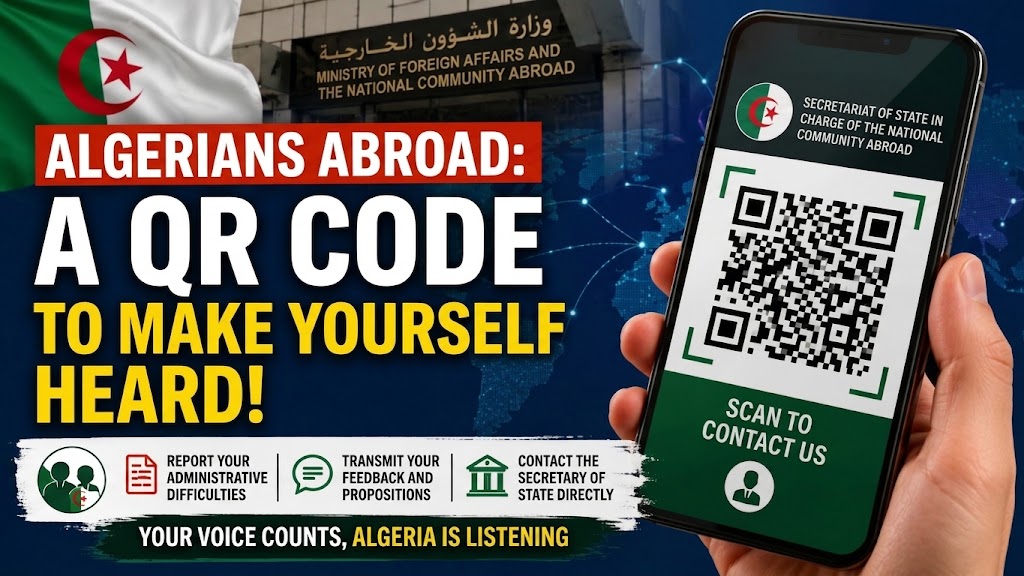
Algeria Gate: Algerian nationals living abroad now have a new way to raise their administrative concerns with Algerian authorities. A QR code, promoted by several consular offices, provides direct access to a contact platform for the Secretary of State in charge of the National Community Abroad.

Direct Access from a Phone

The concept is simple: by scanning the QR code with a smartphone, the user is redirected to a contact form run by the Ministry of Foreign Affairs. They can then explain their situation, share a comment, or submit a suggestion.

The tool thus serves as an additional channel between the Algerian diaspora and government services, particularly for people facing difficulties with their consular procedures.

Delays, Procedures, and Administrative Issues

This new channel can be used in particular to report a delay in issuing a document, a difficulty with an administrative procedure, a problem booking an appointment, or an unsatisfactory experience at a consular office.

Users can also submit suggestions aimed at improving reception services, simplifying certain procedures, or enhancing the quality of services provided to the national community abroad.

A Push to Better Listen to the Diaspora

Beyond its digital dimension, this initiative reflects a broader effort to facilitate dialogue between diaspora members and Algerian institutions. For nationals living far from Algeria, having quick access to flag a difficulty directly to the relevant departments can serve as an additional tool for getting their concerns addressed.

The tool is also part of a wider push to digitize administrative services for Algerians living abroad. Electronic platforms already exist for certain procedures, particularly to make it easier to obtain administrative documents.

With this QR code, the goal is to bring the administration closer to the diaspora: a simple scan can now be enough to submit a complaint, a comment, or a suggestion to the relevant authorities.

#Algeria#Diaspora
Author
Lys Iwannughen
View my articles

Leave a comment

Your email address will not be published. Required fields are marked *

African coast
Share this post

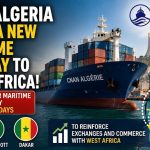
CNAN El Djazaïr Opens a New Maritime Gateway to West Africa

CNAN El Djazaïr Opens a New Maritime Gateway to West Africa

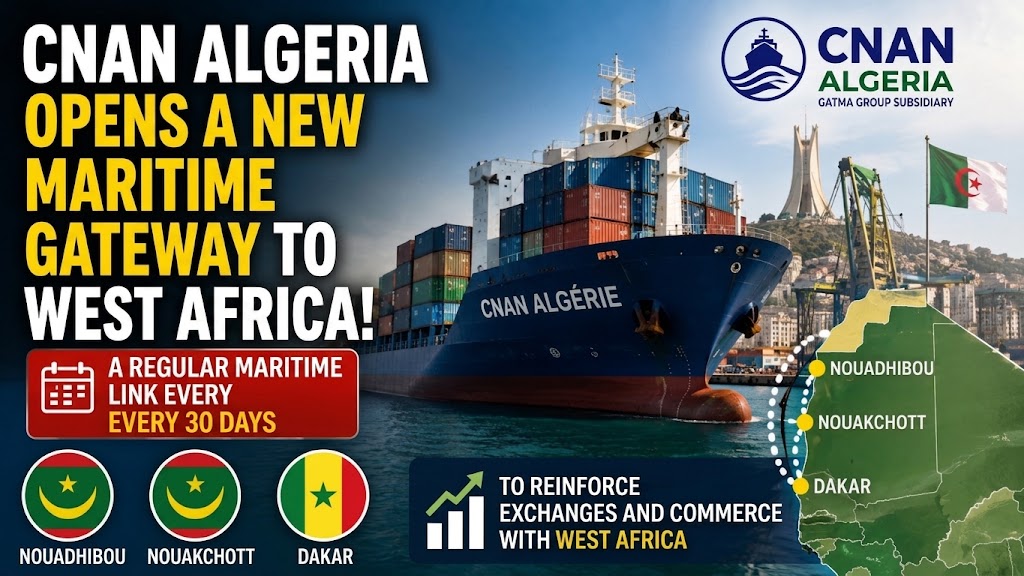
Algeria Gate: State-owned company CNAN El Djazaïr, a subsidiary of the Algerian Maritime Transport Group (GATMA), is strengthening its presence in West Africa with the launch of a regular maritime link operating once every 30 days. The route will connect Algeria to the ports of Nouakchott and Nouadhibou in Mauritania, as well as Dakar in Senegal.

This new line is primarily aimed at facilitating trade and improving the shipment of Algerian goods to West African markets. It forms part of a broader strategy to develop maritime freight transport and support non-hydrocarbon exports.

According to CNAN El Djazaïr‘s official website, the company already operates regular services to Mauritania and Senegal, with a fleet that includes container ships and General Cargo-type vessels.

With this monthly link, Algiers aims to strengthen its economic foothold in West Africa and provide Algerian operators with a more regular maritime logistics option for accessing these markets.

This initiative underscores the growing role of maritime transport in Algeria’s strategy of export diversification and the consolidation of trade ties with the African continent.

#Algeria#Mauritania#Senegal
Author
Lys Iwannughen
View my articles
Algeria
Share this post

Russia’s Newest Aerial Tanker.. Is the Il-78MK-90A Headed for the Algerian Air Force?

Russia’s Newest Aerial Tanker.. Is the Il-78MK-90A Headed for the Algerian Air Force?

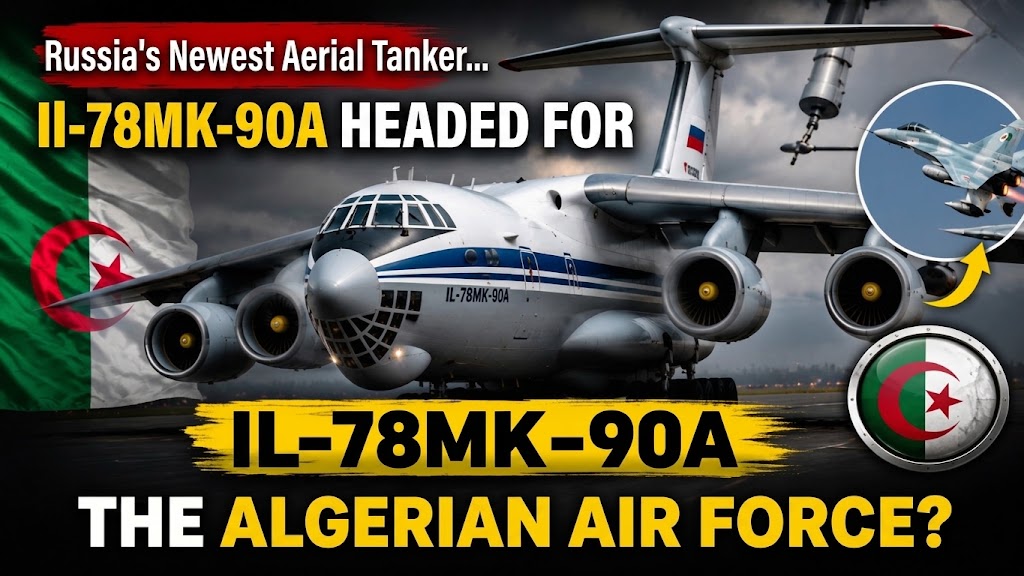
Algeria Gate: Specialized Russian military media are reporting that Algeria has inked a deal for three Il-78MK-90A aerial refueling tankers; a move that would give the Algerian Air Force a major boost in its in-flight refueling capacity. Neither Algiers nor Moscow has confirmed the report so far, and no official details of any such agreement have been made public.

This comes as Russia unveiled, on August 19th, 2026, a new export version of the Il-78MK-90A refueling aircraft, a move that has reignited speculation about which countries might be potential buyers of this model.

Extending Range and Operational Capabilities

The Il-78MK-90A is the export version of the Il-78M-90A, itself derived from the Il-76MD-90A heavy transport aircraft. According to data provided by Russian industry, the aircraft can carry up to 78 tons of fuel and is equipped with three in-flight refueling points, and can also be converted into a transport aircraft.

https://twitter.com/algatedzEng/status/2090231942457233872?s=20

These capabilities give the aircraft an important role in extending the range of fighter jets and military aircraft, particularly during long-range missions. For a fleet that includes heavy Russian fighters, such a system could enhance the air force’s ability to carry out operations over longer distances.

An Integrated Russian Air System

This development takes on added significance in light of the Su-57E’s entry into Algerian-Russian military cooperation. Images that surfaced in February and March 2026 showed fifth-generation fighters flying over Algeria, which observers considered the first aircraft of this kind designated for Algeria, making it the presumed first foreign operator of this model.

Should Algeria decide to acquire the Il-78MK-90A, the move would strengthen the integration of its air fleet and give its heavy fighters greater capability to carry out long-range missions.

#Algeria#Russia
Author
Lys Iwannughen
View my articles
Algeria
Share this post

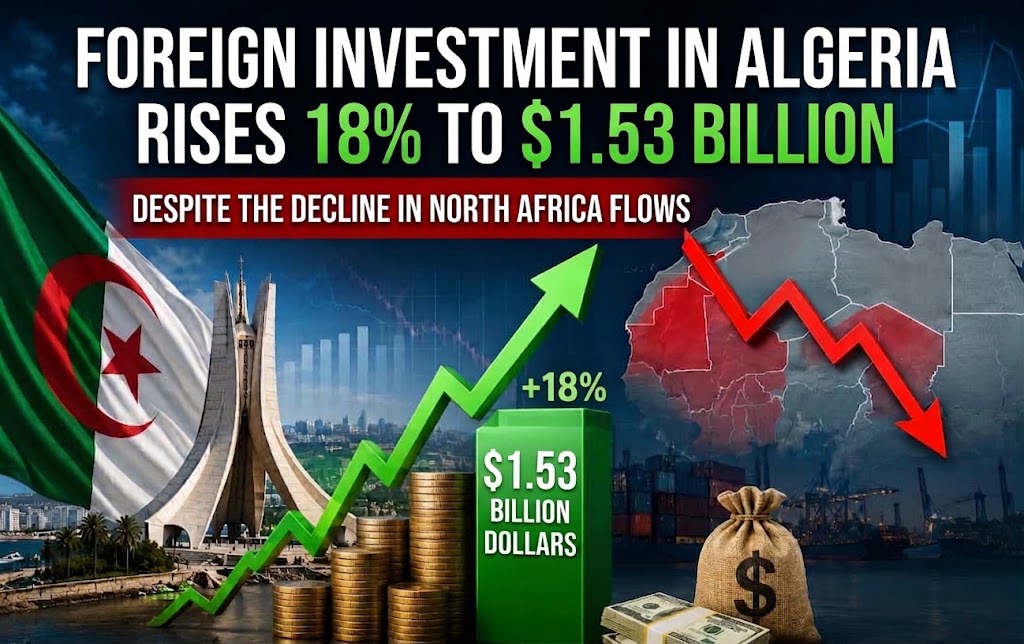
Foreign Investment in Algeria Rises 18% to $1.53 Billion Despite Decline in North African Flows

Foreign Investment in Algeria Rises 18% to $1.53 Billion Despite Decline in North African Flows

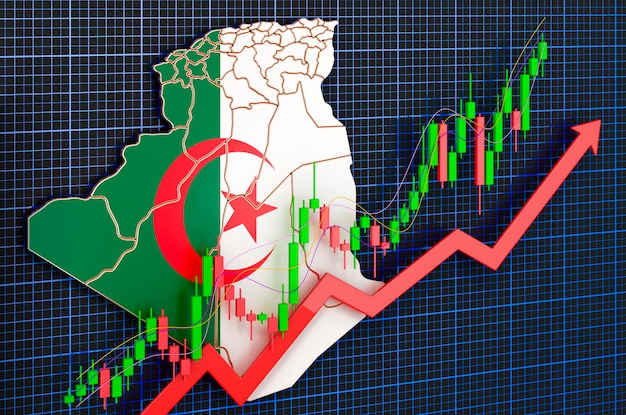
Algeria Gate: Algeria attracted $1.53 billion in foreign direct investment (FDI) during 2025, an increase of 18.15% compared with 2024, while the cumulative stock of foreign investments present in the country rose to $39.67 billion, according to the World Investment Report 2026 issued by the United Nations Conference on Trade and Development (UNCTAD).

Foreign Investment in Algeria Rises 18% to $1.53 Billion Despite Decline in North African Flows

This rise places Algeria in an advanced position within North Africa, after the region recorded a sharp decline of 56% in FDI inflows, from $51.269 billion in 2024 to $22.394 billion in 2025.

The UN report, published on 7 July 2026, stated that Algeria stood out among African countries that attracted major investment projects in hydrocarbons, refining, and industrial activities. It also listed Algeria among the economies that expanded foreign investment participation in the mining sector over the past year. UNCTAD: World Investment Report 2026

This performance comes at a time when FDI inflows to the African continent fell from $94.294 billion in 2024 to $69.506 billion in 2025, making the growth of flows toward Algeria contrary to the downward trend recorded at both the African and regional levels.

Foreign Investment in Algeria Rises 18% to $1.53 Billion Despite Decline in North African Flows

$1.53 Billion and Highest Flows Since 2020

UNCTAD data show that Algeria attracted $1.295 billion in FDI during 2024 before the flows rose to $1.530 billion in 2025; an increase of $235 million in a single year.

This level represents the highest annual inflows recorded by Algeria during the period covered by the report’s statistical annex, extending from 2020 to 2025.

FDI inflows stood at $1.140 billion in 2020, then fell to $870 million in 2021, before dropping to $255 million in 2022.

Flows then resumed an upward path, rising to $1.202 billion in 2023, then $1.295 billion in 2024, and reaching $1.530 billion in 2025.

These figures mean that FDI flows into Algeria multiplied sixfold compared with their 2022 level, equivalent to growth of 500% over three years.

At the North African level, Algeria ranked third in terms of FDI inflows in 2025, after Egypt, which attracted $15.453 billion, and Morocco, which recorded $3.338 billion. Tunisia followed Algeria with inflows of $1.173 billion, then Libya with about $828 million.

Foreign Investment in Algeria Rises 18% to $1.53 Billion Despite Decline in North African Flows

Algeria’s share amounted to roughly 6.8% of total FDI inflows to North Africa and about 2.2% of the flows recorded within the African continent.

The large regional decline is mainly due to the high base of comparison in Egypt in 2024, when the Ras El Hekma real-estate and investment project boosted flows exceptionally.

Excluding the effect of non-recurring mega-projects, the UNCTAD report noted that FDI inflows to Africa in 2025 remained about one-third higher than the average for the period 2010–2024.

In this context, Algeria recorded a continuous increase in flows over three consecutive years, reflecting an improvement in its ability to attract foreign capital compared with the decline recorded at the beginning of the period.

Foreign Investment in Algeria Rises 18% to $1.53 Billion Despite Decline in North African Flows

Foreign Investment Stock Reaches $39.67 Billion

In addition to the rise in annual flows, the stock of FDI present in Algeria reached $39.670 billion in 2025, compared with $38.140 billion in 2024.

That represents an increase of $1.530 billion, or approximately 4.01% in a single year.

The FDI stock measures the cumulative value of investments present in the economy, while annual flows express new investments or the net change recorded during a specific year.

The historical series shows that the stock of foreign investment in Algeria rose from $3.379 billion in 2000 to $19.545 billion in 2010, before reaching $38.140 billion in 2024 and then $39.670 billion in 2025.

Thus the cumulative stock of foreign investments in Algeria multiplied about 11.7 times since 2000 and more than doubled the level recorded in 2010.

At the regional level, the total stock of FDI in North Africa reached $435.726 billion in 2025, giving Algeria a share of approximately 9.1% of total foreign investments present in the region.

The stock of Algerian direct investments abroad also rose to $3.029 billion in 2025, compared with $2.976 billion in 2024—an increase of $53 million.

Algerian direct outflows reached $53 million in 2025, after recording only $300,000 in 2024 and $165 million in 2023.

The stock of Algerian investments abroad stood at $205 million in 2000, before rising to $1.505 billion in 2010 and then exceeding $3 billion in 2025.

Mining Law Expands Participation of Foreign Investors

The World Investment Report 2026 linked Algeria’s position within investment liberalization policies to the measures adopted in the mining sector, noting that a limited number of global measures during 2025 targeted sectors outside services, including mining activity in Algeria.

The reference concerns Law No. 25-12 of 3 August 2025, which reorganized mining activities and expanded the possibilities for foreign investors to participate in exploration and exploitation projects.

According to UNCTAD’s Investment Policy Hub, the new framework allows foreign participation of up to 80% in companies tasked with exploiting mines, while a public Algerian institution retains a stake of no less than 20%. UNCTAD: Algeria expands foreign investment participation in mining projects

In contrast, quarry activities remain subject to a foreign participation ceiling of 49%, with the Algerian public side retaining a stake of no less than 51%.

The law requires that a company established under Algerian law hold the exploitation licenses, thereby linking the entry of foreign capital to an institutional presence inside Algeria and partnership with national institutions.

The U.S. Department of Commerce, in a note published on March 18th 2026, confirmed that the new reform allows foreign investors to hold up to 80% of mining projects, provided they establish a partnership with Algerian public institutions. U.S. Department of Commerce: Reform of mining legislation in Algeria

This framework grants the mining sector wider scope to attract capital and technical expertise in exploration, extraction, and processing, particularly amid rising global demand for minerals and raw materials linked to industry, energy, and technological transformation.

The importance of the reform also lies in linking mining projects to local manufacturing chains, including the processing of ores, production of industrial inputs, and increasing value added rather than limiting activity to the export of raw materials.

The law also provides a basis for expanding investment in phosphate, iron, and other mineral materials, with the necessity that new projects be linked to technology transfer, the development of engineering services, and the integration of Algerian institutions into supply chains.

Energy Projects Support Investment Attractiveness

The UNCTAD report listed Algeria among a group of African countries that attracted major investment projects in hydrocarbons, refining, energy storage, and industrial activities.

This reference is consistent with the international contracts Algeria concluded during 2025 to develop oil and gas production and expand exploration operations.

On July 7th 2025, Sonatrach and the Italian company Eni signed a production-sharing contract in the Zemoul El Kebir area of the Berkine Basin, with total investments estimated at $1.35 billion.

Project estimates include the production of 415 million barrels of oil equivalent over the contract period, including 9.3 billion cubic meters of gas. Reuters: Sonatrach-Eni contract worth $1.35 billion

On 24 July 2025, the Chinese company Sinopec signed a contract to explore and develop the Ghern El Kassa II block in the Gourara-Timimoun Basin, following an earlier agreement worth $850 million to develop the Hassi Berkane North field. Reuters: Sinopec agreement to explore a gas block in Algeria

Sonatrach then signed a contract on 13 October 2025 with the Saudi company Medad Energy worth $5.4 billion to develop oil and gas resources in the Illizi Basin.

The contract extends for 30 years, with the possibility of a further 10-year extension, while the Saudi company allocated $288 million for the exploration phase that lasts seven years.

The resources expected to be developed are estimated at about 993 million barrels of oil equivalent, including 125 billion cubic meters of natural gas. Reuters: Algeria-Medad Energy agreement worth $5.4 billion

On 14 April 2026, the National Agency for the Valorization of Hydrocarbon Resources (ALNAFT) granted the British company BP a license to carry out reconnaissance work in the Eastern Basin, as part of a drive to expand exploration in under-exploited areas.

The agency clarified that the hydrocarbon mining domain in Algeria extends over more than 1.7 million square kilometers, with vast areas that still require geological studies and advanced exploration techniques. Reuters: New license for BP for reconnaissance in Algeria

These developments fall within an energy investment program running from 2025 to 2029 valued at $60 billion, according to previous statements by the Minister of State, Minister of Hydrocarbons and Mines Mohamed Arkab.

Arkab stated in October 2025 that 80% of this envelope would be directed to exploration and production activities, while the remainder would be allocated to refining and petrochemical projects.

He also pointed to the launch of renewable energy projects with a capacity of 3,200 MW, affirming Algeria’s commitment to the energy transition while preserving the place of natural gas within its economic system. Reuters: Algeria allocates $60 billion for energy investment between 2025 and 2029

However, the value of the announced contracts and programs does not necessarily equate to the FDI flows recorded in a single year, because project implementation occurs in stages and the overall envelopes may include both national and foreign contributions spread over several years.

UNCTAD data show that the direct impact of foreign investments in Algeria during 2025 amounted to $1.53 billion, while the energy and mining contracts form a base that could support flows in the coming years if the announced projects move into the stages of financing, execution, and production.

With the cumulative stock of foreign investment rising to $39.67 billion and the expansion of investor participation in mining activity, the economic challenge is shifting toward raising the share of industrial and processing projects, strengthening local integration, attracting technology, and converting investment flows into exports, jobs, and added value inside Algeria.

#Algeria#Economy
Author
Lys Iwannughen
View my articles