Sunday, 18 October 2026 • 19:24 Algiers time
Algeria Gate
News Room
Cameron Hudson: UAE is virtually the sole backer of the RSF..without its support the war in Sudan would not continue Algeria-Niger: Official launch of Trans-Saharan fibre optic link Five minutes of lament over Algeria: Amar Belani exposes CNEWS’s real obsession Algerian courts hand down first death sentences under new drugs law Ségolène Royal’s masterclass on Algeria against an ignorant and demagogic journalist President Tebboune and senior officials receive the remains of Boualem Boualem in Algiers NAPEC 2026 in Oran: Algeria at the Heart of Africa’s and the Mediterranean’s New Energy Landscape Pegasus Files: Amnesty Uncovers Morocco’s Espionage Against Spain President Tebboune Orders Salary Increases in Algeria’s 2027 Budget, Rules Out New Taxes on Citizens Algeria Emerges as a Trusted Power for Regional Peace and Stability
Share this post

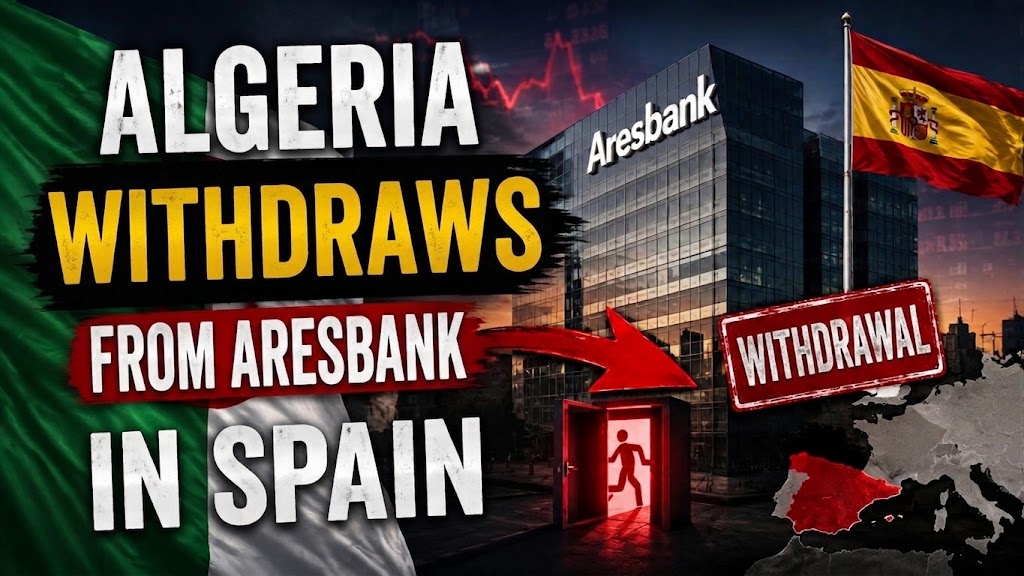
Algeria withdraws from Aresbank in Spain

• Author: Lys Iwannughen • 0 comments • 49 views
Algeria withdraws from Aresbank in Spain

Algeria Gate: The Crédit Populaire d’Algérie (CPA) has sold its stake in the capital of Aresbank, a Spanish bank specialising in particular in the financing of international trade between Spain, North Africa and the Arab world. The operation, recorded at the end of July 2026, ends the Algerian presence in the capital of the Madrid-based institution.

The CPA’s holding was, however, very limited: the Algerian public bank held only 0.14% of the capital, against 99.86% for the Libyan Foreign Bank, also owned by the Libyan State. With this withdrawal, the Libyan bank thus becomes the sole shareholder of Aresbank.

A bank oriented towards international trade

Founded in 1975, Aresbank has specialised in international trade operations, particularly between Spain and Arab countries, as well as in interbank operations.

The institution is also posting improving results. In 2025, Aresbank recorded a profit of 16 million euros, up 21% year-on-year, while its loan portfolio reached approximately 733.3 million euros. The number of operations processed also rose by 25%.

The bank is currently pursuing an expansion strategy in Spain, with notably the recent opening of a branch in Valencia, in addition to its establishments in Madrid, Barcelona and Bilbao. It also plans to develop new products, particularly in the field of Islamic finance.

A withdrawal that comes in a particular context

The CPA’s decision comes at a time when relations between Algiers and Madrid are experiencing a phase of rapprochement after several years of diplomatic tensions.

Spanish Prime Minister Pedro Sánchez visited Algiers in July 2026 with the aim of relaunching cooperation between the two countries in several areas, notably energy, trade, investment and judicial cooperation.

The CPA’s withdrawal from Aresbank therefore does not signify a general disengagement by Algeria from Spain. It is above all an operation concerning a very minority stake in a bank whose control was already largely held by Libya.

With this disposal, Aresbank is now fully controlled by the Libyan Foreign Bank, while the CPA ends a presence in the capital that represented only 0.14%.

#Algeria#CPA#Spain
Author
Lys Iwannughen
View my articles

Leave a comment

Your email address will not be published. Required fields are marked *

Algeria
Share this post

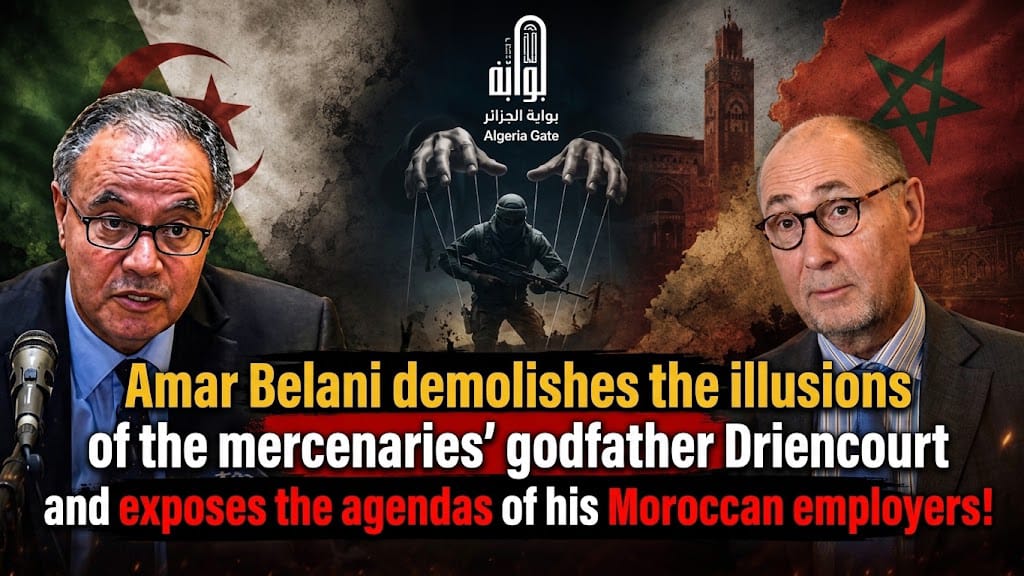
Amar Belani demolishes the illusions of the mercenaries’ godfather Driencourt and exposes the agendas of his Moroccan employers!

Amar Belani demolishes the illusions of the mercenaries’ godfather Driencourt and exposes the agendas of his Moroccan employers!

Amar Belani exposes a colonial nostalgia that seeks to revive the project of detaching Algiers and Oran… and warns of a shift in discourse from tearing Algeria apart yesterday to stigmatizing French citizens of Algerian origin today

Algeria Gate: Xavier Driencourt is no longer content with attacking Algeria or presenting himself in the French media as an “expert” in dismantling its relations with Paris. His colonial nostalgia has reached the point of resurrecting an old project to dismember the country after independence, with implicit regret that France did not retain two colonial enclaves in Algiers and Oran, separated by ethnic and political lines on the model of Berlin and Jerusalem.

The paradox is that the former French ambassador chose a Moroccan platform to revive this project. In an article published on the Moroccan website Le360 on August 25th 2026, Driencourt returned to a proposal put forward by Alain Peyrefitte to General Charles de Gaulle during the decolonization negotiations: leave most of Algerian territory to the National Liberation Front while carving out Algiers and Oran as fortified French enclaves and retaining an outlet to the Sahara.

Driencourt did not present the project as evidence of colonial violence or of France’s attempts to prevent Algeria from recovering its territorial unity. Instead, he framed his article around a question laced with clear regret: what would history have looked like had de Gaulle accepted Peyrefitte’s plan? He then concluded by relaying a claim about “Algerian enclaves in Marseille,” smoothly shifting from recalling the partition of colonial Algeria to portraying French citizens of Algerian origin as a foreign extension inside France.

This is no longer an innocent historical reading, but a fully integrated discourse: a colonial partition that, according to the implication, should not have been neglected in the past, and an Algerian presence that should today be presented as a demographic and identity threat. Between the two ideas, incitement hides behind the mask of analysis, and the writer shelters behind the phrase “some say.”

Belani: He unmasks an operative who is trying again

Former Algerian diplomat Amar Belani responded in a sharp tone, considering that Driencourt is “trying again” as an operative responding to the requests of his Moroccan employer, the website Le360, and is dredging up a dishonourable episode from the history of Algeria’s decolonization whose outcome he still appears not to have digested.

In a contribution devoted to the issue, Belani described Driencourt’s article as weak and poorly written, arguing that its author expresses regret that de Gaulle did not adopt Peyrefitte’s proposal to divide Algeria into two fortified French enclaves in Algiers and Oran, while leaving the rest of the country to its original inhabitants after isolating them from the two most important cities, centres of decision-making and ports.

Belani does not use the term “operative” lightly. He places Driencourt’s return to writing on a Moroccan platform within a recurring pattern in which Algeria has become a commodity for media investment between a former French ambassador still bitter about his experience and a Moroccan outlet searching for every voice that can be instrumentalized in the political conflict with Algeria.

The article offers Morocco no practical information about Ceuta and Melilla, nor does it explain its crisis with Spain. Instead, it summons Algeria’s history to propose a comparison that strips the Spanish occupation of its context and turns the failure of the French colonial project into material for political entertainment. Thus Driencourt does not appear as an analyst of Spain’s relationship with Morocco, but as a man unable to approach any dispute or crisis without returning to Algeria. Even Ceuta led him to open maps of Algiers, Oran and the Sahara.

A plan that was never innocent

The project that Driencourt has once again presented reveals the violence inherent in late colonial conceptions. Peyrefitte proposed gathering Europeans and certain Algerians linked to France inside two zones around Algiers and Oran, transferring others to the rest of the territory, while France retained an outlet to the Sahara and divided the capital with a separating line.

This was not a solution to protect the population, but a project of demographic engineering and mass uprooting that classified people according to origin and political loyalty and redistributed them by force. It would have deprived independent Algeria of its capital, one of its largest ports and cities, and kept France entrenched inside the new state, able to choke it security-wise and economically.

Even more telling is that de Gaulle himself recognized the project’s impossibility and danger, according to the account relayed by Driencourt. He warned that the result would not be peaceful coexistence but a hostile neighbourhood dominated by the most extreme forces. Yet Driencourt made the question of his article revolve around the history that might have been produced had the plan been implemented.

If de Gaulle saw the plan as unviable, what drives a former ambassador more than six decades later to dig it out of the archives and present it on a Moroccan platform, coinciding with the Ceuta crisis? The answer lies not in historical value, but in political function: to provoke Algeria, re-legitimize the colonial imagination, and treat the territorial integrity of formerly colonized states as a hypothesis open to renewed discussion.

From ambassador to activist in the camp of extremism

Driencourt’s article cannot be separated from the political path he has taken since leaving the diplomatic service. He has gradually drawn closer to right-wing and far-right circles in France and become one of the leading promoters of hardline discourse toward Algeria and immigration.

Amar Belani noted that since 2023 Driencourt has held a seat on the strategic committee of the outlet Frontières, classified as far-right media, and that since 2024 he has been advising leaders of the National Rally on international policy and contributing to the training of its cadres within the “Campus Hemera” linked to Jordan Bardella. Campus Hemera presents itself as an intellectual and training space affiliated with the National Rally; Driencourt’s name appears among the contributors to its content.

An investigation published by Le Monde described Driencourt as having turned into a political “influencer” from whom French right-wing circles draw their hardline line toward Algeria. It pointed to his contacts with Marine Le Pen and Jordan Bardella, and to the fact that his ideas on immigration, the 1968 agreement and bilateral relations now feed the discourse of currents seeking to make Algeria a permanent adversary in French politics.

A man who helps train the cadres of a far-right nationalist party, warns of “cultural dissolution” because of immigration, and then writes about French colonial enclaves inside Algeria and “Algerian enclaves” inside Marseille is recycling a single conception of land, identity and population.

Marseille exposes the intention

The final sentence of Driencourt’s article concentrates the political meaning of the entire text. He wrote that “malicious tongues” say there are Algerian enclaves in Marseille in 2026. The sentence is carefully designed to pass on the accusation while taking shelter by attributing it to anonymous sources.

Driencourt does not state directly that French citizens of Algerian origin constitute an “occupation” of Marseille, but he places the idea before the reader after pages about colonial enclaves and separation lines, then claims he is merely reporting what others say. The comparison is thus planted without being openly endorsed.

Belani considers that this style lends false credibility to the illusion of the “Great Replacement,” because it portrays French citizens on the basis of their origins as a foreign body or an extension of a foreign state inside French territory. This is not geopolitical analysis; it is ethnic stigmatization dressed in a diplomatic suit.

The comparison also exposes a fundamental contradiction: Driencourt treats French settlers in Algeria as entitled to carve out territory and establish a state within a state, while treating French citizens of Algerian origin in Marseille as a suspicious presence. It is an explicit colonial equation: the Frenchman can be a landowner inside Algeria, while the Algerian remains a stranger even when he becomes a French citizen inside France.

A Moroccan platform for a French colonial imagination

The article becomes still more revealing because of where it was published. Le360 has repeatedly given Driencourt space to attack Algeria, granted him a lengthy interview in 2024, and celebrated in July 2026 his new book mounting a political and historical trial of Algeria.

The interests of both sides converge. Driencourt obtains a regional platform to continue his personal war against a country in which he served as ambassador twice, while Moroccan media obtains a former French voice that can be presented as a witness from inside French diplomacy.

Yet this alliance produces a paradox embarrassing for Morocco itself. The platform that demands an end to the Spanish presence in Ceuta and Melilla publishes an article that, with a degree of nostalgia, revives a French project to retain Algiers and Oran after Algeria’s independence. Using Ceuta to revive a map that partitions Algeria reveals that the criterion is not resistance to colonialism, but the use of every available material to target Algeria—even when it comes from the archives of French settlement. Here Le360 becomes a partner in recycling the colonial imagination against an African country that liberated itself at enormous cost.

Algeria won and the project is over

Whatever maps Driencourt digs up, the truth that pains him does not change: Algeria wrested its independence as a united country, recovered Algiers, Oran and the Sahara, and defeated the project that sought to turn liberation into an incomplete independence besieged by French military enclaves.

Partition failed because the Algerian revolution did not negotiate a flag over a portion of the land, but the full recovery of sovereignty. It also failed because the Algerian people refused to allow cities, ports and the Sahara to become a price paid to France. Invoking the plan 64 years later carries the meaning of defeat more than that of a historical alternative. Whoever returns to the maps rejected by de Gaulle is searching the archives for a victory that never happened.

Amar Belani summed up this trajectory when he considered that Driencourt’s history revolves in a pathetic way around Algeria, with new sponsors who harbour a constant hatred for it. The man left the embassy, but he did not leave his personal battle; his status changed from representative of a state to mentor of the far right, while Algeria remained the axis of his discourse and the reason for his media presence.

Driencourt’s danger does not lie in any ability to re-partition Algeria; that chapter was closed once and for all by the Algerian people. It lies in his attempt to turn colonial language into acceptable material in French political debate and to link it to a discourse that questions the belonging of millions of French citizens of Algerian origin.

He begins by regretting two lost French enclaves in Algeria and ends by implying the existence of Algerian enclaves inside Marseille. Between the beginning and the end, the diplomat’s mask falls to reveal a single discourse: nostalgia for a land that is no longer a colony, and hostility toward people who are no longer colonized.

As for the Algeria that Driencourt seeks to partition in Peyrefitte’s books, it settled the matter in 1962. It remained united, recovered its Sahara, its cities and its sovereignty, while the partisans of “French Algeria” continue to carry their old maps from one platform to another, hoping that ink will grant them what colonialism failed to retain by force.

#Algeria#France#Morocco
Author
Lys Iwannughen
View my articles
African coast
Share this post

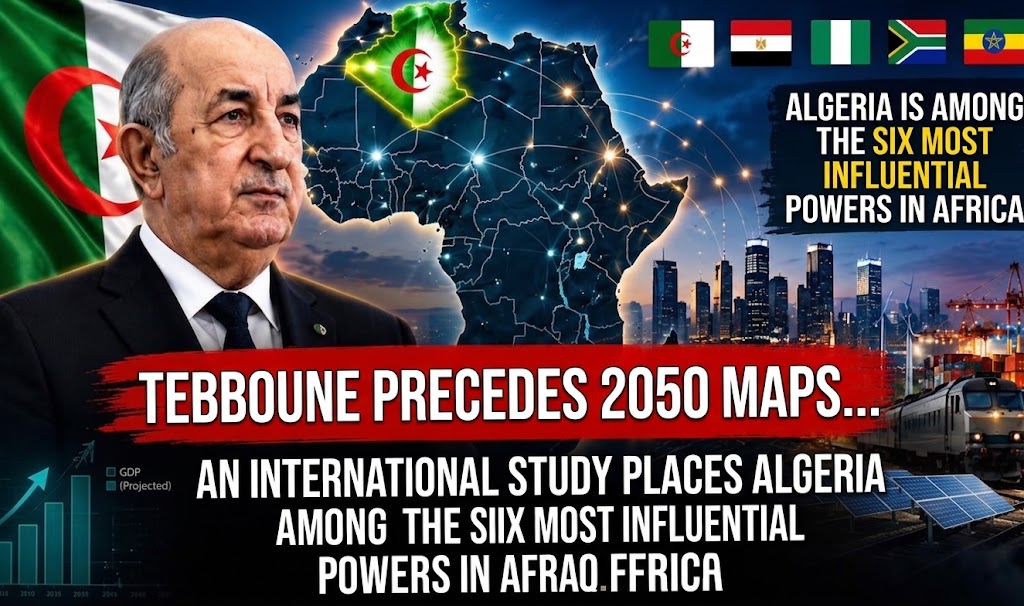
Tebboune anticipates the 2050 maps… An international study places Algeria among the six most influential powers in Africa

Tebboune anticipates the 2050 maps… An international study places Algeria among the six most influential powers in Africa

Gas, the army, the Mediterranean, and the Sahel are cards that President Tebboune has turned into negotiating power… Algeria consolidates its position as the fourth economy and fourth African power

Algeria Gate: When an international prospective study placed Algeria among the six African countries most capable of exercising influence until 2050, it measured the result of a political and strategic path by which President Abdelmadjid Tebboune anticipated the transformations reshaping Africa and the world. Ranked the fourth-largest economy on the continent and the fourth African power in the Global Power Index, Algeria did not reach this position through gas alone, but through an integrated system of sovereign decision-making, defensive capability, Mediterranean positioning, and a strong return to the African and Sahelian depth.

The map drawn by the Institute for Security Studies appears as international confirmation of the choices pursued by President Tebboune since assuming leadership. He reordered priorities on the basis that Algerian power cannot remain hostage to a single resource, and that geographic location becomes influence only when supported by a strong state, a diversified economy, an army capable of protecting national decision-making, and independent diplomacy spanning Africa, the Mediterranean, and the Arab world.

The study finds a state that has regained the initiative, raised its economic ambition, and restored importance to industry, mining, strategic agriculture, and major infrastructure while expanding African relations and diversifying partners. These choices show that Tebboune anticipated the shift toward a multipolar world in which dependence on a single center declines and the value of states possessing energy, location, defensive capability, and freedom of decision rises.

Tebboune anticipates the 2050 maps… An international study places Algeria among the six most influential powers in Africa

The updated study “Africa in the World 2043,” from the African Futures and Innovation program of the Institute for Security Studies, gives this path measurable dimensions. Based on the “International Futures” model linking economy, population, technology, energy, trade, governance, and security, it tested positions within four scenarios to 2050: a sustainable world, a markets-and-growth world, a world of competing blocs, and a world dominated by wars. Across these paths, Algeria remains within the narrow circle of African influence, resting on strategic assets that endure in different environments. This is the deeper achievement of Tebboune’s vision: building a state that retains value whether the world cooperates or divides.

International recognition of a power built by Algeria

Figures show the position Algeria has fortified. At market exchange rates it ranked fourth-largest African economy in 2025, after Nigeria, Egypt, and South Africa. It also ranked fourth in Africa on the Global Power Index and 50th out of 188 countries. The index measures economy, population, technology, resources, institutions, and military capabilities rather than raw GDP or population alone.

This status stems from the transformation led by Tebboune. Policies shifted from merely managing oil revenues toward restoring the productive base and launching major investments in mining, railways, industry, agriculture, energy, and seawater desalination, while prioritizing non-hydrocarbon exports, national institutions, and African markets.

The ranking measures an existing base whose strategic meaning comes from projects designed to advance the economy. The Gara Djebilet bet aims at an industrial and logistical chain from mine to railways, processing, and export. Expanding southern railways and roads establishes continental corridors linking the Mediterranean to the Sahel. Food security has become a sovereign issue tied to local production and strategic crops in the south, while desalination has become infrastructure protecting cities and freeing resources for development.

Power measured by international models is not a single figure but the capacity to secure energy, water, food, infrastructure, and defense, then convert them into independent decision-making and wider negotiating margins.

Tebboune read the transformation before it was complete

President Tebboune’s policy dealt early with a world that no longer tolerates dependence on a single axis. Algeria maintained deep ties with Europe while expanding partnerships with China, India, Turkey, Russia, the Gulf states, and Africa, without reducing its sovereign decision to a closed alignment.

This balance is a policy of power. A state with strategic resources, a sensitive location, and diverse partners can choose among offers and direct investments toward national priorities. The study confirms that China, India, the Gulf states, and Turkey have become growing sources of capital, trade, infrastructure, and security partnerships, while Europe remains central. In this multipolar world Algeria has pursued open partnerships with Algerian decision-making, investments within national priorities, and wide relations without trading sovereignty for immediate gains.

Algeria’s listing among India’s main African economic partners, alongside Nigeria, South Africa, Angola, Egypt, Kenya, Morocco, and Mozambique, evidences successful diversification as global trade and investment shift toward Asia and the Global South. Tebboune built from the outset an approach that keeps Europe as a partner while opening the economy to rising poles, treating global transformation as an opportunity rather than a forced choice of camps.

Tebboune anticipates the 2050 maps… An international study places Algeria among the six most influential powers in Africa

Only six countries possess the tools of influence

The Diplomacy, Military, and Economy (DiME) index places Algeria among only six African countries with the greatest capacity to exercise influence until 2050, alongside Egypt, Nigeria, South Africa, Morocco, and Libya. It measures usable tools: embassy networks and treaties, military capability, and economic base. The index asks not only about size but about what a state can do with its capacities.

Population size grants other countries large markets but does not by itself create influential foreign policy. Rapid growth does not automatically become influence without institutions, defensive capability, and diplomatic independence. Algeria has accumulated a coherent system combining economy, army, and diplomacy into a presence beyond its borders.

Nigeria will demographically surpass most competitors yet lacks South Africa’s institutional corporate reach, Egypt’s strategic location, or Algeria’s hydrocarbon resources and military capability. Algerian weight rests on an interweaving of assets difficult to gather in one state. Algeria is distinguished by sovereign decision-making, the absence of foreign military bases, and a defensive army designed to protect a vast territory and complex borders. Military power thus guarantees stability and independence rather than imposing tutelage.

Four cards from which Tebboune made Africa’s gateway

The study summarizes Algeria’s position in four words: gas, the Mediterranean, military capability, and access to the Sahel. These place it among the “gateway states” that major powers compete to engage because they offer access to energy, markets, corridors, or regional security.

Tebboune converted these from static privileges into interconnected policy. Gas has become an element of European energy security and a basis for long-term partnerships grounded in reliability. In turbulent markets Algeria presented itself as a responsible supplier that neither bargains with contracts nor squanders sovereign interests. The Mediterranean location has become a base linking Europe to African depth, with ports, roads, railways, energy lines, and communications positioned to make Algeria a passageway for production, trade, and investment.

Military capability remains the shield protecting development and national decision-making amid expanding wars, organized crime, terrorism, and foreign interventions. Combining economic construction with a strong army allows Algeria to convert wealth into protected national power. The Sahel card most clearly expresses the prospective vision: southern borders are secured not by surveillance alone but by a stable neighborhood capable of managing its territory. Partnerships in electricity, energy, training, infrastructure, and trade make development the first line of defense. Moves with Mali, Niger, and Chad seek a strong neighborhood that protects its own sovereignty and prevents the Sahel from becoming an open arena for terrorism, smuggling, and foreign powers.

Gas is the beginning of power, not its end

Algeria’s importance for Europe has risen as the continent seeks to diversify gas sources. Tebboune’s vision goes beyond the traditional supplier role toward expanded exploration, production, and petrochemicals, alongside renewable energies, hydrogen, and electricity interconnection. The economic value of gas lies in using it as a lever for industry, fertilizers, iron and steel, and power, then directing revenues toward productive assets that outlast hydrocarbon markets.

The study’s recognition is a certificate of a base on which further construction is possible—and the leadership has already begun through major mining projects, railway expansion, processing industries, investment climate reform, and priority for national production and export. Algeria has the opportunity to become a multi-energy platform between Africa and Europe combining gas, electricity, hydrogen, renewables, and engineering services. Its value would then rest on its position within a broader system of production, transport, and distribution.

2050 is not a warning but a race Algeria has already begun

The study anticipates shifts in African economic rankings by mid-century, with Ethiopia, Kenya, Tanzania, and the Democratic Republic of Congo rising through population growth, expanding markets, and investment. Ethiopia may surpass Algeria’s economy and possibly South Africa’s if it converts demographic mass into productivity. This does not mean Algerian contraction but faster growth elsewhere in indicators favoring large population markets. Scenarios are paths that change with policies and productivity, not final judgments.

Algeria cannot compete numerically with demographic giants but can excel in economic quality, per capita income, infrastructure efficiency, energy security, technology, industry, and market access, making productivity the basis of power in 2050. Modeling shows Algeria remaining among relatively advanced African economies in GDP per capita at purchasing power parity. Crucially, it stays within the influential group in all scenarios, including divided or war-dominated worlds, thanks to gas, army, location, and diplomacy, while diversification offers a chance to improve rather than merely defend its position.

Algeria’s influence turns into an African gain

The rise of African powers does not automatically become collective continental strength if major states prioritize regional rivalries or external ties. The African Union, Continental Free Trade Area, and infrastructure integration are essential to convert national capabilities into continental weight. This aligns with Tebboune’s conception, which has restored Africa to the forefront of foreign policy because Algeria cannot separate its economic and security future from the continent’s. Opening markets, linking southern infrastructure, strengthening border trade, and supporting Sahel stability form a single project making Algeria a gateway between the continent and the Mediterranean.

Declining traditional European influence and the rise of China, India, Turkey, and the Gulf states widen Algeria’s margin for mediation. A state with balanced relations can serve as a bridge and direct external competition toward financing, technology, and expertise rather than struggles for influence on African soil. Algerian position becomes a continental gain when used to defend sovereignty, reject foreign interventions, settle crises through dialogue, and build linking projects rather than dependency.

Africa’s economy could exceed $17 trillion by 2050 in the sustainable scenario (versus about $3.4 trillion in 2025), but only $9.6 trillion in a war-dominated one. Intra-African trade remains just 16.3 percent of total continental trade, underscoring the opportunity Algeria can seize through production, logistics, energy, and services. The best guarantee of continued Algerian power is contributing to a more stable and interconnected continent: every southern road, railway, electricity, communications, or border trade project expands the market, reduces isolation costs, and turns security into economic value.

Tebboune anticipates the 2050 maps… An international study places Algeria among the six most influential powers in Africa

The Algeria that Tebboune saw before the models measured it

The Institute for Security Studies study places numbers behind a reality Tebboune has consolidated: Algeria is a pivotal state that cannot be reduced to gas, bypassed in Mediterranean and Sahel arrangements, or treated as a dependent market. It is the fourth African economy at the model’s starting point, the fourth power on an index combining economy, technology, population, resources, and army, and one of only six countries with practical tools of influence to 2050. It is classified as a gateway state granting access to gas, the Mediterranean, and the Sahel, protected by military capability and independent decision-making.

The real value lies in the fact that Tebboune read early what the study measures today. He understood that economic sovereignty begins with production, national security extends to the Sahel, gas should finance a post-gas economy, balance among partners protects decision-making, and Africa is the field in which Algerian power will be tested. While models draw four possible worlds to 2050, Algeria is building its own path under a president who has made foresight part of decision-making, transforming geography into an economic asset, energy into a sovereign card, the army into a guarantee of stability, and African belonging into a project of influence and development.

The question is not whether Algeria will remain an influential African power; the study answers that clearly. The real question is how far it will convert this influence into industry, technology, exports, and continental networks before 2050. Current indicators show Algeria did not wait for the future to arrive; Tebboune has already begun building the state that intends to meet it.

#Africa#Algeria#President tebboune
Author
Lys Iwannughen
View my articles
African coast
Share this post

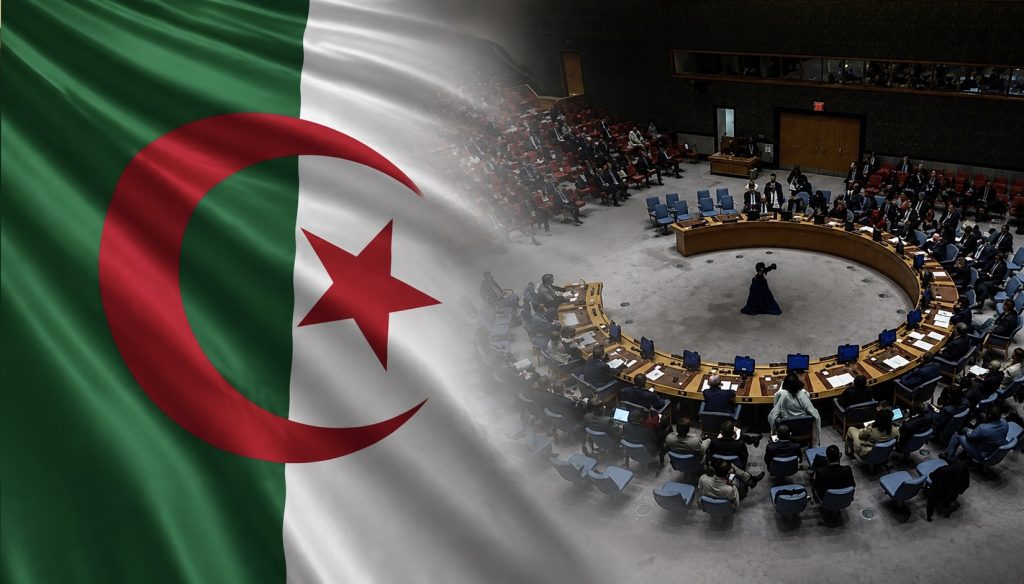
Security Council: Algeria Calls for an End to the Use of Starvation as a Weapon of War

Security Council: Algeria Calls for an End to the Use of Starvation as a Weapon of War

Algeria Gate: Algeria has called on the United Nations Security Council to take concrete and enforceable measures to prevent starvation from being used as a weapon of war, warning of the devastating humanitarian consequences witnessed in Gaza and Sudan.

Speaking before the Security Council on Tuesday, Algeria’s Deputy Permanent Representative to the United Nations, Mehdi Litim, highlighted the unprecedented scale of global food crises, noting that the Global Report on Food Crises recorded two simultaneous famines in 2025 for the first time in its history, affecting populations in Gaza and Sudan.

During a Security Council meeting focused on “Food under the Fire of War: The Role of the Security Council in Reducing Global and Local Food Crises,” Litim stressed that starvation cannot be justified under any circumstances as a method of warfare.

Algeria warns of catastrophic food crisis in Gaza

Addressing the situation in Gaza, the Algerian diplomat described the humanitarian crisis as “an open and deep wound,” pointing to the latest figures from the Integrated Food Security Phase Classification (IPC).

According to the data cited by Laitim, around 1.4 million people in Gaza continue to face acute food insecurity, underscoring the scale of the crisis facing the Palestinian population.

He warned that the famine conditions previously recorded in Gaza demonstrate the devastating consequences of deliberately depriving civilians of food and essential resources.

“Children are dying from malnutrition while trucks loaded with vital aid remain stuck just a few kilometers away,” he said.

Against this backdrop, Algeria renewed its call for an immediate ceasefire in Gaza and unrestricted humanitarian access, stressing that aid must be allowed to reach civilians without obstruction.

Sudan faces one of the world’s worst food emergencies

Laitim also drew attention to the worsening humanitarian situation in Sudan, describing it as one of the world’s most serious emergencies in terms of acute food insecurity.

The latest IPC figures cited during the Security Council meeting indicate that 19.5 million people; nearly 41% of Sudan’s population, are facing high levels of acute food insecurity.

Even more alarming, Laitim said, is the fact that 135,000 people have been classified in Phase 5, or catastrophe, and are experiencing famine, while approximately 825,000 children are suffering from severe acute malnutrition.

The Algerian representative attributed the deterioration to continued conflict, restrictions on humanitarian access, attacks on supply routes and the destruction of agricultural and food-production infrastructure.

He also expressed concern over the collapse of international funding for the food sector, which he said has fallen to its lowest level in a decade.

Algeria demands accountability for attacks on food and water infrastructure

For Algeria, the use of hunger against civilian populations represents a grave violation of international humanitarian law.

Litim reiterated that parties to armed conflicts have a strict obligation to protect civilians and the infrastructure essential to their survival, particularly food-production systems and water supplies.

He emphasized that safe, rapid and unhindered humanitarian access is indispensable, particularly in conflict zones where civilians are already facing displacement, hunger and the destruction of basic services.

Algeria, he noted, continues to contribute to international efforts in this area through its co-chairmanship of the working group on the protection of civilian infrastructure under a global initiative designed to strengthen political commitment to international humanitarian law.

He further recalled Algeria’s commitment to protecting humanitarian personnel, renewed through its signing of the Declaration on the Protection of Humanitarian Workers in September 2025.

Algeria proposes concrete measures against starvation as a weapon of war

Algeria called on the Security Council to move beyond declarations and adopt concrete measures to combat starvation and prevent its deliberate use as a weapon of war.

Among the measures proposed are:

  • Establishing strong early-warning mechanisms to monitor attacks against food and water infrastructure.
  • Mobilizing adequate resources to rebuild vital facilities destroyed or damaged by armed conflicts.
  • Guaranteeing safe, rapid and unrestricted humanitarian access.
  • Holding perpetrators accountable for attacks against civilian infrastructure.
  • Creating a specific sanctions regime against parties that violate UN Security Council Resolution 2417 and deliberately use starvation as a weapon of war.

The Algerian position reflects growing concern over the use of food deprivation and the destruction of essential civilian infrastructure as tools of warfare in contemporary conflicts.

Algeria: Hunger must never again be used as a weapon

Concluding his intervention, Mehdi Litim reaffirmed Algeria’s commitment to working with international partners to strengthen respect for international humanitarian law, protect human dignity and advance sustainable peace.

He stressed that hunger must never again be turned into a weapon against civilian populations.

For Algeria, the crises in Gaza and Sudan demonstrate the urgent need for the international community, and particularly the UN Security Council, to translate its commitments into effective mechanisms capable of preventing starvation, protecting civilians and ensuring humanitarian assistance reaches those who need it most.

#Africa#Algeria#United Nations
Author
Lys Iwannughen
View my articles