
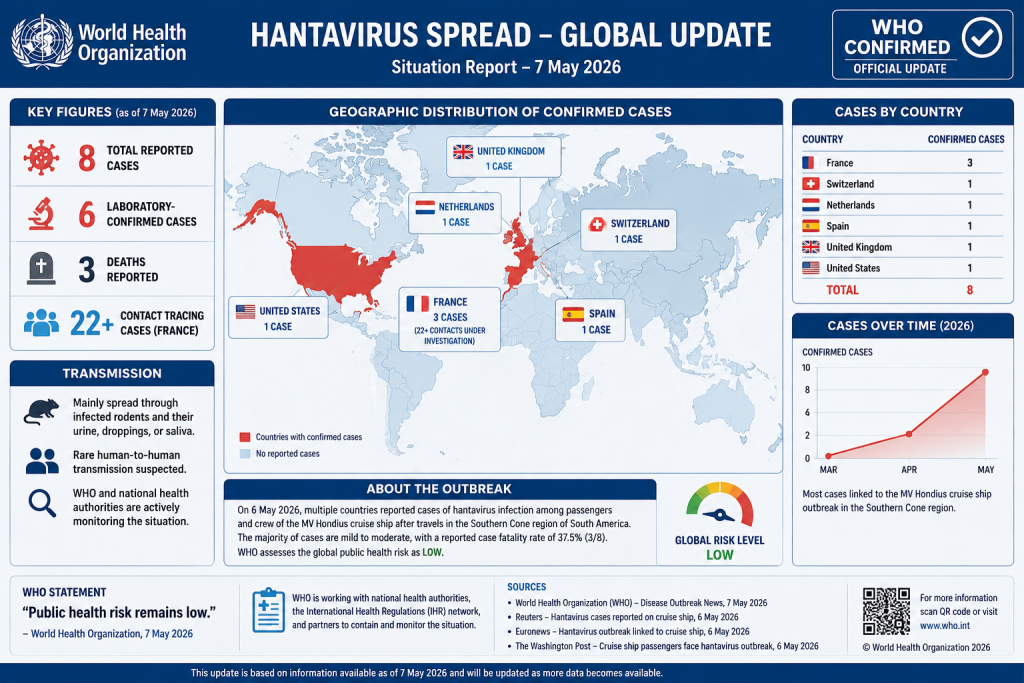
Algeria News portal:The emergence of Hantavirus has prompted a global health alert, following confirmed cases identified multiple countries, where a French woman was medically quarantined in Paris by health authorities. Both the World Health Organization (WHO) and the Centers for Disease Control and Prevention (CDC) affirm that the overall global risk is currently low. However, the circulation of the ‘Andes’ strain necessitates diligent monitoring.
WHO Technical note for the disembarkation and onward management of passengers and crew in the context of an Andes virus-associated cluster MV Hondius cruise ship. Read here: https://t.co/YB7jgI3t1x
— World Health Organization (WHO) (@WHO) May 10, 2026
+
Management of contacts of Andes virus (ANDV) cases from the MV Hondius cruise…
Hantavirus represent a category of viruses primarily hosted by rodents, such as mice and rats. Human infection typically occurs through exposure to contaminated urine, feces, or saliva from these animals. In the Americas, Hantavirus Pulmonary Syndrome (HPS) presents as a severe respiratory condition, exhibiting a case-fatality rate generally between 38% and 50%.Conversely, Hemorrhagic Fever with Renal Syndrome (HFRS) is prevalent in Europe and Asia, where its case-fatality rates vary from under 1% to as much as 15%, contingent upon the specific viral strain.
#Hantavirus is not COVID, and the risk to the people of Tenerife is low because of the nature of the disease and the actions of the Spanish government.
— Tedros Adhanom Ghebreyesus (@DrTedros) May 10, 2026
I commend Spain’s response, in line with the International Health Regulations, and the strong show of solidarity by Prime… pic.twitter.com/bqANrg5U0W
Globally, multiple nations including France, the United States,Netherlands, Spain, Switzerland ; are implementing precautionary measures. These initiatives involve identifying affected individuals and establishing protocols to mitigate further transmission.
Presently, neither a vaccine nor a targeted antiviral treatment exists for Hantavirus infections. Management primarily relies on supportive care; this includes oxygen therapy for patients diagnosed with (HPS) and dialysis for individuals afflicted with (HFRS) . Efforts to prevent infection predominantly center on effective rodent population control and the implementation of safe cleaning practices.