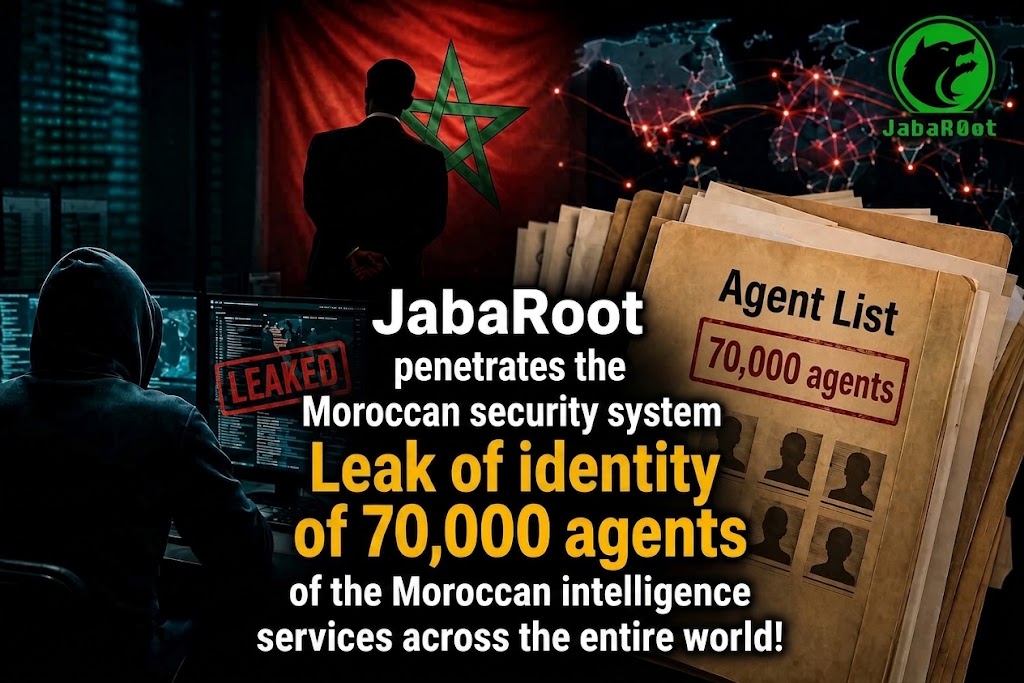
Algeria Gate: A new cybersecurity affair is shaking Morocco. The hacker group JabaROOT claims to have obtained data belonging to members of the Moroccan security services and is threatening to make public the information of several tens of thousands of agents.
According to several media outlets that have reported on this matter in recent days, the group claims to hold a database containing around 70,000 names linked in particular to the General Directorate of Territorial Surveillance (DGST) and the General Directorate of National Security (DGSN). To support its statements, JabaROOT is said to have already published a sample including the names and dates of birth of about twenty people presented as DGST officers.
A threat that strikes at the heart of the security apparatus
If the existence and authenticity of the entire database were to be confirmed, the affair would constitute a serious threat to the security of the individuals concerned and to Moroccan intelligence systems.
The potential publication of personal data associated with agents operating in Morocco or abroad could, in particular, expose their identities, career paths, and professional networks. At this stage, however, the figure of 70,000 agents and the entirety of the claimed data remain assertions by the hacker group and cannot be considered definitively established.
JabaROOT, a group already known for its attacks
This new threat comes in a context marked by several precedents. JabaROOT is presented as a collective active since 2025 that has already claimed several operations against Moroccan institutions.
One of the most significant cases involved the National Social Security Fund (CNSS), whose data relating to nearly two million people were exposed following a cyberattack. The CNSS had confirmed the existence of the attack while contesting the accuracy of certain information that was circulated.
New pressure on the Moroccan authorities
The claim also comes amid high tensions surrounding security and the migration crisis in Ceuta. According to information reported by the press, JabaROOT is said to have linked its threat to several political demands and used this affair to call into question the functioning of the Moroccan security apparatus.
The matter is therefore being followed closely, but several questions remain open: What is the exact origin of the claimed data? How much information was actually exfiltrated? And above all, do the files presented by the group actually correspond to internal databases of the DGST and DGSN?
For the time being, it is necessary to distinguish the elements that have actually been published from the assertions of the hacker group. An independent and official confirmation of the scale of the leak would be required before concluding that 70,000 agents have been compromised.
If the claim were nevertheless confirmed in its entirety, it would represent one of the most significant data security crises ever associated with the Moroccan security apparatus.