

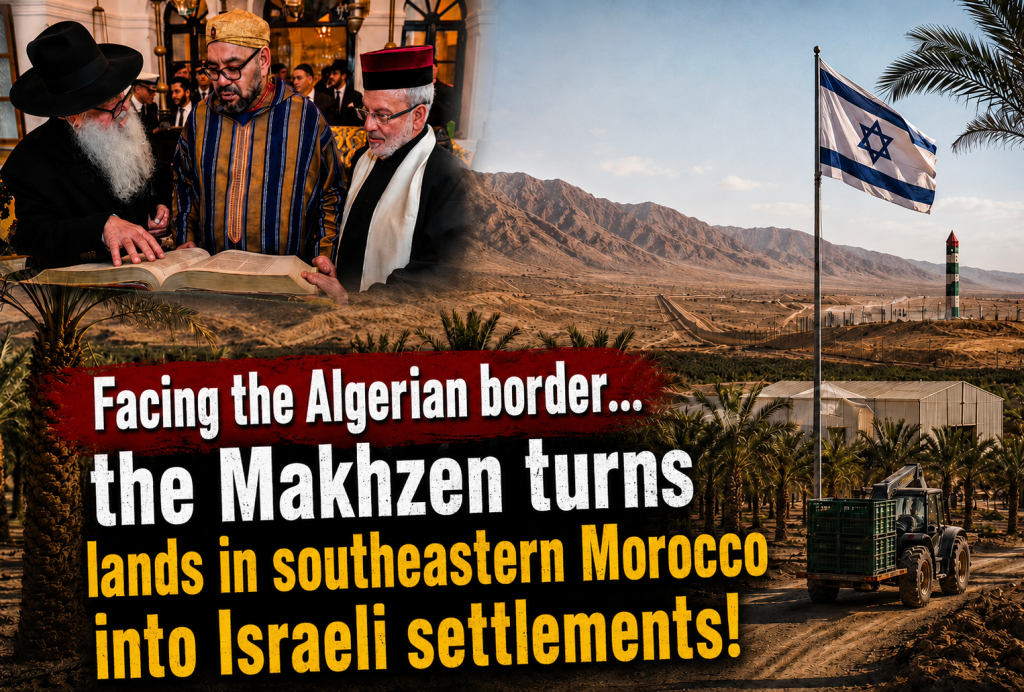
Algeria Gate: It appears that the transformation of Morocco into “Israeli settlements and kibbutzim” by order of the Moroccan Makhzen regime and under pressure from the Zionist lobby that has tightened its grip on Rabat is proceeding at an accelerating pace.
In a blatant violation of human rights and citizenship, original Moroccan inhabitants are being expelled from their lands to hand them over on a golden platter to Israeli settlers.
Several areas in southeastern Morocco, near the Algerian border, witnessed unprecedented popular tensions and unrest just days before the Ceuta migration crisis, in which some 60,000 irregular Moroccan migrants fled the hell of Mohammed VI, over the seizure of residents’ lands and their allocation to Jewish settlers.
This was confirmed by Ahmed Wehman, president of the Moroccan Observatory Against Normalization, during his appearance as a guest on a Moroccan news channel. He noted that clashes involving live fire occurred in some areas, such as Kenitra, against the backdrop of disputes over collective (soulaliya) lands.
In the same vein, Wehman spoke of lands and pastures that he said had been seized from tribes and population groups in the southeast. Among those he mentioned were “Ait Merghad, Ait Haddidou, Ait Yahya, Ait Yazzi, Ait Sahrouj, and Ait Atta.”
“These lands were allocated to Israeli investors for agricultural investment, particularly the cultivation of “Medjool” dates,” he said.
He mentioned Bourouk Tafilalet as an exampl; an Israeli settlement in the heart of Morocco that he described as covering vast areas larger than the Gaza Strip. “These lands were taken from poor categories of nomads and livestock breeders before being allocated to two Zionist investors,” he added.
Moreover, he said that the Ait Khabash area in the southeast, relatively close to the Algerian border, itself witnessed what he called a “social tremor” days before the Ceuta crisis over issues related to collective lands. He also pointed to residents of mountainous areas taking to the streets in protest marches, considering that these movements reflected, in his words, a state of social tension linked to the file of those lands.
Wehman went further, arguing that the dispute takes on a more sensitive dimension in the southeast, where there are lands that historically belonged to a group of tribes, including Ait Khabash, Ait Atta, and Ait Yaflman.
These are areas he said were linked to “epics of resistance against French colonialism,” citing in this context the battles of Bougafer and Bab Doub.
He considered that the sons of those “resistants” who took part in those battles today face the risk of losing these lands, while at the same time criticizing what he described as “neglect of the national memory.”
In a scene that reflects the accelerating pace of comprehensive Zionization following the shameful Moroccan-Zionist normalization, this sounds the alarm amid the rising influence of Mohammed VI’s Zionist advisor André Azoulay, who is leading the kingdom toward total destruction.